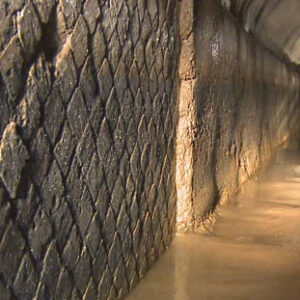
For decades, it lay hidden beneath the surface of a reservoir in western Spain.
Most people never knew it existed.
Some believed it had been lost forever.
Then the water disappeared.

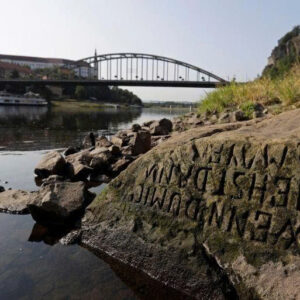
As a severe drought gripped the region, the shoreline retreated farther and farther back. Mudflats emerged. Ancient ground resurfaced.
And rising from the exposed earth was something extraordinary.
A circle of massive standing stones.
A monument so old that it predates Stonehenge.
Older than the Great Pyramid of Giza.
Older than nearly every famous monument of the ancient world.
Archaeologists call it the Dolmen of Guadalperal.
Many people simply call it:
The Spanish Stonehenge.

The monument was built approximately 7,000 years ago during the Neolithic period, when farming communities were beginning to transform Europe.
This was an age before writing.
Before kingdoms.
Before empires.
Yet somehow these early people organized the labor needed to transport enormous granite stones across the landscape and arrange them into a carefully planned ceremonial structure.
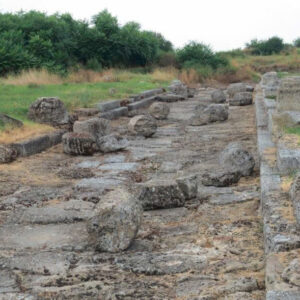
The site originally consisted of more than 100 standing stones forming an oval enclosure surrounding a central chamber.
Nobody knows exactly why it was built.
Some researchers believe it served as a sacred ritual center.
Others suggest it may have functioned as a burial monument.
There are also theories that its builders aligned the stones with the movements of the Sun, creating a prehistoric observatory that tracked important seasonal events.
Whatever its purpose, one thing is certain.

The builders possessed knowledge and organizational abilities far beyond what many people imagine when thinking about prehistoric societies.
For thousands of years, the monument stood overlooking the surrounding landscape.
Generations came and went.
Entire civilizations rose and fell.
The Romans arrived.
The Visigoths followed.
Then the medieval kingdoms.
Still the stones endured.
But in the 1960s, everything changed.
The construction of the Valdecañas Reservoir flooded the valley.
Water slowly swallowed the ancient monument.
Stone by stone.
Year after year.
Eventually, the site disappeared beneath the surface.
Only a few archaeologists remembered what lay below.
For nearly sixty years, the monument remained submerged.
Then nature intervened.

During one of the worst droughts in modern Spanish history, reservoir levels dropped dramatically.
As the water receded, the forgotten stones emerged once more.
Photographs of the site spread across the world.
Visitors rushed to see it.
Researchers returned to document it.
For a brief moment, a chapter of human history hidden beneath the water became visible again.
Standing among the stones today is a strange experience.
The monument feels both familiar and mysterious.
It resembles other megalithic structures scattered across Europe.
Yet its true purpose remains uncertain.
The people who built it left no written records.
No explanations.
No inscriptions describing their intentions.
Only stone.
Silent witnesses from a world that vanished thousands of years ago.
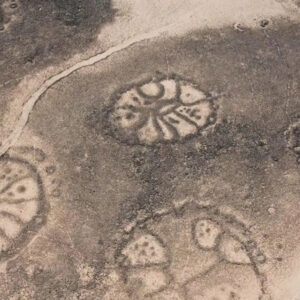
One of the monument’s most intriguing features is a carved stone bearing a series of winding lines.
Some archaeologists believe the carving may represent a serpent.
Others have proposed something even more remarkable.
It could be one of the oldest maps ever created in Europe, depicting the nearby Tagus River and the surrounding landscape.
If true, it would reveal an astonishing level of geographic awareness among people living seven millennia ago.
The Spanish Stonehenge is a reminder that humanity’s story is far older and more complex than many realize.
Long before cities dominated the horizon, people were already reshaping entire landscapes.
They were moving enormous stones.
Creating sacred places.
Observing the heavens.
And building monuments designed to survive for generations.
Today, the drought that exposed the site serves as a warning about modern environmental change.
Yet it also provided a rare opportunity.
For a brief period, the water pulled back and revealed a forgotten world.
A world where ancient builders stood beneath the same sky we see today.
A world whose mysteries remain buried beneath time.
And as the reservoir eventually rises again, the stones may once more disappear beneath the water.
Waiting.
Silent.
Until history decides to reveal them again.