In the spring of 1974, a group of farmers near the Chinese city of Xi’an were digging a well in dry ground, hoping to reach water. Instead, their shovels struck something far stranger: fragments of a life-sized human figure, moulded from clay and buried for more than two thousand years. They had no way of knowing it, but they had just punched a hole into one of the greatest archaeological discoveries in human history.
Beneath their feet lay an entire buried army — thousands of clay soldiers standing in silent ranks in the dark. And those soldiers were not the prize. They were the guards. Somewhere close by, sealed and untouched, lay the tomb they had been built to protect for eternity: the resting place of the First Emperor of China. To this day, no one has dared to open it.
An army that waited 2,000 years in the dark
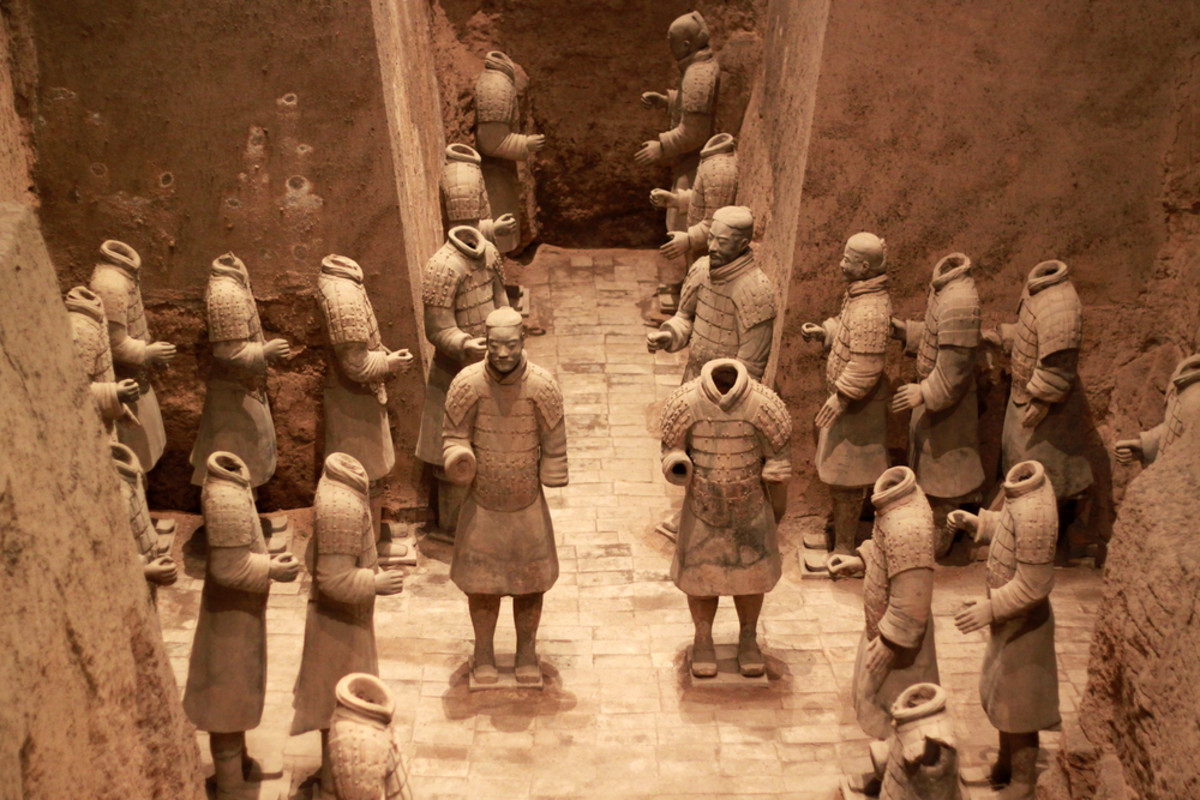
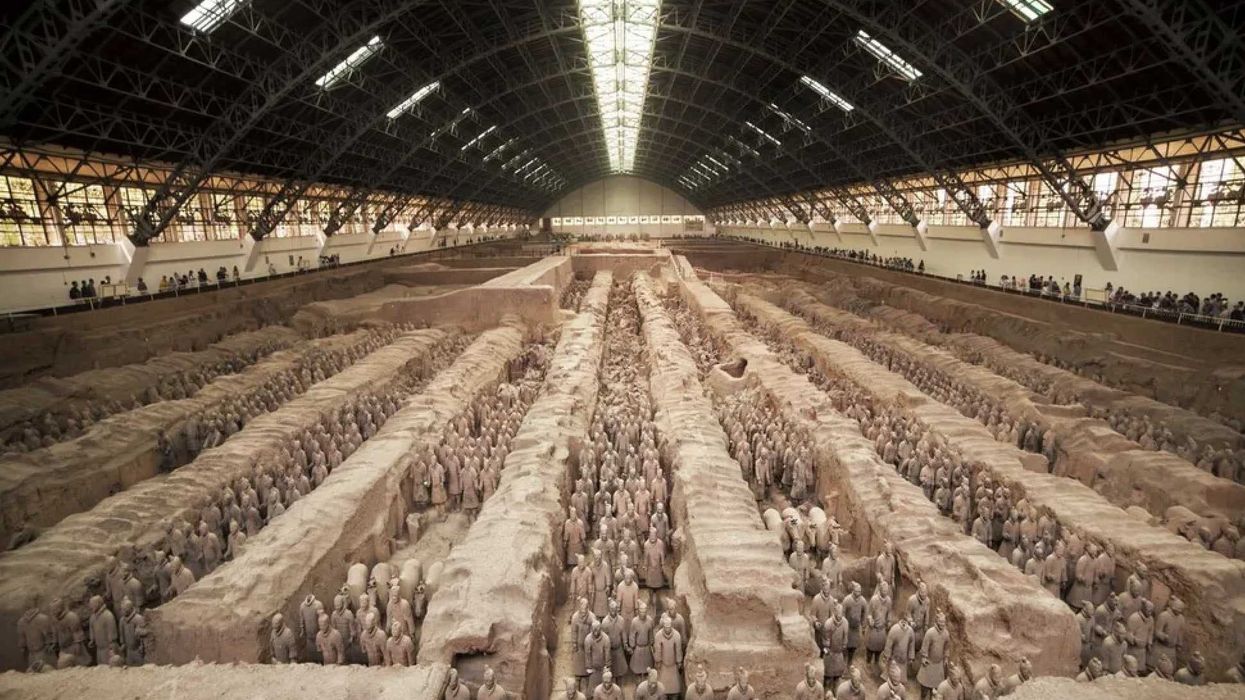
What the farmers had stumbled upon would come to be known as the Terracotta Army, and its scale is almost impossible to absorb. Archaeologists working the site over the following decades uncovered pit after pit filled with life-sized warriors arranged in battle formation — an estimated eight thousand soldiers in all, accompanied by some five hundred horses and over a hundred wooden chariots.
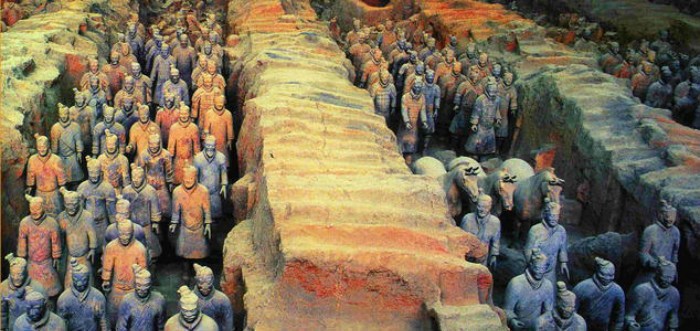
These were not crude, identical dolls stamped from a single mould. Each warrior was given its own face. Infantry, archers, cavalrymen and officers stand in disciplined rows, their expressions, hairstyles and armour individually detailed, as though a real army had been frozen in clay. When they were first made, they were brightly painted, a vivid host of colour rather than the grey ranks we see today.
For more than two millennia they stood underground in total darkness, holding their formation, guarding a king. And here lies one of the most poignant details of all: when archaeologists first exposed some of the figures, the original paint, after surviving two thousand years sealed away, reportedly began to flake and curl within seconds of touching modern air. The army had survived the centuries — but not, it seemed, the moment of being found.
The man they were built to guard
To understand why anyone would build an army of clay, you have to understand the man at the centre of it. He was Qin Shi Huang, the First Emperor — the ruler who, in 221 BC, unified the warring states of ancient China into a single empire and declared himself its first emperor. He was a figure of staggering ambition, credited with sweeping reforms and with linking together early walls that would form the foundation of what later became the Great Wall.
He was also, by all accounts, a man obsessed with death — or rather, with not dying. Ancient sources describe an emperor desperately seeking the secret of immortality, dispatching expeditions in search of elixirs of eternal life. When those searches failed, he turned his immense power to a different goal: to recreate his empire underground, so that he might continue to rule in the afterlife exactly as he had in this one.
**He could not conquer death. So he built an entire world to rule after it.**
The Terracotta Army was just one part of that plan — a military force to protect him for eternity. The true centre of it all was his tomb.

The sealed mountain
The First Emperor’s tomb is not a hidden, forgotten thing. Archaeologists know exactly where it is: beneath an enormous earthen mound, shaped something like a flattened pyramid and rising roughly seventy-six metres high, a short distance from the pits of the clay army. According to the ancient historian Sima Qian, writing about a century after the emperor’s death, the mausoleum took some seven hundred thousand labourers around thirty-eight years to build.
Sima Qian’s account of what lies inside reads less like a tomb and more like a buried universe. He describes a vast subterranean chamber that recreated the emperor’s entire realm: palaces and towers filled with treasures, the heavens depicted overhead, and — most hauntingly — the rivers and seas of China reproduced in flowing mercury, made to move mechanically across a model of the land. The emperor, in this telling, was laid to rest at the centre of his own miniature cosmos.
For a long time, this sounded like exactly the kind of legend that grows around a great king. Then modern science took a closer look.
Rivers of mercury
When researchers tested the soil of the great mound, they reportedly found something remarkable: unusually high concentrations of mercury, far above the natural background levels of the surrounding land, concentrated over the buried tomb. The pattern of those readings is broadly consistent with the idea of large quantities of mercury sealed inside the chamber below.
In other words, the ancient claim of rivers of mercury — once dismissed as poetic exaggeration — may contain a literal, deadly truth. Liquid mercury is highly toxic, its vapour dangerous to breathe. If Sima Qian’s “hundred rivers” really do still pool in the dark beneath that mound, then the First Emperor is guarded not only by an army of clay, but by a moat of poison.
This is one of the central reasons the tomb has never been opened.

Why no one has dared to look inside
Fifty years after the army was found, the emperor’s burial chamber remains sealed. It is a decision that surprises many people — surely, with all this attention, archaeologists would be desperate to open it? The reality is the opposite. The reasons for waiting are sober and practical.
The first is preservation. The fate of the warriors’ paint is a stark warning written in flaking colour: open the tomb with today’s technology, and whatever delicate treasures lie inside could be damaged or destroyed in the very act of revealing them. Many specialists argue it is wiser to leave the chamber sealed than to risk ruining it, trusting that future methods may one day allow a far gentler approach.
The second is danger. Beyond the mercury, ancient texts describe the tomb being fitted with automatic crossbows, rigged to fire on anyone who broke in. Whether such mechanisms were ever real, and whether they could possibly still function after more than two thousand years, is impossible to know — and most experts treat the booby-trap stories with caution. But combined with confirmed toxic mercury readings, the message is the same: this is not a door to open lightly.
And so the world waits, peering at a mound it cannot enter, knowing the answer to one of history’s great mysteries lies just beneath the soil — and choosing, for now, not to disturb it.
Why it still grips us
There is something almost unbearable about a sealed door we know holds a secret. The First Emperor’s tomb is exactly that, on a colossal scale: a buried palace, a poison sea, an emperor laid out beneath an artificial sky, all of it real, all of it located, all of it untouched. We have the army that guarded him in our museums. We simply do not yet dare to meet the man himself.
Perhaps that is fitting. Qin Shi Huang built his tomb so that he might rule, undisturbed, forever. Two thousand years later, that wish is, in a strange way, still being honoured — not by magic, but by our own caution and respect.
So here’s the question to sit with: an entire buried world is waiting beneath that mound, exactly where we know it to be. Would you open the door of China’s First Emperor — or, like everyone before you, leave