Most fossils are fragments. A tooth here, a shattered piece of jaw there, a single vertebra worn smooth by sixty-seven million years of stone. From scraps like these, scientists have spent over a century trying to reconstruct the most famous predator that ever walked the Earth.
Then, on a hot August morning in South Dakota in 1990, a fossil hunter walked up to an eroded cliff and found almost the entire animal. Not a fragment. A *Tyrannosaurus rex* preserved so completely that it would rewrite what we thought we could ever know about the king of the dinosaurs. Her name is Sue — and she is still the most complete T. rex ever found.

The morning everything changed
The story begins with a flat tire. In the summer of 1990, a team from the Black Hills Institute was working the badlands near the town of Faith, South Dakota, when their truck broke down. While the others went to fix it, a marine archaeologist and fossil hunter named Susan Hendrickson decided to explore a nearby cliff that had caught her eye.
What she saw stopped her cold. A few large vertebrae were jutting out of the eroded bluff, weathered but unmistakable. She had stumbled onto the bones of a *Tyrannosaurus rex* — and as the team began to excavate, they realised this was no ordinary find. The skeleton was extraordinarily complete, with bone after bone emerging from the rock in their proper places.
The dinosaur was named “Sue” in her honour. It is worth saying clearly: the nickname does not tell us the animal’s sex. Despite the name, scientists have never been able to confirm whether Sue was male or female, because T. rex skeletons do not reveal that easily. The name is a tribute to the woman who found her, nothing more.
Ninety percent of a king
To understand why Sue matters so much, you have to understand how rare completeness is in paleontology. A “good” dinosaur skeleton might be a fraction of the animal. Sue is something else entirely.
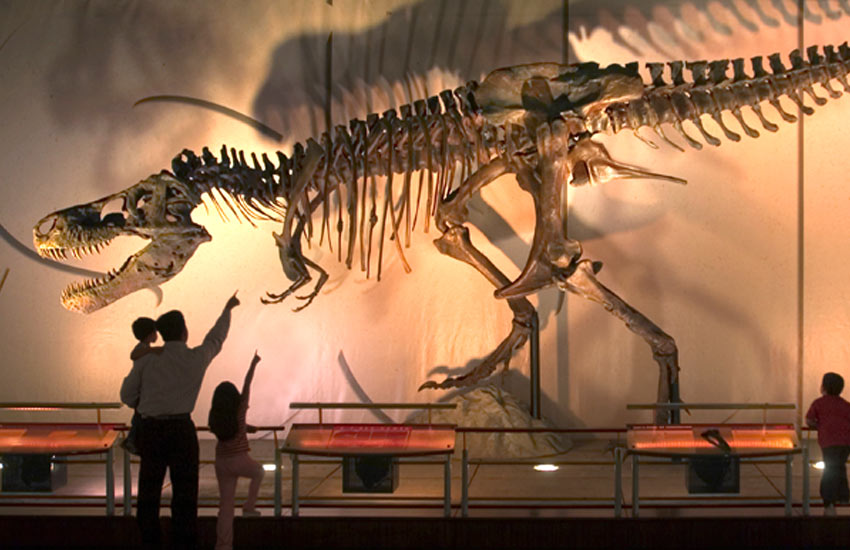
She preserves roughly ninety percent of her skeleton by volume — around 250 of the nearly 380 bones known in a *Tyrannosaurus rex*. Laid out, she stretches more than twelve metres, about forty feet, from snout to tail tip. Her skull alone is a monstrous object, well over a metre long, lined with serrated teeth built to crush bone.
And it is not just the quantity of bones that makes her priceless, but the rarity of certain ones. Sue preserves a furcula — a wishbone, the same kind of bone that links dinosaurs to living birds. She has a tiny stapes, a delicate bone from the ear that almost never survives. She has nearly all her gastralia, the floating “belly ribs” that are usually scattered and lost. These are the bones that fall apart first, the ones science almost never gets to study. In Sue, they were waiting.
**She is not just a big skeleton. She is the closest thing we have to a complete blueprint of the most famous predator that ever lived.**
A body that survived a brutal life
Spend time with Sue’s bones and a second story emerges — not of death, but of survival. This was an animal that lived hard and carried its scars.
Her skeleton is a catalogue of old wounds that healed. There are ribs that broke and knitted back together, including one that mended as two separate pieces. There is damage around the right shoulder, a region that took a serious injury at some point — a torn arm tendon, a damaged shoulder blade — yet all of it shows signs of healing, meaning Sue lived on afterward. One of her lower leg bones is nearly twice the thickness of its partner, swollen by what looks like a long-term bone infection. There is arthritis fused into the bones of her tail.
She even carries bite marks. Some of her vertebrae show wounds that appear to have been inflicted by other tyrannosaurs, hinting at a violent social world where these giants fought one another.

The mystery in her jaw
Perhaps the most haunting clues are a series of smooth, round holes punched through her lower jaw. For years their cause was debated. One widely discussed explanation is that they were not battle wounds at all, but the marks of disease — possibly a parasitic infection similar to one that afflicts birds today, sometimes linked to a microbe called *Trichomonas*. If that idea is correct, the infection could have eaten into the bone of her throat and jaw, making it painful or even impossible for her to swallow near the end of her life.
It remains an interpretation rather than a proven fact, and scientists continue to study these strange lesions. But it points to something profound: by reading the damage in a single exceptional skeleton, researchers can begin to reconstruct not just how a dinosaur looked, but how it suffered, struggled, and perhaps finally died.
When she did die, Sue was old. Studies of the growth rings inside her bones suggest she was around twenty-eight years old — making her one of the oldest *Tyrannosaurus rex* individuals ever identified. For a giant predator, simply reaching that age was an achievement.
The fossil that ended up in an FBI raid
Sue’s afterlife was almost as dramatic as her life. The skeleton was found on land within the Cheyenne River Sioux reservation, on a ranch belonging to a man named Maurice Williams. The Black Hills Institute had paid him a sum for the right to dig — but the land was held in federal trust, and the legal situation was anything but simple.
In 1992, federal agents, reportedly assisted by the National Guard, raided the institute and seized the fossil. What followed was a long and bitter legal battle over who actually owned the most complete T. rex on Earth. In the end, a federal court ruled that Williams was the rightful owner, and the dinosaur was put up for public auction.
On 4 October 1997, Sue went under the hammer at Sotheby’s in New York. In a matter of minutes, the bidding soared to a record-shattering 8.36 million dollars. The winning bid came from the Field Museum in Chicago, backed by major corporate sponsors. After sixty-seven million years in the ground and years tied up in courtrooms, the king had finally found a home.

Why Sue still matters
Today Sue stands in the Field Museum, one of the most studied dinosaur specimens in the world. Because she is so complete, she has let scientists explore the biology, growth, evolution, and behaviour of *Tyrannosaurus rex* in detail that scattered bones could never allow. Nearly every modern claim about how this animal lived owes something to her.
But there is a deeper reason she grips us. Sue collapses the distance between myth and reality. Children draw T. rex as a roaring monster; films turn it into a special effect. Sue is neither. She is a real individual — an animal that broke ribs, fought rivals, fell sick, grew old, and finally died on a riverbank in a vanished world. We can name her injuries. We can guess at her last painful months. We can stand beneath the skull and know it once belonged to something that breathed.
So here is the thought to sit with: if a single set of bones can tell us how one dinosaur lived, hurt, and died across nearly seventy million years, how much of the past is still lying out there in the rock, waiting for someone with a flat tire to stop and look?