In 1984, archaeologists digging into a sealed burial chamber inside Structure II at the ancient Maya city of Calakmul, in what is now the state of Campeche, Mexico, broke through a wall and found a face looking back at them.

It had been waiting in the dark for roughly thirteen hundred years.
The face was assembled from hundreds of carefully cut jade tiles, each piece fitted together like a mosaic to form a human countenance — cheekbones, nose, brow, the curve of lips parted slightly open. The eyes were made from shell, the irises from dark pyrite that still caught the light after more than a millennium of total darkness. Jade ear ornaments flanked the face. The expression was still, powerful, and impossible to read.
This was the Jade Mask of Calakmul — and it is one of the most extraordinary Maya artifacts ever discovered.
The City That Rivaled the Sun
To understand what the mask means, you have to understand the city where it was found.
Calakmul is not famous the way other Maya sites are. It doesn’t draw tourists in the tens of millions the way Chichén Itzá does, and its name doesn’t appear in most general histories of the ancient world. But among archaeologists and Mayanists, it is recognized as one of the most powerful cities the Maya ever built — a capital so dominant that its rulers styled themselves the **Snake Kings**, or the *Kaan* dynasty, and their emblem glyph, the serpent head, appeared in inscriptions across the Maya lowlands as a symbol of conquest and alliance.

At its height, between roughly 500 and 800 AD, Calakmul and its rival **Tikal** — to the south, in what is now Guatemala — engaged in a geopolitical struggle that played out over centuries, drawing other cities into alliances, proxy wars, and dynastic marriages. The two great superpowers of the Classic Maya world, fighting for dominance of a civilization that covered an area the size of modern Europe.
Calakmul’s jungle canopy hid it so thoroughly that it wasn’t rediscovered by the outside world until 1931. When archaeologists finally mapped it properly, they found more than **6,000 ancient structures** and over **120 monuments** bearing hieroglyphic inscriptions — more than any other Maya site on Earth.
The city was hiding more than ruins.
Tomb 1: A King in the Dark
Structure II is the largest pyramid at Calakmul — a massive temple mound that rises above the jungle canopy. Within it, in 1984, archaeologist **Arnolfo González Cruz** led the excavation that uncovered Tomb 1: a sealed burial chamber that had remained undisturbed since the Classic Maya period.
Inside, amid funerary offerings, lay the skeletal remains of a Maya ruler.

The bones had collapsed and dispersed over the centuries as the organic material that once held them dissolved. But the jade mask had held its position. It sat where a face had once been, staring upward at the stone ceiling of the tomb — a face assembled in death to replace the one that had decayed.
The tomb also contained jade jewelry, obsidian blades, ceramic vessels, and shell ornaments. Every object spoke to the status of the person buried there — someone who commanded extraordinary wealth and labor, someone whose court deemed it essential that they enter the afterlife fully adorned.
The identity of the king remains uncertain. Based on the tomb’s architecture and the associated artifacts, researchers have tentatively dated the burial to around **600–700 AD**, placing it squarely in the era when the *Kaan* dynasty was at its most powerful. The ruler buried here may have overseen campaigns that reshaped the political map of Mesoamerica.
His name, if he had one recorded in stone, has not yet been definitively matched to this tomb.
What Jade Meant to the Maya
The mask was not made from any ordinary material. Among the ancient Maya, jade was not merely precious — it was sacred in a way that gold was not.

The Maya word for jade, *yax*, also meant “green,” “blue,” “first,” and “precious.” Jade was the color of maize, of water, of new growth — the color of life itself in the Maya cosmos. Wearing jade was not a display of wealth the way wearing gold might be in another culture. It was a statement of divine connection. Only those closest to the gods — rulers, high priests, the dead who were destined for transformation — were buried in it.
A jade mosaic mask was the ultimate funerary gift. It replaced the face of the dead with something incorruptible, something that would endure through the underworld journey and emerge on the other side still wearing the expression of power.
The eyes of pyrite and shell are especially significant. Pyrite — iron sulfide, a mirror mineral — was associated in Maya cosmology with vision, reflection, and the ability to see across the boundary between the living and the dead. To give a corpse eyes of pyrite was to give it sight in a world the living cannot enter.
**They didn’t bury this king blind. They sent him seeing.**
The Mosaic’s Makers
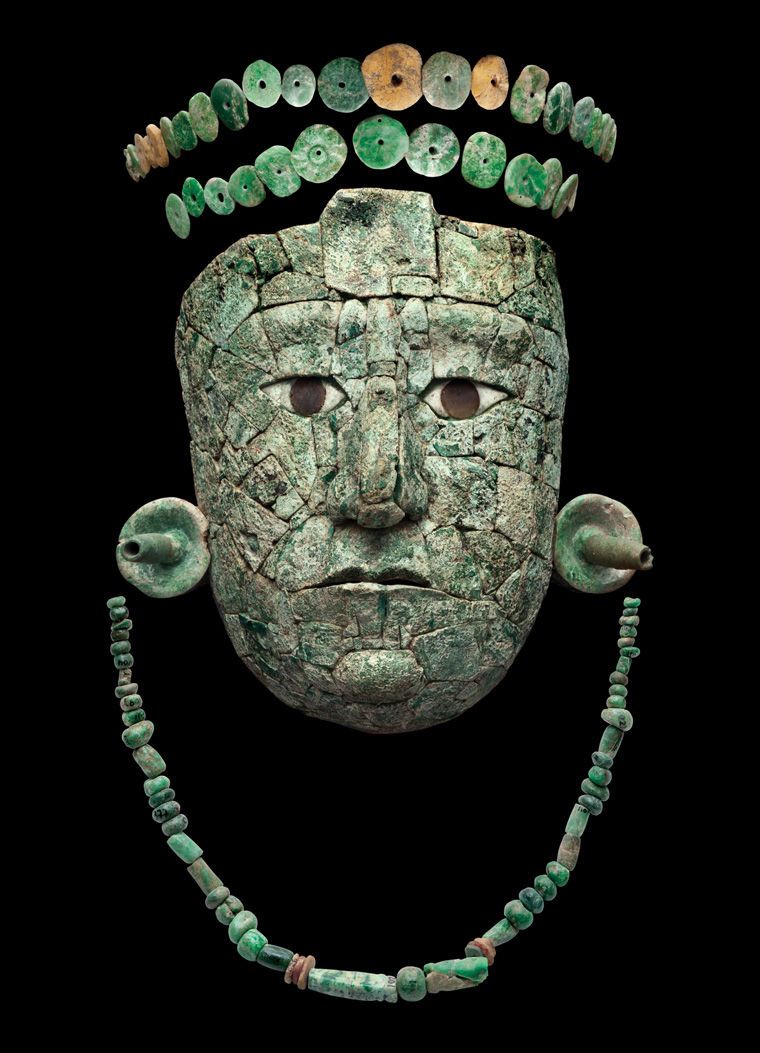
Look at the mask closely and the craftsmanship becomes almost disorienting. Each jade tile was individually cut, shaped, and fitted to the contour of the face beneath — a matrix of hundreds of pieces, no two identical, assembled with a precision that was entirely hand-achieved.
The jade itself came from sources far from Calakmul — the Motagua River valley in what is now Guatemala was the primary jade source for Classic Maya civilization, and obtaining it required trade networks spanning hundreds of kilometers. The labor required to work jade — a stone harder than steel — using only stone tools and abrasive sand, is nearly incomprehensible by modern standards.
Whoever made this mask spent months, perhaps years, on a single object. The king for whom it was made may never have seen it finished.
A Face Without a Name
The mask stares out now from behind museum glass. It has done time in several collections and is today one of the signature objects of Maya archaeology. Researchers photograph it, analyze its isotopic composition, compare its construction to other Maya mosaic masks from Palenque, Tikal, and Río Azul.
And yet it keeps its essential secret. The face it was made to resemble — the actual king, his features, his expression in life — is gone completely. The mask gives the impression of a face without actually being one: a series of approximations, human but not human, ancient but startlingly present.
There is something in that gaze that the pyrite eyes were perhaps always meant to convey. Not the face of one man. The face of power itself — composed, intact, and watching, across whatever distance lies between the living and the dead.