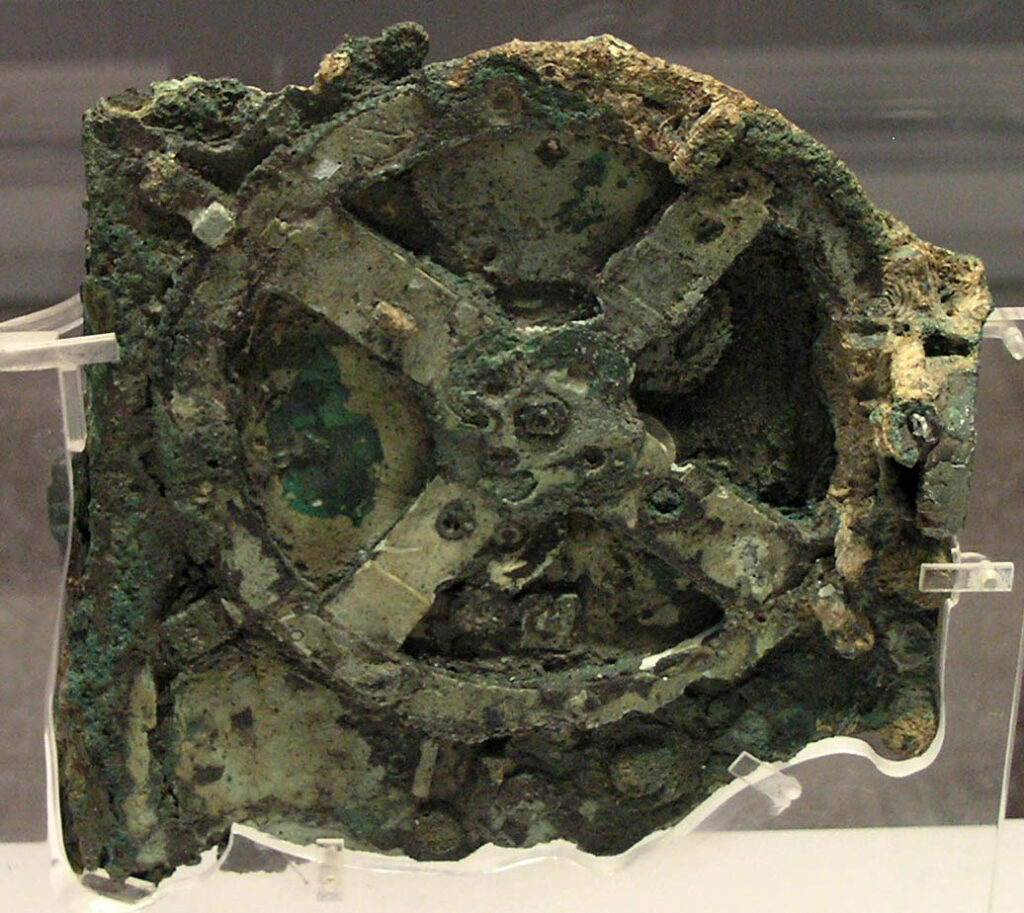
In 1901, sponge divers working off a tiny Greek island brought up a corroded lump of bronze and wood, crusted with two thousand years of sea-floor sediment. Next to the marble statues and treasures from the same shipwreck, it looked like junk — a shapeless, broken nothing.
It was, in fact, the most sophisticated machine to survive from the ancient world. Hidden inside that lump was a system of finely cut bronze gears, engineered to model the heavens. Turn a handle, and it would tell you where the Sun and Moon stood, where the planets wandered, and even when the next eclipse would darken the sky. We call it the Antikythera Mechanism — and it is, by general agreement, the oldest known analog computer on Earth.

A treasure from the sea floor
The story begins with disaster — an ancient one. Sometime around two thousand years ago, a Roman-era ship laden with cargo went down in the deep, treacherous waters near the island of Antikythera, between Crete and the Greek mainland. There it lay, undisturbed, for twenty centuries.
In 1900 and 1901, Greek sponge divers stumbled onto the wreck and began recovering its contents: bronze and marble statues, glassware, coins, the scattered luxuries of the ancient Mediterranean. Among the haul was that unremarkable corroded mass. For a while it sat in a museum, attracting little attention.
Then someone noticed something impossible. Embedded in the corrosion were the unmistakable shapes of gear teeth — precise, regular, machined. This was not a statue or a piece of jewellery. It was a machine. And nothing else like it would be found from the ancient world for more than a thousand years.
A pocket model of the cosmos
So what did it actually do? In essence, the Antikythera Mechanism was a hand-powered astronomical calculator — what we might call an orrery, a mechanical model of the cosmos as the Greeks understood it.

Housed in a wooden case roughly the size of a thick book, it had dials on the front and back and a handle on the side. Turning that handle drove a hidden train of interlocking bronze gears, and those gears moved pointers across the dials to show the state of the sky for any chosen date.
On the front, it displayed the position of the Sun and the Moon against the zodiac, and tracked the changing phases of the Moon. Reconstructions strongly suggest it also showed the positions of the five planets known to the ancients — Mercury, Venus, Mars, Jupiter and Saturn — the wandering “stars” visible to the naked eye. You did not read hours and minutes from it. You read the heavens.
This was not a clock. It was the entire known universe, shrunk into a box of bronze and turned by hand.
The genius hidden in the gears
The real marvel is the engineering. Researchers studying the fragments have identified around thirty surviving bronze gears, and the original device almost certainly held more. These were not crude cogs. They were carefully cut, sometimes with dozens of fine teeth, and arranged in trains that performed genuine mathematics.
By choosing gear ratios with specific numbers of teeth, the makers built astronomical cycles directly into the metal. The back of the device carried two great spiral dials. One, an upper spiral, tracked a calendar based on the 19-year Metonic cycle — the period after which the phases of the Moon fall on the same dates again. The lower spiral encoded the Saros cycle of 223 lunar months, the rhythm by which eclipses repeat.
To capture the strange, looping motion of the planets, the mechanism appears to have used clever arrangements of gears mounted off-centre, turning on pins, to mimic the way planets seem to speed up, slow down and even reverse against the stars. This is mechanical thinking of astonishing subtlety — the kind of gearing the world would not see again until medieval clockmakers, well over a millennium later.
Predicting darkness
Of all its functions, the most chilling is eclipse prediction. On that lower back spiral, small inscribed symbols — glyphs — mark the months in which a solar or lunar eclipse was expected. Some even seem to note the likely time of day and other details.
Think about what that means. Two thousand years ago, with no electricity, no telescopes, no modern mathematics as we know it, someone built a device into which you could feed a date and have it warn you, through the turning of bronze wheels, that the Sun or Moon was about to go dark. To a world that often read eclipses as omens from the gods, this was a machine that could see the future of the sky.
It even tracked human time. One of the dials is thought to have followed a four-year cycle marking the dates of the ancient games — including, remarkably, the Olympiad, the count of the Olympic Games. Astronomy and civic life, both turning on the same hidden gears.
Who could possibly have built it?
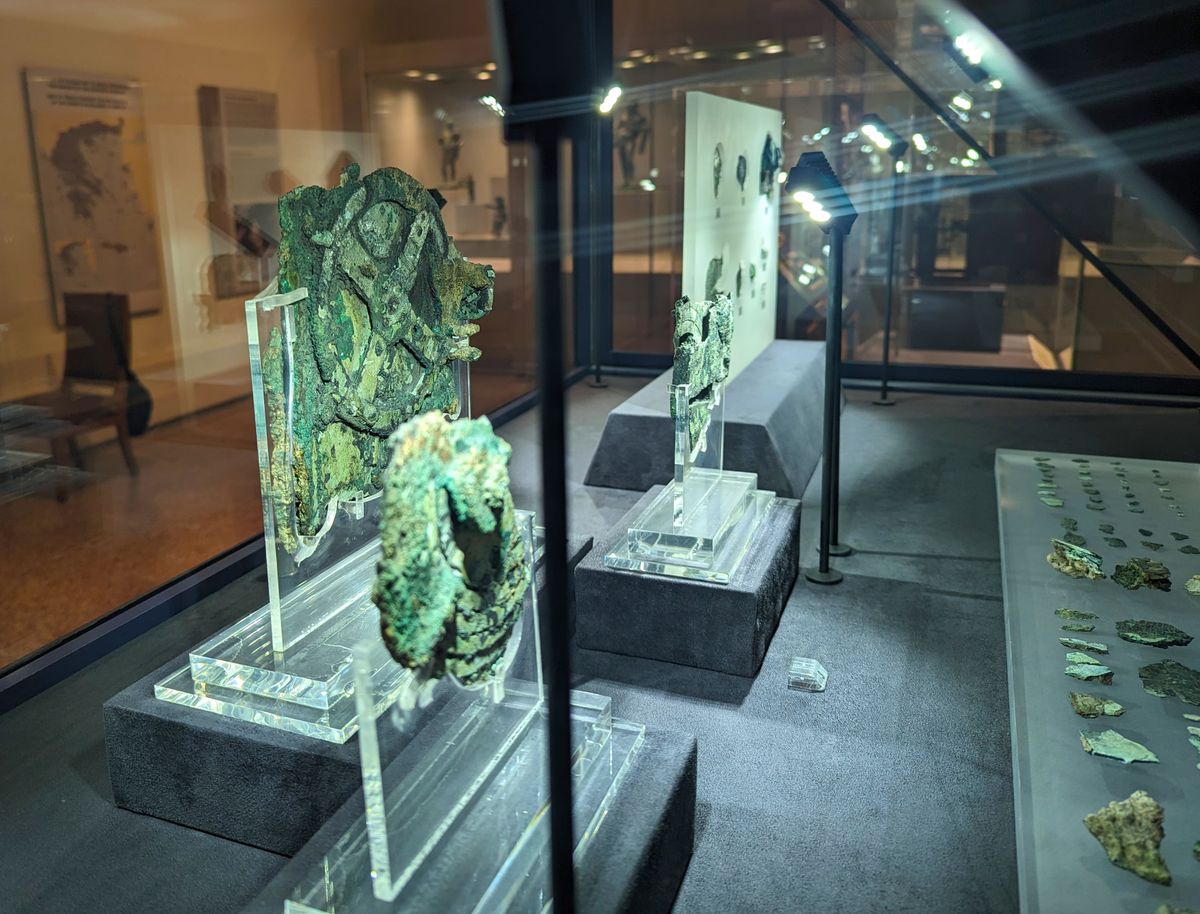
Here is where honesty matters more than mystery. The Antikythera Mechanism is genuinely extraordinary — but it is human work, not magic, and certainly not anything from beyond our world. It is the product of Greek mathematics, astronomy and metalworking at their height, in a culture that understood the heavens deeply.
Exactly who made it, and where, remains uncertain. The device is usually dated to somewhere in the second or first century BC. Scholars have suggested links to the great scientific tradition associated with figures like Archimedes and the astronomer Hipparchus, and to workshops on islands such as Rhodes — but these remain informed hypotheses rather than proven facts. We do not have the maker’s name. We only have the machine, and the dazzling competence frozen into its gears.
What we can say is that it was almost certainly not unique. A device this refined was probably the descendant of a whole tradition of such instruments, most of which have simply dissolved back into the earth and the sea. The Antikythera Mechanism may be the lone survivor of a lost branch of ancient engineering.
Why it still stuns us
In 2021, a team at University College London led by Tony Freeth published a detailed reconstruction of the front display, proposing how a compact set of gears could have driven the planets across the dial in step with the inscriptions found on the device. Work like this continues to this day, with researchers using X-ray imaging and 3D scanning to read writing and structure hidden inside fragments no human eye had seen in two millennia.
The reason the mechanism grips us is simple. It breaks our quiet assumption that the ancient world was simpler than ours — that real precision, real machinery, real computation belong only to modern times. Here, instead, is proof that more than two thousand years ago, human beings could capture the motions of the heavens in cut metal and read the future of eclipses by turning a crank.
So here is the thought to sit with: if a single shipwreck could hand us a 2,000-year-old computer that we almost mistook for a rock, how much ancient genius has already been lost — and how much is still waiting on the sea floor?