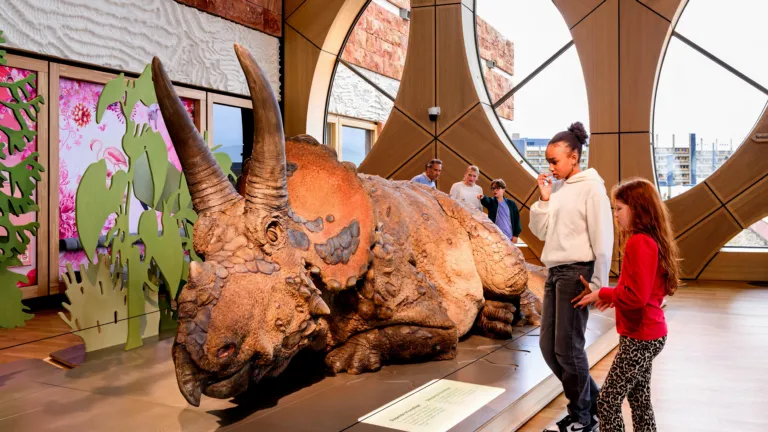
For more than a hundred years, we have told ourselves the same story about Triceratops: a massive, three-horned loner, plodding across the Late Cretaceous on its own, the rhinoceros of the dinosaur world. It is the version in the films, the museums, the picture books.
A patch of badland in Wyoming is quietly tearing that story apart. Buried in a single thin layer of ancient rock lies a graveyard of these horned giants — not one animal, but a group, young and old together, who appear to have died in the same moment around 66 million years ago. And the way they died may finally answer a question paleontologists have argued over for generations: were these creatures truly alone, or did they live in herds?

A graveyard of giants in Wyoming
The site, reportedly known as the Darnell Triceratops Bonebed, sits in the Lance Formation about 30 kilometres south of Newcastle, Wyoming — a stretch of quiet, dry American badland that 66 million years ago was something else entirely: a lush, low coastal plain on the edge of a vanished inland sea.
The excavation has been a marathon. Over roughly a decade, a team from the Naturalis Biodiversity Center in the Netherlands has reportedly pulled some 1,200 individual bones from the ground here, painstakingly mapping where each one lay. This isn’t a single skeleton. It’s an assemblage — and the way the bones are packed together is the whole story.
And the timing could hardly be more dramatic. The Lance Formation preserves some of the very last dinosaurs ever to walk the Earth — the world of the final stretch of the Cretaceous, when Triceratops shared its floodplains with Tyrannosaurus rex itself. These animals lived right at the edge of the end. Not long after, the asteroid struck, and the age of dinosaurs was over.
At least five, who died together
When researchers studied the remains, they reportedly identified at least five separate Triceratops — and crucially, a mix of ages, from subadults to full adults. A multigenerational group. Young and old. In one place.
Even more telling: the bones are concentrated in a single thin layer, with no other species mixed in. This wasn’t a slow pile-up of random carcasses washed together over centuries, the way many fossil scatters form. The evidence points to one group of Triceratops, of different ages, ending up dead in the same spot at essentially the same time.
Getting to that conclusion took extraordinary patience. Each bone reportedly had to be mapped exactly where it lay before it was lifted, building a three-dimensional picture of how the animals came to rest. Researchers have even probed the chemistry locked inside the fossils — stable isotopes that can hint at what these Triceratops ate and the environment they roamed — coaxing clues about behaviour and ecology out of bones that, a generation ago, we’d have struggled to read at all.
The lonely giant — overturned?
Here’s why paleontologists are paying attention.
Some horned dinosaurs, like Centrosaurus, are already famous for dying in enormous bonebeds — proof they moved in vast herds. But Triceratops was different. For a long time, it stood oddly alone in the fossil record: found mostly as single individuals, which led many to imagine it as a solitary animal, going its own way across the floodplains.

A group of five, spanning generations, dying together changes that. It’s the strongest sign yet that Triceratops, too, may have lived in groups — that these animals travelled, fed, and protected their young alongside one another.
Think of the difference between finding a single lost hiker and finding a whole family caught together in one place. One simply tells you an animal existed. The other tells you it belonged to something — a group, with young to raise and guard, and presumably much of the social life that implies. That’s a far richer, and far more surprising, portrait of a creature we thought we already knew.
For over a century we pictured Triceratops alone. This Wyoming graveyard suggests they lived — and died — together.

So what killed the herd?
This is where the mystery deepens — and where it pays to be careful, because the honest answer is: we don’t fully know.
What seems clear is that they perished together. One leading idea, according to the research, is that the animals became mired — trapped in a swamp or soft, waterlogged ground they couldn’t escape, the whole group caught in the same fatal moment. Others have wondered whether some kind of flood or sudden water event swept across the low coastal plain and overwhelmed them.
It’s tempting to reach for the most cinematic version — a towering wall of water, an apocalyptic storm. But the truth is the precise mechanism is still being worked out, and a slow, grim entrapment in mud may be closer to what actually happened than any Hollywood deluge. What matters, scientifically, is the togetherness: whatever struck, it struck the whole group at once — and that’s exactly why it tells us so much about how they lived.
Why a pile of old bones matters so much
It’s easy to scroll past “dinosaur bones found in Wyoming.” This one deserves a second look.
Mass-death sites like this are scientifically priceless precisely because they freeze a single moment. Instead of one animal that died alone and was slowly buried, you get a snapshot of a community — ages, group size, who was travelling with whom. From 1,200 carefully mapped bones, researchers can begin to reconstruct not just what Triceratops looked like, but how it lived: in families, in herds, watching over its young.
That’s the difference between knowing an animal’s skeleton and knowing its life. And it’s astonishingly rare to get the second one.
Why it still captures us
Picture them: a family group of horned giants, the young among the old, moving together across a humid floodplain at the very twilight of the age of dinosaurs — only a short geological breath before the asteroid that would end their world. And then, in one bad moment, all of them gone at once, sinking into the ground that would keep them side by side for 66 million years until a team with brushes and picks found them again.
We started with the image of a loner. We may be ending with something far more human-feeling: a group that lived together, and met the end together.
So here’s the question to sit with: were these three-horned giants the solitary warriors we always imagined — or a family that faced the end side by side?