They left no name.
No tools, no shelter, no burial — nothing that would tell us who they were, where they came from, or what they were looking for. They passed through a stretch of land in what is now northern Saudi Arabia, stopped briefly at the edge of a lake, and kept moving.
The lake is gone. The world they knew is gone.
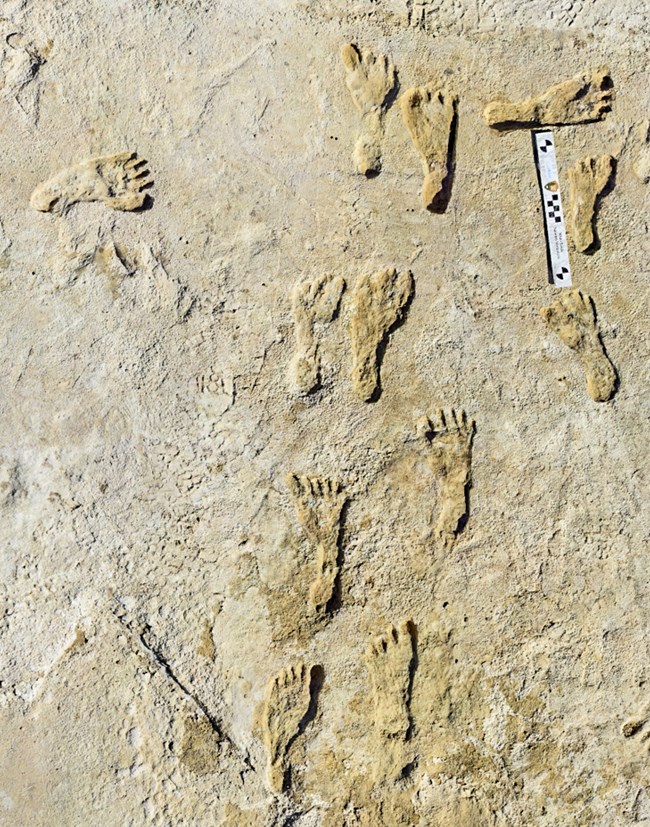
But in the hardened sediment of an ancient lakebed called Alathar, their footprints are still there — pressed into the earth 120,000 years ago, waiting in silence while empires rose and fell above them.
They are the oldest known human footprints on the Arabian Peninsula.
And they raise a question that science has not yet fully answered: who were these people, and what happened to them?
§2 — A Desert That Wasn’t Always a Desert
To understand what Alathar is, you have to forget what Saudi Arabia looks like today.
The Nefud Desert — scorching, vast, hostile — is one of the least forgiving environments on Earth. It is not a place associated with human habitation, with water, or with life. When we think of early human migration routes out of Africa, Arabia appears on the map as an obstacle, not a destination.
But 120,000 years ago, the picture was completely different.
The region was shaped by a wetter climate — rivers ran through valleys that are now dry, lakes filled the interior, and the landscape supported a thriving ecosystem of wildlife. Arabia was not a barrier. It was a living world, abundant with resources, through which early Homo sapiens could move, stop, hunt, and survive.
That world vanished. But it left traces.

§3 — What the Ground Remembered
At Alathar, scientists discovered something the desert had been concealing for over a hundred thousand years.
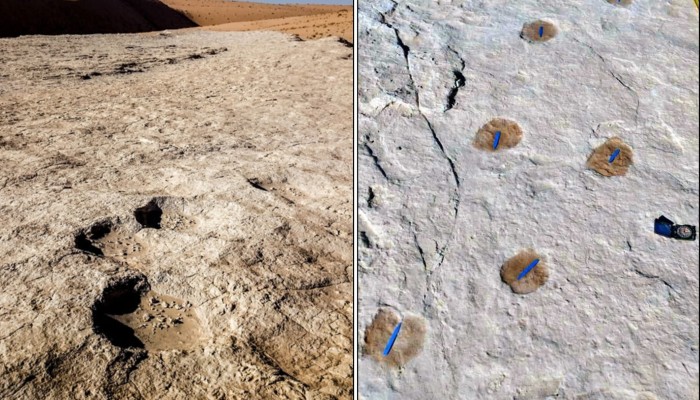
Preserved in the fossilized sediment of an ancient lakebed: human footprints. Multiple sets, belonging to early Homo sapiens, dated to approximately 120,000 years ago. Clear enough to study. Old enough to rewrite history.
The surrounding evidence confirmed what the landscape once was — a thriving environment where humans could stop for water, observe wildlife, and rest during long migrations across a continent. This was not a desperate crossing of barren terrain.
These people were not fleeing a wasteland. They were moving through a world that welcomed them.
And then that world disappeared — transformed, over thousands of years, into the desert that stands there today.
The footprints remained. The people did not.
§4 — The Detail That Changes Everything
For decades, scientists assumed early humans leaving Africa followed coastal routes — skirting the edges of Arabia, staying close to the sea and its resources, avoiding the interior.
Alathar challenges that assumption directly.
These footprints are not on a coast. They are deep in the Arabian interior — in a place that, by the old model, early humans had no reason to enter and no way to survive. Their presence here means Arabia was not just a passage. It was a habitable environment. A place where prehistoric populations lived, moved, and made decisions.
This discovery challenges previous assumptions about early human dispersal routes and forces researchers to reconsider the map entirely.
How many other routes were there? How many other populations moved through landscapes that are now desert, leaving no trace except the occasional footprint pressed into the right kind of mud?

§5 — The Mystery
Here is what we do not know.
We do not know who these individuals were — whether they were among the ancestors of populations that survive today, or members of a branch of humanity that walked into Arabia and never came back.
We do not know where they were going. The footprints show people in motion — passing through, navigating a world shaped by climate, rivers, and vegetation. Researchers believe they were likely part of a migration out of Africa, following routes determined by water and wildlife rather than the geography we know today.
But migration to where? Survival for how long?
When the climate shifted and the lakes dried, what happened to the communities that had spread through the green interior of Arabia? Did they retreat? Did they adapt? Did they simply run out of places to go?
Each footprint is a silent testament to the journeys, decisions, and survival of humans who lived 120,000 years ago. They walked through a moment in history that was already ending — a paradise mid-transformation into a desert.
They didn’t know. They kept walking.
§6 — What This Means
The Alathar footprints don’t just change the map of early human migration.
They change the story.
The old story was linear: humans left Africa, followed one route, spread gradually across the globe. Clean, manageable, easy to teach.
The new story is messier and more human. People moved through the interior of Arabia when it was green. They stopped at lakes. They watched the wildlife. They made decisions — where to go, whether to stay, how long to rest — based on a landscape that would be unrecognizable to us today.
Some of those decisions led to us. Some of them led nowhere at all.
Alathar is proof that the story of our species is far older, far more complex, and far more full of lives that left no record than we have ever been willing to admit.
§7 — 120,000 Years Later
Even now, these tracks remind us that every step taken by our ancestors left a mark on Earth.
Not always in stone. Not always preserved. Most of what our earliest ancestors did — the paths they walked, the choices they made, the places they called home — has been erased completely by time, weather, and the indifference of geology.
But at Alathar, the mud held.
120,000 years ago, a group of early humans stopped at the edge of a lake in what would one day become one of the world’s great deserts. They rested. They looked at a landscape full of life. And then they kept moving, into a future they could not have imagined, in a direction we cannot follow.
Their footprints are still pointing that way.