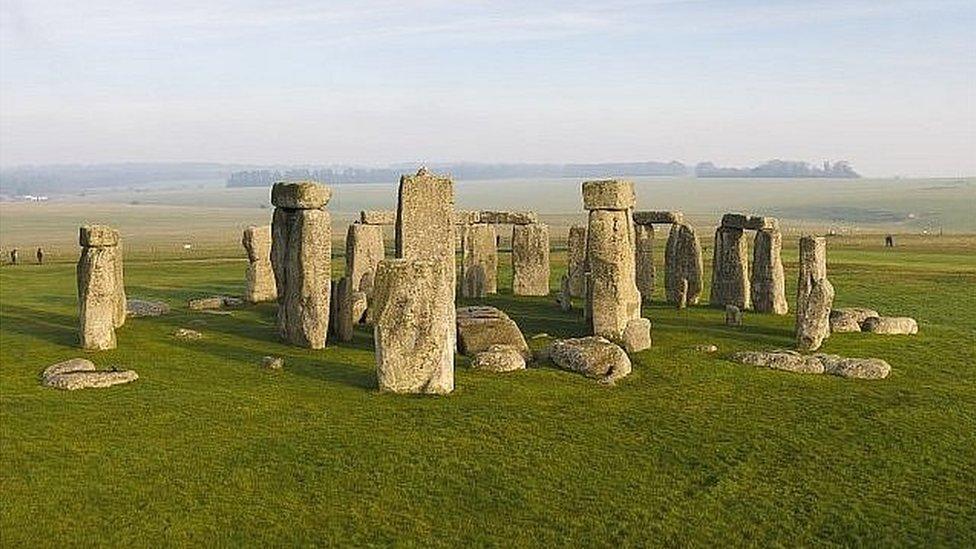
On the morning of the summer solstice, just before sunrise, a line drawn from the center of Stonehenge through the Heel Stone points precisely to the spot on the northeastern horizon where the sun will rise. It has done this every year for approximately five thousand years.
Whether that alignment was intentional, or an artifact of a landscape that humans in the Neolithic period understood differently from us, is one of the central debates in the archaeology of Stonehenge. But the fact itself is unambiguous. The stones are where they are for a reason. And whatever that reason was, it was precise enough to survive five millennia of weathering, vandalism, collapse, and excavation without losing its essential accuracy.
Stonehenge is the most studied prehistoric monument on Earth. It has been excavated, surveyed, dated, theorized about, and argued over for centuries. And it remains, in its most fundamental dimensions, unexplained.

Older Than the Pyramids
The first thing to establish is the timeline, because the popular imagination consistently underestimates the age of Stonehenge and misunderstands its relationship to other ancient monuments.
Stonehenge was not built all at once. It went through at least three major phases of construction spanning roughly **1,500 years**, from around **3000 BCE** to approximately **1500 BCE**. The earliest phase involved the construction of the circular earthwork — a bank and ditch — and the digging of the **Aubrey Holes**, a ring of 56 pits just inside the bank whose function remains debated.
The Great Pyramid of Giza was completed around **2560 BCE**. By that date, Stonehenge had already been a ceremonial site for four centuries, and the first stones — the bluestones, brought from Wales — were arriving or had already arrived.
The sarsen stones, the massive grey sandstone uprights and lintels that form the iconic image of Stonehenge, were erected in the monument’s second major phase, around **2500 BCE**. This is the Stonehenge that photographs. The horseshoe arrangement of five enormous trilithons at the center, surrounded by the outer circle of uprights and lintels — this structure was contemporary with the later phases of pyramid construction in Egypt.
Stonehenge is not a curiosity at the edge of the ancient world. It is one of the defining monuments of the Neolithic and Early Bronze Age across the entire globe.

The Stone That Came 150 Miles
The most technically remarkable aspect of Stonehenge is not the sarsen stones, which came from Marlborough Downs approximately 25 kilometers to the north — still a significant transport achievement for a Neolithic society with no wheeled vehicles and no draft animals larger than oxen. It is the **bluestones**.
The bluestones — around 80 of them, weighing up to 4 tonnes each — are a specific type of spotted dolerite and rhyolite found in a very restricted geological area: the **Preseli Hills** in Pembrokeshire, Wales. The distance from the Preseli Hills to Stonehenge, across some of the most demanding terrain in Britain, is approximately **240 kilometers** — about 150 miles.
These stones were moved, by people with Neolithic technology, from their source in Wales to Salisbury Plain. The method has been debated for over a century. Recent experiments have demonstrated the plausibility of rolling them on wooden sledges and rafts, moving overland and then along the Welsh coast by water. The organization and collective labor involved — the logistics of feeding, coordinating, and directing potentially hundreds or thousands of people across months of transport — is staggering by any measure.
The question that the transport raises is the question at the heart of Stonehenge: **why these particular stones?** The Preseli Hills are 240 kilometers away. There is sandstone closer. There is granite closer. What was it about the bluestones of Pembrokeshire that made them worth a journey of that scale?
Recent research has proposed that the bluestones may have been significant in their original location before they were moved — that there may have been a stone circle at the Preseli Hills that was dismantled and relocated to Salisbury Plain. If so, Stonehenge may incorporate a monument that was already ancient when it was brought there, making the site a palimpsest of meanings layered over millennia.

The Builders
For most of the period when Stonehenge has been studied, the question of who built it has generated more speculation than evidence. Druids, Romans, Merlin, Atlanteans — the monument has been attributed to every culture in the popular imagination except the people who actually built it.
The builders of the earliest phase were the indigenous **Neolithic farming communities** of southern Britain — people who had been settled agriculturalists in the region for centuries before Stonehenge began. The later phases involved the people associated with the **Beaker culture**, a population that arrived in Britain from continental Europe around 2500 BCE and brought new technologies, new burial practices, and new social structures.
Recent ancient DNA analysis has transformed our understanding of these builders. Research published in 2019 showed that the Beaker people who arrived in Britain around 2500 BCE largely replaced the existing population within a few centuries — meaning that the builders of the earliest Stonehenge and the builders of the sarsen stone monument may have been genetically distinct populations, connected by place and by cultural inheritance but separated by ancestry.
The people who began Stonehenge are mostly gone. The monument they started outlasted them by thousands of years.

What It Was For
The honest answer is that we don’t know — and that the range of credible theories spans most of the functions a monument of this size and permanence could serve.
**A burial ground.** Stonehenge was associated with human burial from its earliest phases. Cremated human remains were deposited in the Aubrey Holes and elsewhere around the monument over several centuries. The remains of hundreds of individuals have been identified at the site. Stonehenge may have been, among other things, an ancestral cemetery — a place where the dead were brought from considerable distances to rest within the monument’s protection.
**A solar observatory or calendar.** The solstice alignments are real. The sunrise alignment on the summer solstice and the sunset alignment on the winter solstice are demonstrable. Whether this means Stonehenge was a precision astronomical instrument used to track the calendar — as some researchers argue — or whether the alignments were spiritually significant without being practically functional, is a question the stones cannot answer.

**A healing center.** This theory, proposed seriously by archaeologist Timothy Darvill and others, points to evidence that people traveled to Stonehenge from considerable distances in poor health — skeletal analysis shows individuals with injuries and conditions that would have been debilitating, who made long journeys to the site. If Stonehenge was associated with healing or divine intervention in illness, the bluestones may have been believed to carry medicinal or spiritual power from their original Welsh landscape.
**A political and ceremonial center.** The enormous effort required to build and maintain Stonehenge implies a social structure capable of organizing and directing that effort over centuries. The monument may have been the physical expression of a political system — a demonstration of power, a gathering place for ceremonies that reinforced social bonds and hierarchies across a wide region.
The most defensible answer is probably: all of the above, at different times. A monument five thousand years old, built in phases by different peoples with evolving purposes, almost certainly did not mean one thing. It accumulated meanings as it accumulated stones.
What We Keep Finding
The excavations have not stopped. Modern non-invasive techniques — ground-penetrating radar, magnetometry, LiDAR — have revealed a landscape around Stonehenge far more complex than previously known. Buried features, possible cursus monuments, avenue extensions, and alignments that the surface does not reveal are continuously being mapped.
In 2020, researchers announced the discovery of a circle of approximately 20 large pits enclosing the nearby site of Durrington Walls — a Neolithic settlement associated with Stonehenge’s builders — arranged in a pattern suggesting deliberate monumental construction at a scale comparable to Stonehenge itself.
The monument stands at the center of a ceremonial landscape that covered many square miles, incorporated multiple monuments over several millennia, and was clearly the focus of sustained human attention and ritual activity for longer than most civilizations have existed.
Five thousand years after the first workers broke ground on Salisbury Plain, we are still finding things they left behind.
The stones are still there. The solstice still rises through them. And the question of what the people who placed them there were thinking when they did it remains, for now, the most interesting open question in the archaeology of the ancient world.