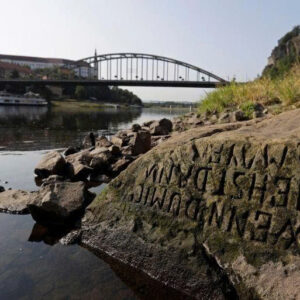
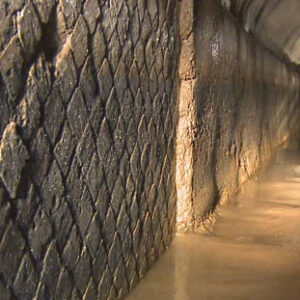
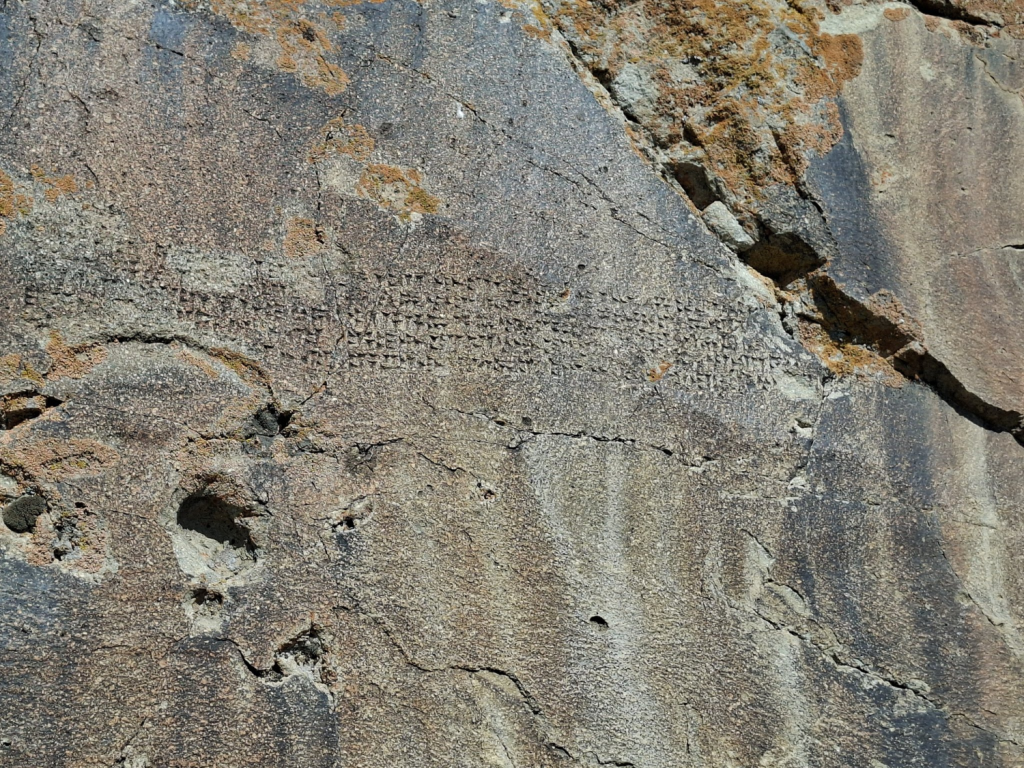
It doesn’t look like much from a distance. A grey rock face in the highlands of Nakhchivan, scarred and lichen-stained, the kind of stone a traveler would walk past without a second glance. Then the light hits it at the right angle — low, raking, late in the day — and the surface stops being random. Rows. Wedges. The deliberate, unmistakable rhythm of writing.
Someone climbed up here, nearly three thousand years ago, and carved a message into the mountain. And for most of recorded history, no living person knew it was there.

What we were told
For an empire of its power, Urartu is almost a ghost. Rising in the Iron Age around the rugged country near Lake Van — a rival that even mighty Assyria treated with wary respect — it built fortresses, mastered metalwork, and ruled a sweep of mountainous land for centuries.
And then it more or less vanished from the written record. Urartian texts are exceptionally rare. We have always known far more about who the Urartians fought than about what they themselves had to say.
But that’s not the whole story. Because the mountain in Nakhchivan had been keeping a sentence of it — in the king’s own words.
What was found
A lost inscription, carved directly into a remote cliff, dated to roughly 2,800 years ago. Not a fragment scratched on a potsherd. A full, official statement, cut into living rock in the wedge-shaped cuneiform script the Urartians borrowed and made their own.
This is the part that makes archaeologists hold their breath. Written Urartian survives in such small quantities that every new line is a windfall. A whole inscription — placed deliberately, meant to last, meant to be seen — is something else entirely.
An empire that barely spoke to the future just said something out loud.
The detail that changes everything
It isn’t a prayer. It isn’t a boundary marker. According to early readings, it’s a war record — an official account of a major military campaign waged by a powerful Urartian king.
Kings carve campaigns into mountains for a reason. They are not writing diaries; they are writing claims. This land is mine. I came here. I won here. Remember it. A monument like this isn’t just a record of where an army marched — it’s a flag planted in stone, aimed at everyone who would ever stand where you’re standing now.
And here is what no one has fully explained yet: why here? This far north, on this particular cliff, at the edge of what we thought the empire controlled.
The mystery
That single question is what has linguists racing.
The text sits at the empire’s northern frontier — and frontiers are where official stories get interesting. A king doesn’t carve a triumph into a quiet, settled heartland. He carves it where the borders are contested, where a message needs to be sent, where the edge of the known world is being pushed.
So the inscription may be doing two things at once: recording a conquest, and quietly redrawing the map of how far Urartian power actually reached. If the campaign it describes happened where the stone suggests, then our neat lines around this ancient empire may have been drawn too small.
The cuneiform is still being decoded, sign by sign. Every wedge could shift a border. And no one yet knows what the final lines will say.

So what could it really be?
Scholars are weighing it carefully, and a few possibilities hang over the cliff.
The first: exactly what it appears to be — a genuine royal campaign monument, marking a real victory at the empire’s edge, and extending the known reach of Urartu further north than the textbooks allow.
The second: a frontier claim more than a frontier fact — a king announcing dominion over land he raided but never truly held, the ancient equivalent of propaganda carved to intimidate locals and rivals alike.
The third, and the most tantalizing: a clue to events we have no other record of at all — a campaign, a king, or a conflict that existed only in this stone, lost the moment the empire fell, and recovered now by pure chance.
No one can say for certain until the last sign is read. And that may be the point.
Why it still haunts us
There’s something humbling about a sentence that waited 2,800 years for a reader. Empires rise convinced they’ll be remembered, and most of what they say to the future is lost — burned, buried, weathered into silence. Urartu nearly vanished completely. And yet one stubborn line, cut into one remote cliff, survived long enough to start rewriting history.
It’s a reminder that the past isn’t finished talking. It’s just waiting for the light to fall at the right angle, for someone to climb up and look closely, for the right person to recognize that the marks in the stone are not random at all.
So here’s the thought worth sitting with: if a single forgotten cliff can redraw the borders of an empire — how much of the history we think is settled is really just the part that happened to survive?