Lay a grown man down beside it, arms at his sides, and he barely reaches across half of it. That’s the first thing people do when they see the shell — they lie down next to it, because numbers don’t land until a human body is in the frame. Thirteen feet, flipper to flipper. A single turtle’s shell, wider than a small car is long.
And it has been waiting in the rock of South Dakota for roughly eighty million years.

What we were told
Say “turtle” and the mind serves up something gentle and small — a creature you could lift in two hands, a slow tenant of ponds and beaches. Even the giants of today, the great leatherbacks, sit within the bounds of what feels possible.
That’s the comfortable scale. The one our instincts are calibrated to.
But that’s not the whole story. Because the rocks of the American Midwest remember a sea — and in that sea swam something the word “turtle” can barely contain.
What was found
A fossilized carapace, the great domed shell of a marine turtle, spanning an astonishing four meters across. Not crushed flat. Not scattered. Recovered with its structure intact enough that researchers can read the architecture of the living animal in it.
That detail matters more than the size. Shells this wide and this uncrushed are extraordinarily rare — most are flattened by the weight of ages into puzzles no one can fully reassemble. This one held its shape. It came up out of the ground still looking like what it was.
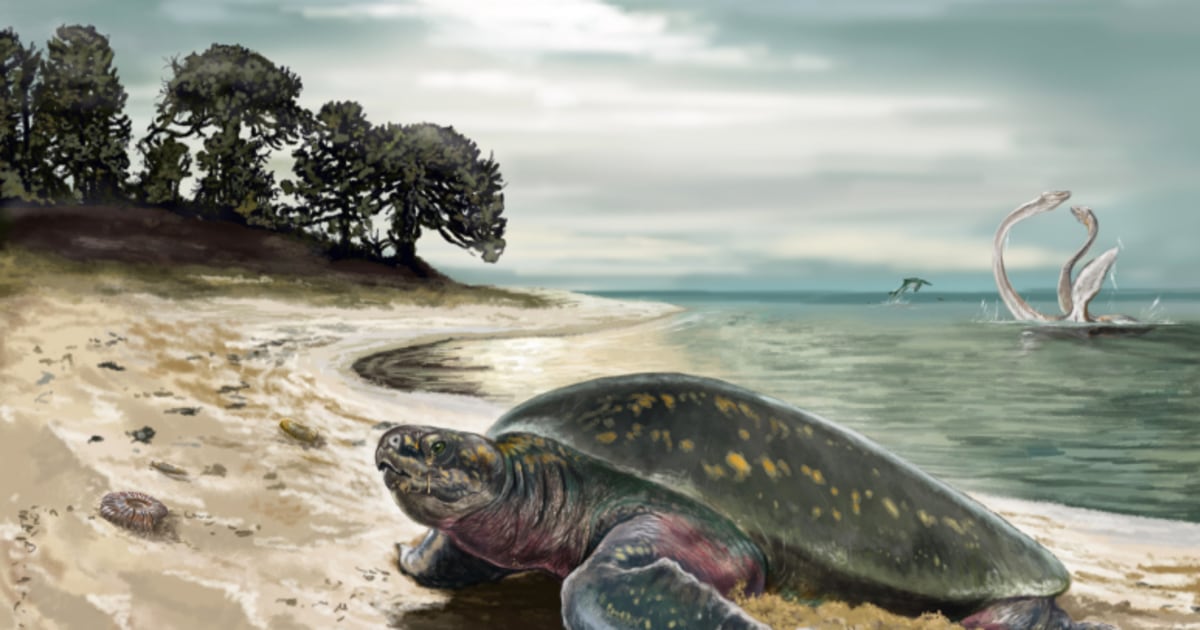
It belonged to Archelon — the absolute largest turtle ever known to swim on Earth.

The detail that changes everything
Here’s the twist that surprises people. A shell that enormous should be impossibly heavy — a slab of solid bone no animal could haul through open water.
It wasn’t. Archelon’s shell wasn’t the dense, heavy fortress of a modern tortoise. It was a lighter, leather-like framework — a ribbed, strut-supported structure that shielded the vital organs without the crushing weight of solid bone. It was armor engineered for the open ocean: protective, but buoyant enough to let a giant cruise and migrate across a vast sea.
So the size isn’t even the strangest part. The strangest part is how it was built — a body solving, eighty million years ago, the exact problem of how to be both massive and seaworthy.
The mystery
And that is the question the fossil quietly poses: how did a turtle get this big in the first place?
Gigantism in the ocean is a recurring puzzle. Again and again, the sea has grown creatures to sizes the land never allowed — and then, just as often, erased them. Archelon is one of its most extreme experiments: a reptile scaled up past every turtle before or since, then gone.
A single well-preserved carapace becomes a kind of instrument. From it, researchers can estimate how the animal controlled its buoyancy, how it moved through open water, how it managed the brutal demands of long-distance migration. One shell, read carefully, starts to rebuild an entire vanished animal — and the ecosystem it ruled.
But the deepest question lingers: what pushed this lineage to such size, and why did the ocean, having built it, let it disappear?

So what could it really be telling us?
Paleontologists read a shell like this on several levels at once.
On one, it’s a measuring stick — hard physical proof of just how large marine reptiles became during the Late Cretaceous, when much of today’s Midwest lay drowned beneath a warm, shallow inland sea.
On another, it’s a blueprint — evidence of how evolution engineered a lightweight giant, a design for armor that protects without sinking its owner, written in rib and strut instead of solid bone.
And on a third, it’s a window into a lost world: a seaway teeming with life where there is now dry prairie, an entire ecosystem of giants whose rules we are still reconstructing from fragments like this one.
No single fossil answers everything. But few say as much at once.
Why it still haunts us
There is something deeply unsettling about lying down beside a shell that once belonged to a living thing — and being dwarfed by it. It collapses the comfortable distance between “now” and “then.” The prairie wind moving over South Dakota today blows across the grave of a sea, and the animals that ruled it were built on a scale we struggle to picture even with the proof right in front of us.
That’s the strange gift of a fossil like this. It doesn’t just tell us the past was old. It tells us the past was enormous — stranger and bigger than our instincts allow — and that the ground we stand on has been the floor of a completely different world before.
So here’s the thought to carry with you: if a single shell can resurrect a giant we’d never have imagined — what other monsters are still lying in the rock beneath our feet, waiting to be measured against a human body?
👇 Tag the person who’d lie down next to that shell for scale.