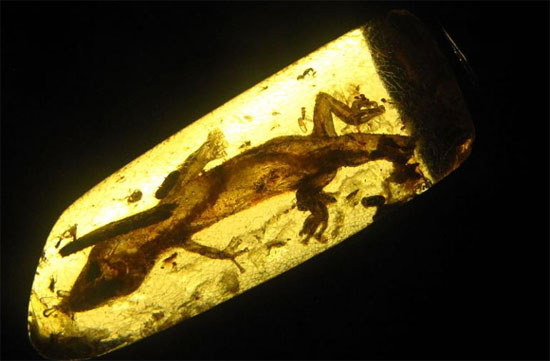
It is smaller than your finger. Less than two inches, nose to tail. And it is looking out at you through a window of golden glass that has not opened in twenty-three million years.
Hold that number for a second. Not twenty-three thousand. Twenty-three million. When this lizard took its last breath, there were no humans, no cities, no written word — the ancestors of modern mammals were only beginning to spread across a younger Earth. And in all that time, its skin never rotted, its body never collapsed. It simply waited.

What we were told
Fossils, we’re taught, are stone. Bone turned to mineral, the soft parts long gone — a flattened skeleton pressed into rock, the faint outline of a creature you have to imagine back to life.
That’s the usual deal the past offers us. Hard parts survive. Everything that made the animal look alive — skin, color, the curve of a muscle — disappears.
But that’s not the whole story. Because this little lizard didn’t turn to stone. It was caught by something gentler, and far stranger.
What was found
In the amber mines of Simojovel, in Chiapas, Mexico, miners splitting open nodules of fossilized tree resin found a complete vertebrate sealed inside — a tiny lizard of the genus Anolis, the same group of small, agile lizards that still dart across tropical trees today.
It hadn’t been fossilized in the ordinary sense. It had been embalmed in sap. Millions of years ago, a drop of sticky resin oozed down a tree trunk, and this lizard — alive, moving, going about its day — got caught. The resin flowed over it, sealed it airtight, and slowly hardened into amber.
A creature that should have vanished without a trace instead became one of the most complete amber fossils ever found on mainland Americas.\

The detail that changes everything
Here’s what stops paleontologists in their tracks: it isn’t just bones in there.
The amber preserved soft tissue and skin — the parts that virtually never survive. We’re not looking at the shape of a lizard. We’re looking at the lizard itself, near-perfectly intact, its scales and body frozen mid-life like a photograph that became three-dimensional.
And complete vertebrates in amber are extraordinarily rare. Amber is famous for trapping insects — a mosquito, an ant, a fleck of ancient pollen. A whole lizard, with its skeleton and its skin? That is a once-in-a-very-long-time discovery.
The mystery
So why this one? Why did this particular tiny animal beat odds so steep they’re almost incalculable?
Think about everything that had to go right. The lizard had to be small enough to be fully engulfed before it could struggle free. The resin had to flow fast, then seal completely, locking out air, water, bacteria — everything that drives decay. The amber had to survive twenty-three million years of geological violence without cracking. And then a miner, by pure chance, had to split exactly the right stone.
Change any one of those, and this lizard is simply gone, like the countless trillions of creatures that left no mark at all. What we’re really looking at isn’t just a fossil. It’s a statistical miracle — a single survivor standing in for an entire vanished world.

So what could it really be telling us?
For scientists, a find like this is a time capsule with the lid still sealed.
A skeleton tells you the frame of an animal. This tells you the animal — how its skin was structured, how its body was proportioned, how a member of the genus Anolis actually looked and lived during the Miocene, when the world’s continents were still shifting and grasslands were spreading across the planet.
It also anchors a date. Amber can be tied to the age of the deposits it comes from, so this lizard becomes a fixed point — a way to track how these little reptiles evolved, migrated, and survived across millions of years and a changing map.
One drop of sap, in other words, may hold more usable information than a quarry full of crushed bone.
Why it still haunts us
There’s something almost unbearably intimate about it. Most of the deep past reaches us as fragments — a tooth, a footprint, a smear of mineral. This is a moment. One ordinary afternoon, twenty-three million years ago, a small lizard made a small mistake, and the Earth quietly kept it.
It didn’t take a tomb. It didn’t take a museum or a monument. It took a single bead of tree resin, sliding down a trunk at exactly the wrong second for the lizard and exactly the right second for us.
So here’s the thought worth sitting with: nature doesn’t need a museum to preserve its masterpieces — sometimes a single drop of sap is enough. What else is out there, sealed in gold, still waiting for someone to split the right stone? 👇 Tag the person who’d hold this up to the light with you.