The ground beneath the Pacific Ocean is coming apart. And for the first time in scientific history, researchers are watching it happen in real time.
Not in a model. Not in ancient rock. Right now, on the live seafloor.
What we always assumed
Plate tectonics usually moves at the speed of a growing fingernail — far too slow for any human to “watch.” We learn about the deep machinery of the planet from its fossils: crumpled mountain ranges, scars of oceans that vanished hundreds of millions of years ago. The drama always seemed safely locked in the past.

That assumption just cracked — literally.
What’s really happening off Vancouver Island
Off the coast of Vancouver Island, two oceanic plates have been slowly sliding beneath North America for millions of years — a classic subduction zone, where one slab of seafloor dives under another.
Now, seismic instruments planted on the ocean floor have revealed something no one had ever caught in the act: one of those plates is fracturing as it sinks.
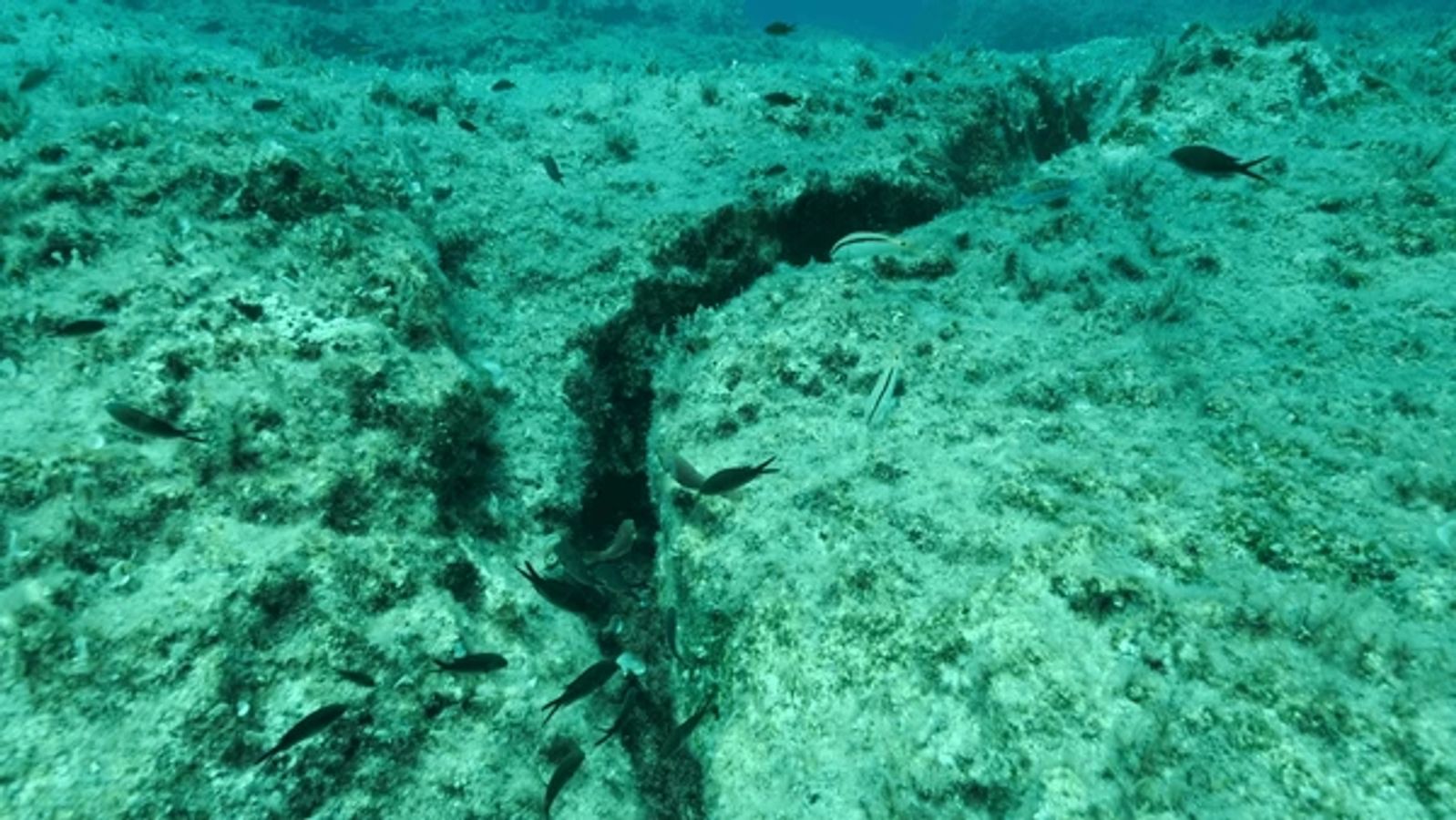
A fault roughly 75 kilometers long is actively ripping the plate apart. In one spot, a section of seafloor has already dropped five kilometers along a single crack — a wound in the planet’s crust, opening in real time.
The detail that gives scientists chills
The lead researcher described it with an image that’s hard to shake: it’s like watching a train slowly derail — one car at a time.

Geologists have always known, in theory, that subduction zones eventually die. They don’t last forever; they fail, stall, and break. But knowing something happens and watching it happen are two very different things. Until now, no one had ever had a front-row seat to a subduction zone in the act of failing.
Reading a story that used to be only fossils
Here’s why it matters so much. The remnants of dead subduction zones are preserved in mountain ranges all over the world — fragments of ocean crust that disappeared into the Earth eons ago. For generations, scientists have studied those stone “fossils” and tried to guess how the systems ended.
Now they don’t have to guess.
For the first time, the ending is playing out on instruments in front of them — a living version of a process they’d only ever read backward from the rocks.
Should you worry?
No — and this is important. This is not a looming disaster. Each piece of the plate takes millions of years to break away. Nothing about this threatens a sudden quake or a coastline tomorrow.
What it threatens is something gentler and stranger: our sense of scale.
Why it humbles us
This is the planet remaking itself in deep time — a process so vast that the entire span of human civilization is too brief to register as even a pause within it. Empires, languages, every story we’ve ever told: a flicker, against the slow tearing of a plate.
And yet, for one moment, we get to witness it. We built machines, dropped them to the bottom of the sea, and learned to see the Earth breathing on a timescale we can barely comprehend.
So here’s the thought to sit with. The planet has been doing this for billions of years, in the dark, without an audience. The only thing that’s new… is us, finally learning how to watch.
What does it say about us that we’ve only just opened our eyes to this? 👇 Tag someone who needs their sense of scale rearranged.