For generations, the great mystery of Easter Island was not who built the statues — it was how they moved. The moai of Rapa Nui, those immense stone figures with their elongated heads and stoic expressions, were carved deep inland and somehow transported across kilometres of rugged volcanic terrain to stand on platforms along the coast. No one seemed to know how it was done.
No one, that is, except the people who had always lived there. The Rapa Nui themselves had a simple answer: the statues walked.
For a long time, scholars dismissed this as mythology. Then researchers actually tested it — and found out the islanders were telling the truth.

## The Island at the Edge of the World
Rapa Nui, known in the West as Easter Island, sits in the southeastern Pacific Ocean roughly 3,700 kilometres off the coast of Chile — one of the most remote permanently inhabited places on Earth. The Polynesian ancestors of today’s Rapa Nui people arrived sometime between 700 and 1200 CE, crossing thousands of kilometres of open ocean in outrigger canoes guided by stars, currents, and the accumulated navigational knowledge of generations.
What they found was a small volcanic island, roughly 163 square kilometres, rich in bird life and relatively well forested. They built a society. They developed their own script — Rongorongo, one of the world’s few independently invented writing systems. And they began carving the moai.
## The Statues of Rano Raraku
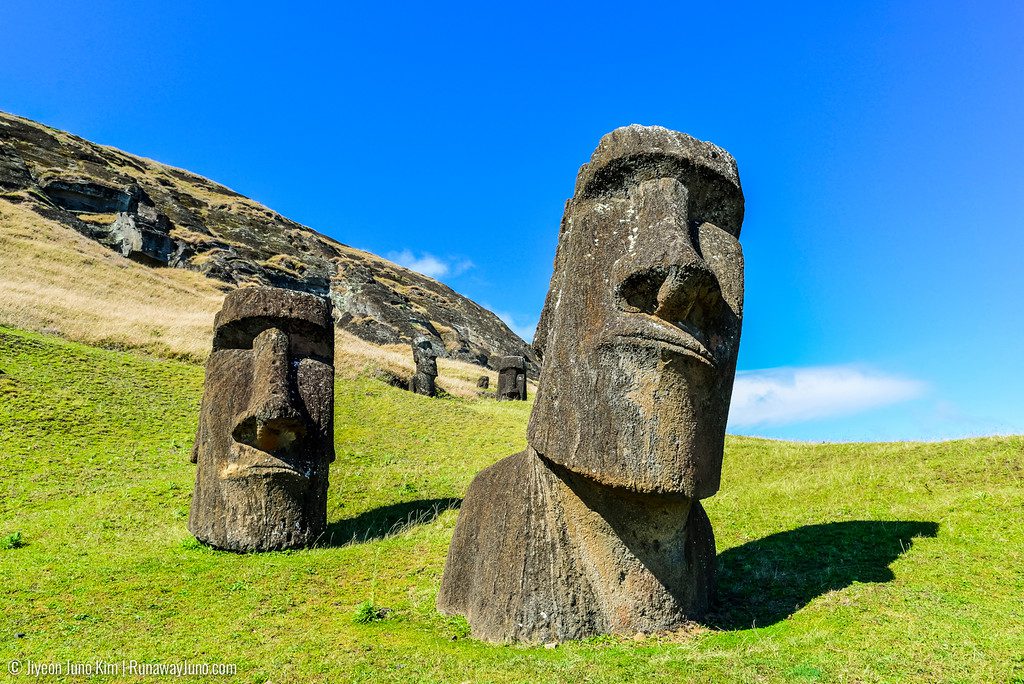
There are approximately 900 moai on Rapa Nui, in various states of completion and preservation. The vast majority were carved from a single source: the volcanic tuff of Rano Raraku, a crater on the eastern side of the island. The rock there is relatively soft and easy to carve with basalt hand picks — yet hard enough to hold fine detail and survive for centuries in the open air.
The moai range dramatically in size. The average statue stands about 4 metres tall and weighs around 13 tonnes. But the largest completed and transported moai — known as Paro — stands nearly 10 metres tall and weighs approximately 75 tonnes. The tallest moai ever carved, still lying unfinished in the quarry, measures over 21 metres and would have weighed an estimated 270 tonnes had it ever been completed.
Carving them was an extraordinary achievement. Moving them was something else entirely.

## The Roads Nobody Understood
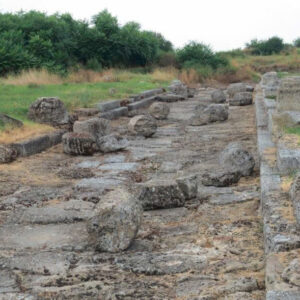
Between the quarry at Rano Raraku and the coastal platforms where the moai stood, researchers found evidence of ancient roads. These were not typical roads — they were deliberately constructed pathways, wider than necessary for simple foot traffic, with strangely rounded edges. For years their exact purpose was debated.
The platforms themselves, called ahu, were equally impressive feats of engineering. The moai stood atop them with their backs to the sea, facing inland toward the villages they were believed to protect. Most had their eyes inlaid — white coral for the sclera, red scoria for the iris — giving them a startlingly lifelike gaze when completed.
During the 18th century, inter-clan warfare devastated Rapa Nui. Most of the standing moai were deliberately toppled, their eyes destroyed. European contact brought further catastrophe: slave raids, introduced disease, and ecological collapse reduced the island’s population from perhaps 15,000 at its peak to fewer than 200 by the 1870s. The knowledge of how the moai had been moved nearly died with the people who carried it.
Nearly — but not entirely.
## “They Walked”
When ethnographers and archaeologists began recording Rapa Nui oral traditions in earnest during the 20th century, they consistently encountered the same explanation for how the statues had been transported: the moai walked. The elders described statues moving upright, swaying side to side as they progressed along the roads. The mana — the spiritual power — of the statues was said to have animated them.
Most outside researchers treated this as colourful legend. The mainstream theories proposed that the moai had been laid horizontally on wooden sledges, hauled by teams of workers using ropes, rollers, and sheer collective labour. Experiments with this method proved possible but inefficient, requiring enormous numbers of people and consuming large quantities of wood — resources that the island would have struggled to supply.
Then, in 2012, archaeologists Carl Lipo of Binghamton University and Terry Hunt of the University of Hawaii decided to take the oral tradition seriously and test the walking hypothesis directly.
## The Experiment That Changed Everything
Lipo and Hunt constructed a 4.35-tonne concrete replica of a moai — roughly one-third the weight of an average real statue — and rigged it with three ropes: two attached to either side and one at the back. With a team of just 18 people, they began to move it.
The technique they used was exactly what the Rapa Nui tradition described. The two side teams pulled alternately, causing the statue to rock from foot to foot in a swaying motion. The back rope controlled the lean, preventing the statue from tipping forward. The statue did not slide or roll — it walked, pivoting on its base and lurching forward with each rock.
In roughly 40 minutes, the team moved the replica 100 metres.
The implications were immediate and significant. This method required far fewer people than the sledge-and-roller approach — a realistic workforce for a community of the size Rapa Nui likely had. It required no wood for rollers or sledges, preserving the island’s timber. And it explained features of the moai that had previously seemed puzzling.

## Designed to Walk
Once researchers knew what to look for, the evidence that the moai had been designed for walking became clear.
The bases of the moai are not flat. They have a distinctive D-shape — curved on the bottom and slightly forward-leaning — that makes no sense for a statue intended to lie on its back during transport but works perfectly as a pivot point for the walking motion. The statues are also notably top-heavy, with their large heads and prominent brows creating a forward centre of gravity that, combined with the D-base, naturally facilitates the rocking gait.
The ancient roads of Rapa Nui, with their strange rounded edges and carefully prepared surfaces, appear to have been built specifically to accommodate walking moai. The rounded verges would have guided the base of a swaying statue, keeping it on track and preventing the wide rocking arcs from sending it off course. The roads were, in essence, channels designed to cradle giants in motion.
## The Oral Tradition Was Right
The walking hypothesis did not replace all other theories entirely. Some researchers believe different methods may have been used for different statues at different times, and the academic debate continues. But the 2012 experiment demonstrated conclusively that the walking method was not only plausible but efficient — arguably the most efficient method yet tested.
What the experiment also demonstrated was something broader and more important: that Rapa Nui oral tradition had preserved accurate technical memory across many generations. The knowledge of how the moai were moved was not lost — it was encoded in the living tradition of the people who built them, waiting for researchers willing to listen.
This pattern is not unique to Easter Island. Across the world, indigenous oral traditions have repeatedly been found to contain precise geological, astronomical, and ecological information preserved across hundreds or thousands of years. The dismissal of such traditions as “myth” has cost researchers decades of insight.
The moai of Rapa Nui walked because their builders designed them to walk, built roads for them to walk on, and remembered — generation after generation, through catastrophe and near-extinction — exactly how it was done.
The statues never stopped moving. We just stopped listening.