Approximately 8,500 years ago, a group of people stood on a coastline — most likely in Sicily, or perhaps somewhere along the North African shore — and looked out at the sea. In front of them was more than 100 kilometres of open water. There was no visible land on the other side. There were no sailing ships. There were no maps. There was, in all likelihood, no one who had ever made this crossing before.

They got in their boats anyway.
What they found when they arrived was an island no human being had ever set foot on: a place of extraordinary life — pygmy hippopotamuses, dwarf elephants, enormous flightless birds — a world that had evolved in complete isolation from the mainland for millions of years.
They were the first people of Malta. And the story of how they got there, and what happened when they did, is one of the most remarkable in all of prehistory.
## An Island That Waited
Malta sits in the central Mediterranean, roughly equidistant between Sicily to the north and the North African coast to the south. Its nearest neighbour, Sicily, is approximately 93 kilometres away. This gap is not enormous by modern standards — a few hours by ferry — but in the context of 8,500 years ago, before any sailing technology had been developed, it was a formidable barrier.
Unlike Sicily, which shows evidence of human presence stretching back at least 20,000 years, Malta has no record of occupation before approximately 6,500 BCE. The island simply waited, uninhabited, through the entire Upper Palaeolithic period and the early Mesolithic, while human populations spread across Europe, Asia, Africa, and eventually into the Americas.
Why it remained unoccupied for so long is not fully understood. One possibility is that the open-water crossing was simply beyond the capability of very early seafarers — that it required not just vessels capable of making the distance but navigational knowledge, planning, and motivation that took thousands of years of coastal seafaring experience to develop.
Whatever held people back eventually gave way. Around 8,500 years ago — the evidence from the site called Għar Dalam, the Cave of Darkness, suggests this date — someone made the crossing.
Għar Dalam: The Cave of Darkness

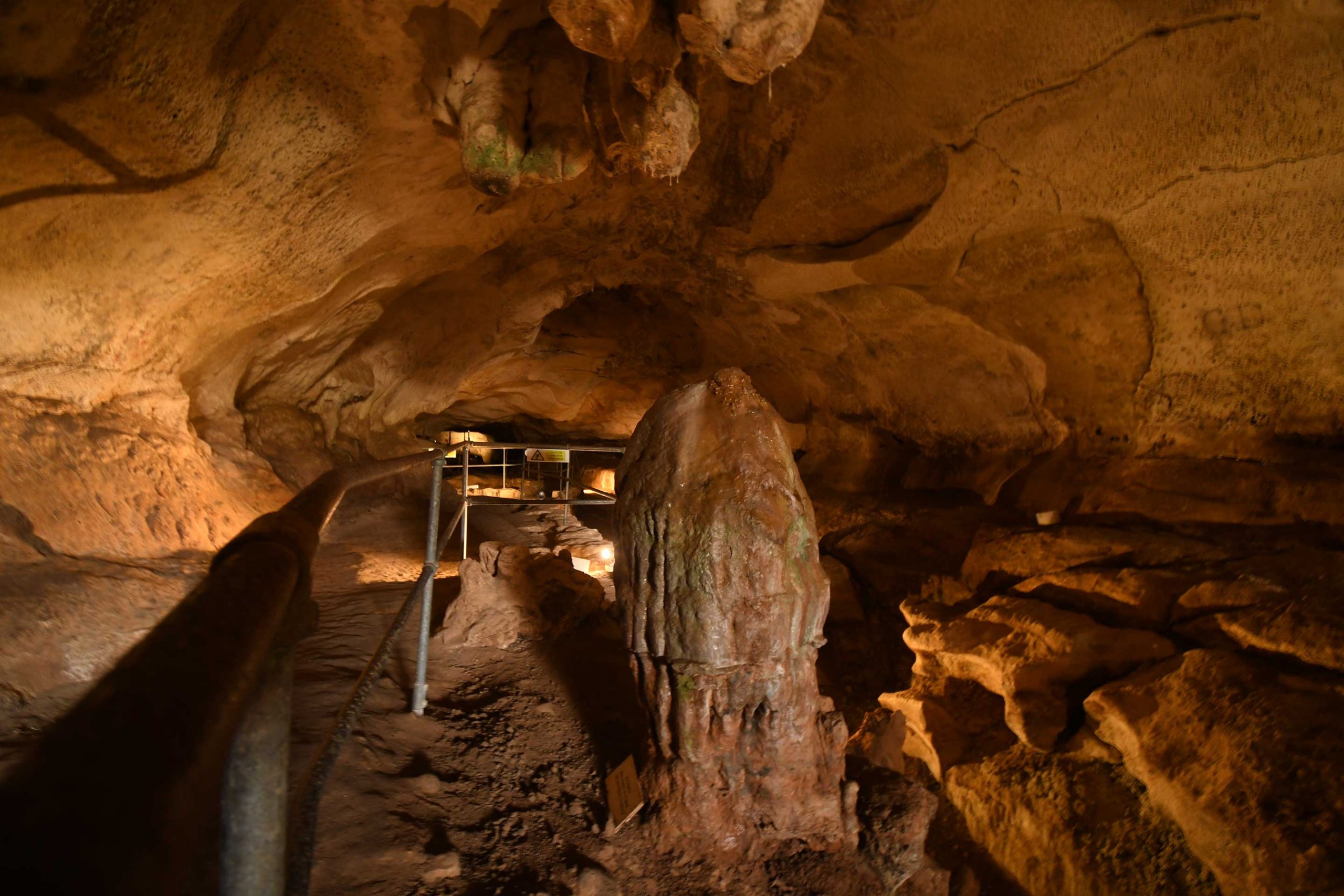
The most important window into Malta’s prehistoric past is a cave on the southeastern coast of the island called Għar Dalam — in Maltese, “the Cave of Darkness.” It is a natural limestone cave approximately 144 metres deep, and its floor sediments contain one of the most remarkable archaeological and palaeontological records in the Mediterranean.
The lower layers of the cave’s sediment are filled with bones of animals that no longer exist anywhere: **pygmy hippopotamuses** — a dwarf species that evolved on the island from mainland hippos that swam out during a period when sea levels were lower — **dwarf elephants**, and **giant birds**, including species of swan and crane that, isolated from mainland predators, had grown to extraordinary sizes. These creatures had lived on Malta for tens of thousands of years, evolving in peaceful isolation into forms found nowhere else on Earth.
The upper layers of Għar Dalam tell a different story. They contain the bones of red deer (not native to Malta, brought by humans), domesticated animals, and the stone tools and pottery fragments of the island’s first human inhabitants. The Għar Dalam phase of Maltese prehistory is dated from approximately 5,200 to 4,500 BCE — but the earliest evidence of human presence on the island predates even this, with genetic and archaeological evidence suggesting hunter-gatherers arrived around 6,500 BCE.
The timing is significant. The giant birds and pygmy megafauna of Malta disappear from the fossil record at almost exactly the point when humans arrive. The extinction of Malta’s unique fauna happened swiftly — on geological timescales, almost instantaneously — following the first human footfall.
The Crossing

Calculating what the crossing actually demanded has been an exercise in both archaeology and physics.
The most recent reconstructions suggest that a group of prehistoric seafarers making the crossing from Sicily to Malta in a dugout canoe or comparable vessel — the best technology available at the time — would have faced a journey of somewhere between 10 and 16 hours of continuous rowing, depending on conditions. Wind and current in the central Mediterranean are highly variable. An unfavourable headwind or current could extend the journey significantly or push a vessel off course entirely.
On the longest day of the year, Malta receives approximately 16 hours of daylight. A crossing beginning at dawn might, under good conditions, reach Malta before dusk. Under less favourable conditions, some portion of the crossing would be in darkness.
Some researchers have proposed that the crossing was made intentionally at night — using stars for navigation, as later Mediterranean and Polynesian seafarers did — or that it was made during particularly calm conditions in summer, when the sea between Sicily and Malta is at its most forgiving. Others have noted that strong swimmers and experienced coastal paddlers would have been able to read currents and maintain direction even without landmarks, using the position of the sun or the direction of swell.
What is clear is that the crossing was not accidental. The people who reached Malta were not blown there by a storm. They arrived, and they survived, and they eventually brought with them the animals and seeds that allowed them to establish a permanent presence. This was a planned, deliberate, sustained migration — the kind of undertaking that required significant preparation, knowledge of the sea, and a degree of collective decision-making that speaks to the sophistication of hunter-gatherer society in ways that earlier frameworks of prehistory tended to underestimate.
## What They Found
The Malta that greeted the first arrivals was dramatically different from the Malta of today.
It was largely forested — a landscape of Aleppo pine, oak, and wild olive that has been almost entirely replaced by agriculture and settlement over the millennia since. It had fresh water. It had extensive coastline rich in fish and shellfish. And it had the extraordinary megafauna: the small hippos that grazed the meadows, the dwarf elephants that browsed the scrubland, the great flightless birds.
These animals, having evolved in the complete absence of human predators for hundreds of thousands of years, would have had no fear response to humans. The first settlers would have walked among them freely. They were, in a sense, stepping into a paradise — an island that had never known hunters.
The megafauna did not survive the encounter. The extinctions followed with the same brutal efficiency that has characterised human arrival on island ecosystems from the Pacific to the Caribbean to Madagascar. Whether through direct hunting, habitat modification, the introduction of mainland animals that outcompeted the island species, or some combination of all three, Malta’s unique pre-human fauna vanished within centuries of first contact.
## The Legacy
The hunter-gatherers who made the crossing around 8,500 years ago did not build the famous temples of Malta — the Ggantija complex, the Hagar Qim, the Mnajdra — which came much later, constructed by their descendants over a period beginning around 3,600 BCE. But they began the human story of the island, and from that first, extraordinary act of open-sea navigation, the remarkable Maltese civilisation would eventually emerge.
What drove those first seafarers into the dark — curiosity, necessity, pressure from competing groups on the mainland, the report of a distant land brought back by a scout — we do not know. We only know that they did it. That they paddled out of sight of land and kept going. That they found what they were looking for.
It was 8,500 years ago. It was one of the most audacious journeys ever made. And it ended on a shore where no human being had ever stood before.