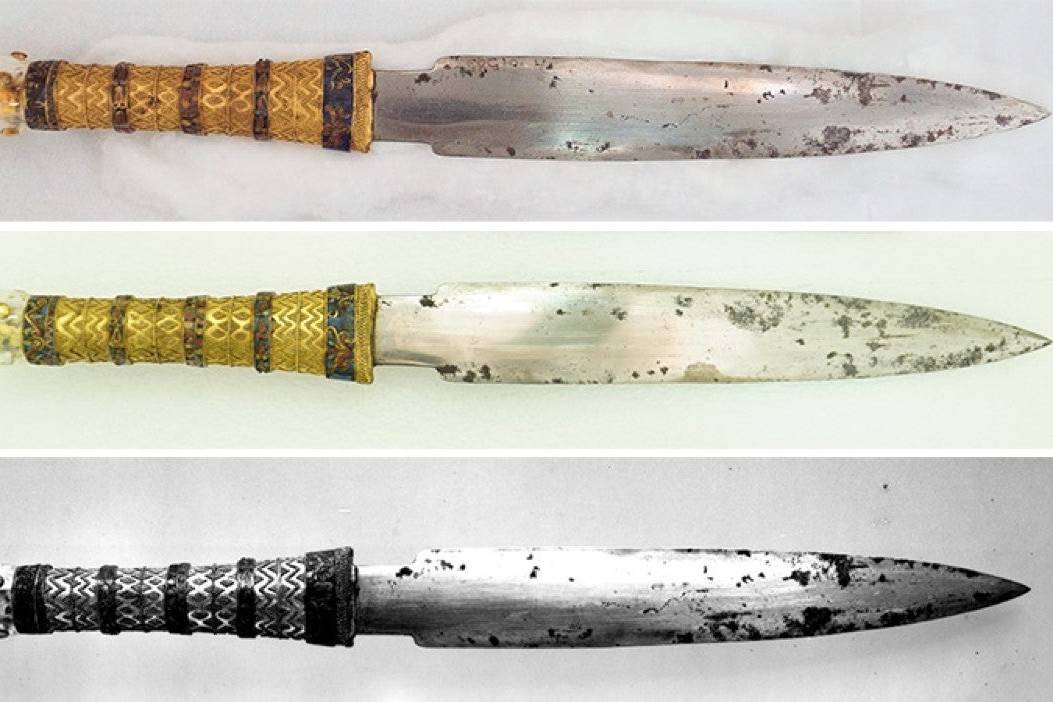
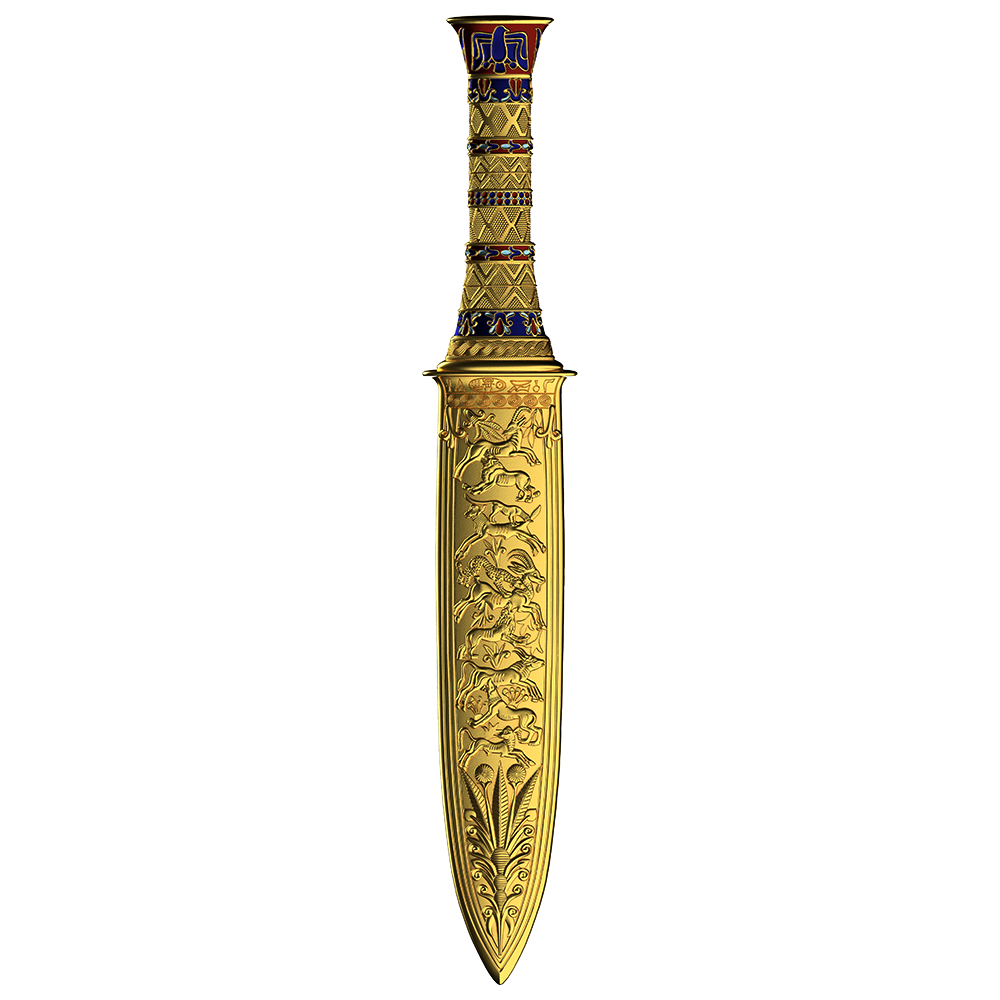
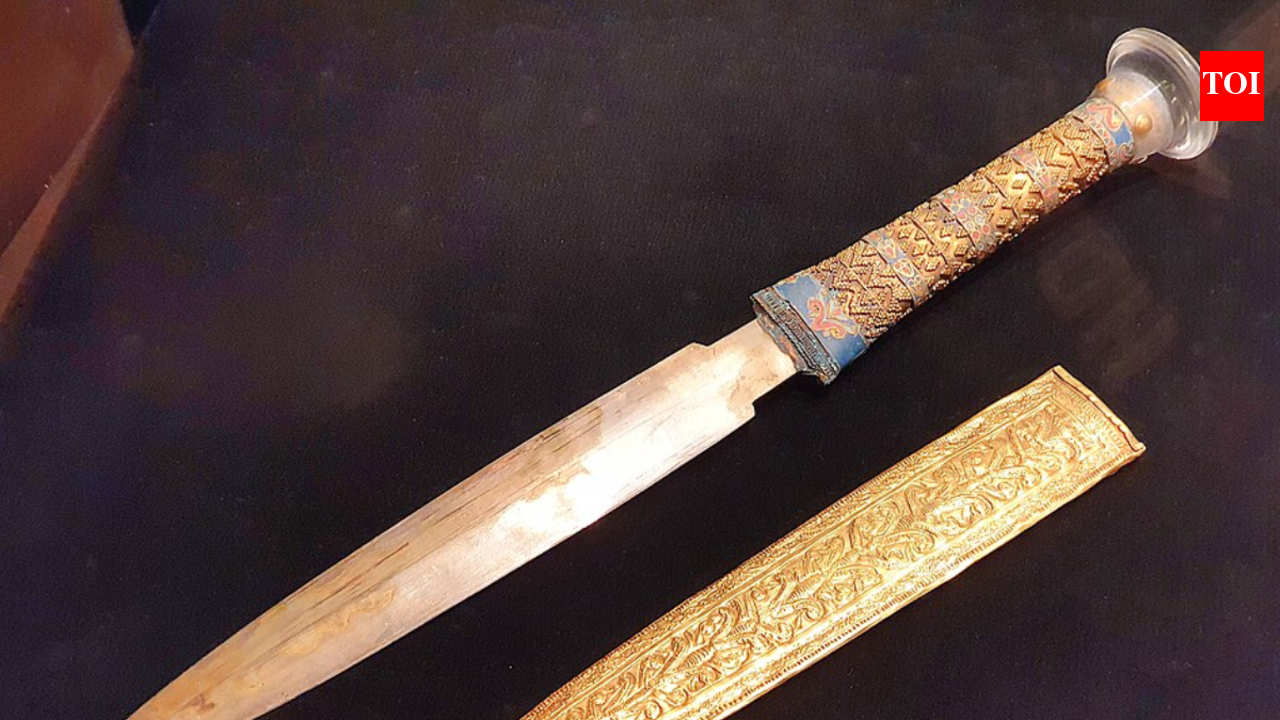
In the gold-choked dark of a sealed tomb, where everything is built to glow, there is one object that refuses to behave. A dagger lies against the body of a boy king, and where it should be eaten by three thousand years of corrosion, the blade is clean. The iron has not rusted. It sits there, dark and intact, as if the centuries simply declined to touch it.
Everything around it was made to last forever. Somehow, this small blade actually did.
## What We Were Told
The tomb of Tutankhamun is the story everyone knows. A young pharaoh, a near-intact burial, treasures piled in gold and lapis and alabaster. For generations, the dagger was just one more item in that staggering inventory, a beautiful weapon resting with a king.
But iron tells on itself. Over thousands of years, ordinary iron oxidizes, flakes, and crumbles toward dust. That is simply what it does in the company of air and time. So a smooth, unrusted iron blade from that era was always quietly strange, a small wrongness in the catalogue that waited a long time for anyone to ask the obvious question.
Where did this metal come from, and why has it survived so much better than it should have?
## What Was Found
When scientists eventually turned modern analysis on the blade, the answer was not subtle.
The iron, reportedly, carried an unusual chemical signature, a high content of nickel along with cobalt, in proportions that don’t match ordinary iron ore pulled from the ground. That particular fingerprint points somewhere very specific. It points up.
Meteoritic iron, the metal of certain meteorites that survive their fall to Earth, characteristically carries exactly that kind of nickel-rich signature. Based on the analysis, researchers concluded the dagger was most likely made from meteoritic iron, metal that had fallen from the sky before it was ever shaped into a weapon for a king.

**A teenage pharaoh was buried holding a piece of a fallen star, carved into a blade.**
## The Detail That Changes Everything
Here is the part that makes it stranger than a simple curiosity.
This dagger appears to predate the era when Egyptians were smelting iron from ordinary ore on any wide scale. In other words, the blade existed in a world that had not yet mastered making iron the usual way, by mining and working terrestrial ore.
So the metal did not come from a furnace and a mine. It came from the sky, already iron, delivered as a gift from nowhere a human could climb to. Someone recognized that this strange, heavy, sky-born material could be worked, and they shaped it into something fit for a pharaoh. The blade was not just rare. It was, in a real sense, the only kind of iron treasure that era could have produced at all.
## The Central Mystery
What we cannot fully recover is what it meant to them.
To people who had no concept of meteorites as we understand them, metal that fell flaming from the heavens would have been profoundly charged with meaning. It arrived from the realm of the gods. It did not rust like earthly things. It was harder and stranger than anything they could dig up.
It is reasonable to imagine, though impossible to prove, that such sky-metal was treated as sacred, perhaps the most sacred metal of all. Burying it with a king, sending him into the afterlife armed with a fragment of the heavens, would have made a certain kind of perfect sense. But the exact beliefs that surrounded the blade are not something we can state with certainty. We have the object. The reverence around it we can only infer.
## Competing Theories
Researchers generally agree on the meteoritic origin of the metal, but other questions remain genuinely open.
One view holds that the dagger was an Egyptian creation, sky-iron sourced locally or regionally and worked by craftsmen who prized its rarity. Another possibility, often discussed, is that such an extraordinary object could have arrived as a diplomatic gift from elsewhere, an offering from another court, given the value placed on rare metals in the ancient world.
There is also debate about just how unusual the working of meteoritic iron really was. Some argue that sky-metal items, while rare, were known across several ancient cultures, suggesting the dagger is a spectacular example of a wider practice rather than a complete one-off. The truth likely sits somewhere among these, and no single account closes the case.
## Why It Still Haunts Us
The blade endures because it collapses two enormous distances at once.
There is the distance of time, the three thousand years between that boy king and us. And there is the distance of space, the unknowable gulf the iron crossed before it ever reached human hands. In one small object, the cosmic and the human touch.
It also reframes how we picture the ancients. Here were people who looked up, saw something fall, and instead of only fearing it, retrieved it, understood it as precious, and made it part of how they sent a king into eternity. That is not superstition alone. That is curiosity and craft.
A piece of the sky, in the hand of a child who ruled an empire and died young. What would you make from a star, if one landed at your feet?
Tag someone who never knew King Tut was buried with a space dagger.