For decades, a remote mountain in northwestern Saudi Arabia has fueled one of the most controversial debates in biblical archaeology. Could Jebel al-Lawz be the real Mount Sinai described in the Book of Exodus—or is it simply another ancient mountain surrounded by compelling legends?
Quick Facts
| Fact | Details |
|---|---|
| Site | Jebel al-Lawz |
| Location | Northwestern Saudi Arabia |
| Elevation | Approximately 2,580 meters (8,465 ft) |
| Proposed Identity | Mount Sinai (according to some researchers) |
| Mainstream View | Unconfirmed and widely debated |
| Status | One of biblical archaeology’s greatest mysteries |
A Mountain Wrapped in Mystery


Caption: Jebel al-Lawz has become one of the most debated mountains in biblical archaeology.
For centuries, Christian tradition has identified Mount Sinai with a mountain on Egypt’s Sinai Peninsula. However, in recent decades, another location has captured the imagination of researchers and biblical historians.
Jebel al-Lawz, located in northwestern Saudi Arabia, has been proposed by some researchers as the true Mount Sinai described in the Book of Exodus.
Supporters argue that several remarkable features surrounding the mountain closely match the biblical account. Critics, however, maintain that the evidence remains inconclusive and that no archaeological consensus has been reached.
The Blackened Summit


Caption: The mountain’s dark summit is one of the strongest arguments cited by supporters of the theory.
One of the most striking features of Jebel al-Lawz is its dark-colored summit.
According to Exodus 19:18, Mount Sinai was covered with smoke because God descended upon it in fire.
Some researchers believe the blackened rocks are physical evidence of that extraordinary event.
Most geologists, however, offer more conventional explanations, suggesting the dark coloration may result from natural weathering, desert varnish, or the composition of the mountain’s rocks rather than evidence of an ancient supernatural fire.
At present, no geological study has confirmed that the summit was burned in the manner described in Exodus.
The “Golden Calf Altar”


Caption: Ancient cattle carvings are frequently associated with the proposed “Golden Calf Altar.”
Near the base of the mountain stands a large stone enclosure commonly referred to by supporters as the “Golden Calf Altar.”
Nearby rocks display numerous carvings of cattle.
Because the Book of Exodus describes the Israelites worshipping a golden calf while Moses was on Mount Sinai, some researchers believe these carvings preserve evidence of that biblical event.
Mainstream archaeologists remain cautious.
Similar cattle carvings appear throughout Arabia and are associated with various ancient cultures. No inscription or securely dated artifact has directly linked these carvings to the Israelites.
Ancient Structures Around the Mountain


Caption: Several ancient stone structures continue to attract archaeological interest.
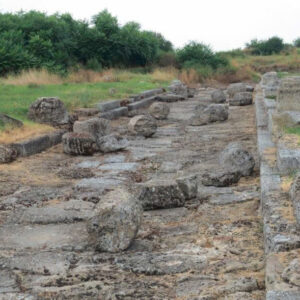
Supporters also point to stone walls, enclosures, and other ancient structures surrounding Jebel al-Lawz.
Some suggest these features resemble the encampment described in Exodus.
Others have proposed that nearby remains of fire pits or furnaces may have been used to melt gold for the construction of the golden calf.
To date, however, none of these interpretations has been confirmed through peer-reviewed archaeological evidence.
Further excavation and scientific dating would be required before any connection to the Exodus could be established.
What Does Archaeology Actually Say?


Caption: Most archaeologists consider the evidence interesting but not conclusive.
This is where the debate becomes most important.
Although Jebel al-Lawz has received widespread attention, most biblical archaeologists do not consider the mountain’s identification as Mount Sinai to be proven.
Their reasons include:
- No inscription identifying the mountain as Sinai.
- No securely dated evidence linking the site to the Israelites.
- Many claims rely on circumstantial rather than direct archaeological evidence.
- Other proposed locations for Mount Sinai remain under investigation.
In archaeology, extraordinary claims require extraordinary evidence.
So far, that level of evidence has not been found.
A Mystery That Continues to Fascinate

Caption: Whether or not it is Mount Sinai, Jebel al-Lawz remains one of the Middle East’s most intriguing archaeological landscapes.
Whether Jebel al-Lawz ultimately proves to be the biblical Mount Sinai or not, it continues to inspire research, exploration, and debate.
Future archaeological discoveries—or the absence of them—may eventually settle the question.
Until then, the mountain stands at the crossroads of history, faith, and science, reminding us that some of the world’s greatest mysteries are not solved by belief alone, but by patient investigation and evidence.