Just outside Denver, a road curves past a slab of tilted rock. Cars pass it every day. Almost no one stops. But the face of that rock is covered in footprints — real ones, pressed into mud when dinosaurs walked here. Not carvings. Not casts behind glass. The actual steps, standing upright at the roadside. How does a dinosaur’s footprint end up vertical, beside a modern road?

Quick Facts
| Site | Dinosaur Ridge, Morrison, Colorado (west of Denver) |
| What | Hundreds of dinosaur footprints in exposed rock |
| Track age | About 100 million years (Cretaceous) |
| Nickname | Part of the “Dinosaur Freeway” |
| Also found | Jurassic dinosaur bones on the same ridge |
| Scientific consensus | Genuine trackway; exact trackmakers interpretive |
What We Were Told
We are used to meeting dinosaurs at a distance. Mounted skeletons under museum lights. Bones roped off behind glass. Assembled, curated, kept apart from ordinary life. And Colorado’s Front Range is a place of ski trips, hiking trails, and Denver traffic. The idea that a plain road cut might open onto the exact surface a living dinosaur crossed is not something most drivers ever imagine.
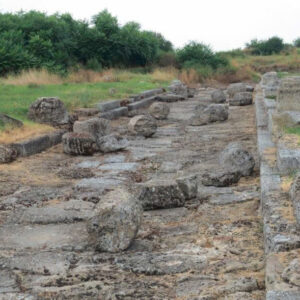
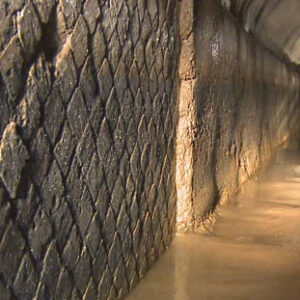
Image caption: The tilted rock face of Dinosaur Ridge, standing beside the roadway.

What Was Found
At Dinosaur Ridge, near Morrison, a single exposed layer of rock preserves hundreds of dinosaur footprints. Around 100 million years ago, this was a muddy flat along the shore of a shallow inland sea. Plant-eating dinosaurs crossed it in numbers, and the predators trailing them pressed prints into the same soft ground. The mud dried, hardened, and was buried, turning to stone. Then the rise of the Rocky Mountains tilted the once-flat layers on end — lifting that ancient surface, tracks and all, into the near-vertical wall you see today.
These are not replicas — they are the genuine impressions of dinosaurs, exactly where the animals set their feet.
Image caption: A close view of three-toed tracks pressed into the ancient mudstone.
The Detail That Changes Everything
The tracks here are not an isolated curiosity. They lie along what geologists nicknamed the “Dinosaur Freeway” — a corridor of similar footprint sites stretching hundreds of miles, marking a coastal route traveled so heavily that generations of dinosaurs effectively wore a path along the ancient shoreline. And there is a second layer to it: the same ridge, in its older Jurassic rock, has produced famous dinosaur bones, making this hillside one of the landmark fossil grounds of the American West. Footprints from one age, bones from another — on the same slope.
Image caption: Map or diagram of the “Dinosaur Freeway” trackway corridor.

The Central Mystery
For all we can read here, the rock keeps its secret. Matching a footprint to the exact animal that made it is famously hard — a print records a foot in motion, not a skeleton — so many tracks can only be tied to broad groups: a large plant-eater here, a three-toed hunter there. We can often say what kind of dinosaur passed, and which way it was heading, but rarely exactly who. You can lay your hand in a hollow a dinosaur pressed into the earth and still not know its name.
Image caption: A visitor’s hand resting inside a fossilized footprint.
Competing Theories
The details invite debate. Track ages and the precise limits of the “Dinosaur Freeway” are refined as new sites are studied, and the trackmakers behind many prints stay interpretations rather than certainties. Even the behavior the surface seems to record is argued over — whether some trackways show genuine herding, or simply many animals crossing the same convenient ground across long spans of time. On the core science, though, researchers agree: these are authentic Cretaceous dinosaur tracks, and the surrounding rock is read as a real ancient shoreline — the uncertainty is about which dinosaurs, not whether.

Why It Still Haunts Us
There is something almost unfair about how close it is. No expedition, no dig, no permit — just a road, a rock, and a hundred-million-year gap you can close with an outstretched hand. Museums teach us to admire dinosaurs from behind a rope; this roadside lets you touch the very spot where one set down its foot and moved on, long before there were mountains here, or roads, or us. What would it change in you, to stand with one hand on your car and the other in a dinosaur’s footprint?