It was a baby. One or two weeks old, barely a meter tall at the shoulder, still with its fur and its skin and its face.
And it had been lying in the Siberian permafrost for forty-two thousand years — through the entire Ice Age, through the rise and fall of everything human, thirty meters down in frozen ground. When scientists finally opened it up, they found something that should not be possible after four hundred centuries: blood. Still liquid. Inside its veins. The oldest liquid blood ever found on Earth — and it came out of a foal that never grew up. How does anything stay liquid for 42,000 years?

Quick Facts
| What | The Lena foal — a baby horse of the extinct Lenskaya breed |
| Age | About 42,000 years old |
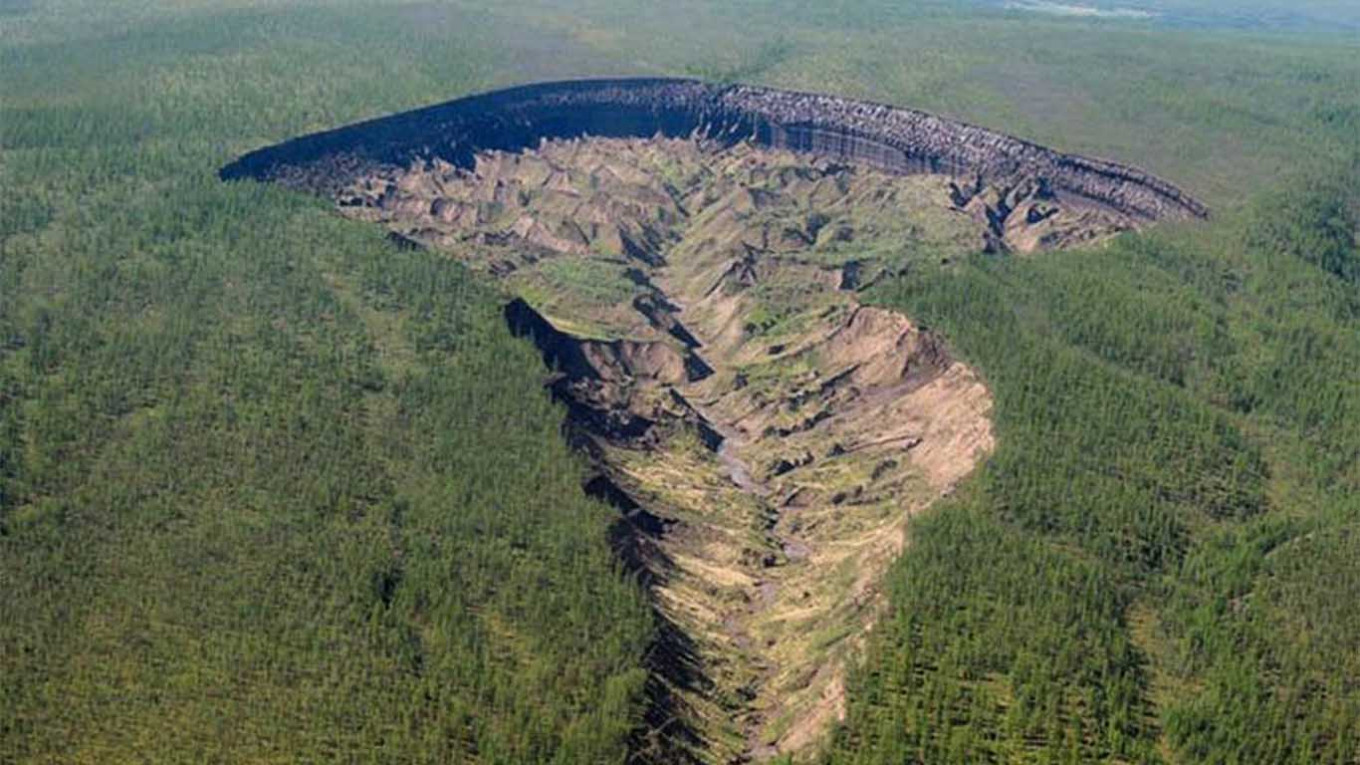
| Found | August 2018, at 30 m depth in the Batagaika crater, Yakutia, Siberia |
| Size | Just 1–2 weeks old, about 98 cm at the shoulder |
| Preserved | Skin, fur, muscle tissue — and internal organs |
| The stunner | Scientists extracted liquid blood and urine — the oldest liquid blood on record |
What We Were Told
Fossils are stone. That’s the deal we’ve made with deep time: the flesh rots, the blood dries, and if anything survives at all it’s bone slowly turned to rock. Forty-two thousand years should leave nothing but a skeleton, if that. The idea of reaching into an Ice Age animal and drawing out liquid blood belongs in a movie, not a lab.
The Siberian permafrost didn’t get the memo.
Image caption: The Batagaika crater in Yakutia, where the permafrost gave up the foal.

What Was Found
In August 2018, researchers working in the Batagaika Depression — a vast collapsing scar in the Siberian permafrost — dug down about thirty meters and found a horse. Not bones. A horse. A foal of the Lena horse, a species now extinct, so complete that it still had its skin, its fur, its muscle, and its organs. It had been one or two weeks old when it died, standing 98 centimeters at the shoulder — a newborn, frozen mid-life for 42,000 years.
Then a team from Russia’s North-Eastern Federal University, working with South Korea’s Sooam Biotech, went further and did something extraordinary.
They extracted liquid blood from its veins — the oldest liquid blood ever recovered, beating the previous record by 10,000 years.
Image caption: The Lena foal, its coat and skin preserved by the permafrost.

The Detail That Changes Everything
And then they tried to bring it back. With cells potentially viable, the team set out to clone the Lena horse — to resurrect an extinct species from a baby that died before humans reached the Americas. It is exactly the kind of thing that sounds like science fiction until you read the lab notes. But the attempt ran into a wall: more than twenty tries to grow living cells from the foal’s tissue, and every single one failed. Forty-two thousand years of ice can keep a body looking alive. It cannot keep the cells willing to live again.
The Central Mystery
So what killed it? Here the truth is quieter, and sadder, than any legend. The foal drowned in mud. No cataclysm, no mysterious flash-freeze, no sudden event that “stopped time” — just a newborn animal that got stuck in soft ground and couldn’t get out, then was buried and locked into the cold. That’s the whole story. The permafrost did the rest, patiently, for four hundred centuries. Sometimes the deepest mystery isn’t how something ended, but how much of it the earth decided to keep.
Image caption: A vial of the dark liquid blood recovered from the foal.
Competing Theories
Two honest notes belong here. First, the “de-extinction” dream is real but far from proven — the failed cell attempts show that even spectacular preservation doesn’t hand you a living animal, and scientists disagree about whether cloning Ice Age species is achievable, or even wise. Second, the viral versions of this story like to hint at some catastrophic event that froze the creature alive. There wasn’t one. Permafrost preservation is well understood and needs no mystery: an animal dies, cold ground buries it, and the ice does the rest. What’s not in dispute is the astonishing part — liquid blood, after 42,000 years.
Why It Still Haunts Us
There’s something about the fact that it was a baby. Not a mammoth patriarch or a great predator — a foal, a week or two old, that stumbled into mud on an ordinary day 42,000 years ago and never got out. The world it was born into vanished. Every human it might have been seen by is gone. And it is still here, with its fur and its face and its blood, waiting in a lab. If the earth can keep a newborn perfectly for 42,000 years, what else is lying in the ice right now — and should we be trying to wake it?
Sources & further reading: The Lena foal, discovered August 2018 at ~30 m depth in the Batagaika crater, Yakutia, Siberia; dated ~42,000 years; liquid blood and urine extracted by North-Eastern Federal University with Sooam Biotech — the oldest liquid blood on record; the foal drowned in mud; cloning attempts have so far failed. Reported by Smithsonian, Live Science, CNN, and Gizmodo (2019).