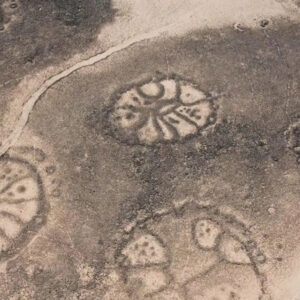
Hot wind scours the empty expanse of the Tenere. Whiteness blinds the eye as fine quartz grit cuts across bare stone. Then, the storm dies. Under cold morning light, satellite lenses resolve an anomaly that should not exist. A silhouette etched into bedrock. Immense. Symmetrical. Silent.
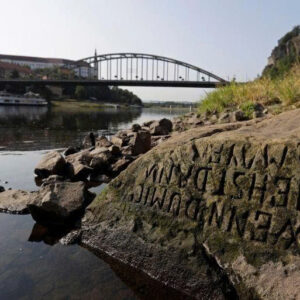
Image caption: High-resolution satellite view of ridge formations in the Central Sahara Desert after a severe dust storm.

Quick Facts
| Field | Detail |
| Legend / Subject | The Sahara Giant Fossil / 80-Meter Skeleton Claim |
| Earliest Source | 21st-century online creepypasta & viral speculative folklore |
| Key Artifact | Anomalous satellite formation resembling an 80m human skull |
| Location | Central Sahara Desert (Algeria/Niger border sector) |
| Mechanism / Claim | Extreme erosion uncovered an ancient mineralized titan skeleton |
| Scientific Consensus | Geological pareidolia involving yardangs and eroded wind-sculpted sandstone |
What We Were Told
For years, whispered narratives across internet forums claimed that a six-hour desert tempest exposed a massive skeletal anomaly in the remote Sahara. According to these persistent accounts, updated satellite imagery revealed an eroded formation measuring over 80 meters wide that mirrored human cranial anatomy. Rumors suggested that rapid military deployments halted private drone operations, that carbon dating failed due to complete mineralization, and that a redacted monastic manuscript in Egypt foresaw the burial of the “last titan.”
Image caption: Wind-eroded sandstone yardangs towering above the desert floor in the Erg Chech region.

What Was Found
Ground investigations and geological surveying across the plateau reveal a starkly different physical reality. Expedition teams exploring the specific coordinates associated with the viral claims encountered vast fields of wind-carved sandstone ridges known as yardangs. Structural mapping confirmed that these formations consist entirely of Paleozoic sedimentary rock formed hundreds of millions of years ago, shaped continuously by relentless aeolian forces.
Spectrographic analysis confirmed the structure consists entirely of quartz sandstone and iron-rich yardang strata, with zero organic bone matrix present.

The Detail That Changes Everything
The crucial focal point of this discovery rests on the extreme physical dimensions reported by sensation-seekers: an isolated skull measuring over 80 meters in width. Biomechanical laws dictating biological life—specifically the square-cube law—render a terrestrial organism of such magnitude structurally impossible under Earth’s gravity. A creature with an 80-meter skull would weigh tens of thousands of metric tons; its bones would collapse under their own mass long before fossilization could ever take place.
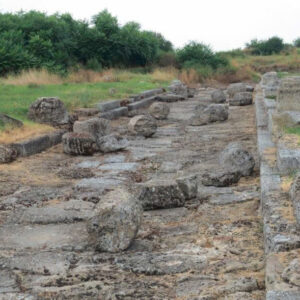
Image caption: Geological field survey team examining heavily mineralized Paleozoic rock strata in the Sahara.
The Central Mystery
If no biological organism created the shape, why does the feature present such striking human proportions from orbital altitudes? Desert wind patterns across the Sahara consistently align along primary wind vectors for centuries at a time. Over millennia, sand-laden blasts carve parallel troughs into bedrock, occasionally forming oval mounds with central depressions. When orbital cameras capture these shapes under low-angle morning sunlight, shadows create dark voids that mirror human eye sockets and nasal cavities with uncanny accuracy.

Competing Theories
Alternative theorists maintain that the structure represents either an artificial mega-monument sculpted by an undocumented prehistoric culture or the petrified remains of a pre-cataclysmic entity concealed by modern intelligence agencies. Others speculate that classified military censors intentionally blanked out high-resolution imagery surrounding the perimeter.
The overwhelming scientific consensus, backed by geomorphologists and remote-sensing experts at satellite observatories, identifies the feature as a textbook case of pareidolia—the human brain’s natural psychological tendency to perceive familiar patterns (such as faces) in random visual data. Combined with natural wind erosion, differential weathering, and low sun angles, ordinary geological yardangs naturally transform into dramatic, face-like optical illusions on satellite scans.
Image caption: Comparative satellite imagery demonstrating how shadow angles alter the visual perception of desert rock formations.

Why It Still Haunts Us
The Sahara remains one of the least explored and most hostile landscapes on Earth, hiding ancient riverbeds, prehistoric rock art, and lost human settlements beneath its sands. As long as vast swaths of our planet remain unmapped by human feet, could an undiscovered structure still be hiding just beyond the horizon of our satellite lenses?
Sources & further reading: NASA Earth Observatory: Geomorphology of Desert Yardangs; Geological Society of America: Aeolian Erosion Mechanics; Cambridge Archaeological Journal: Mythmaking and Archaeological Misinterpretations.