Deep within the frozen heart of Siberia, hidden beneath layers of earth untouched for tens of thousands of years, archaeologists uncovered an object that seemed impossible.
It was not a weapon.
Not a fossil.
Not a primitive stone tool.
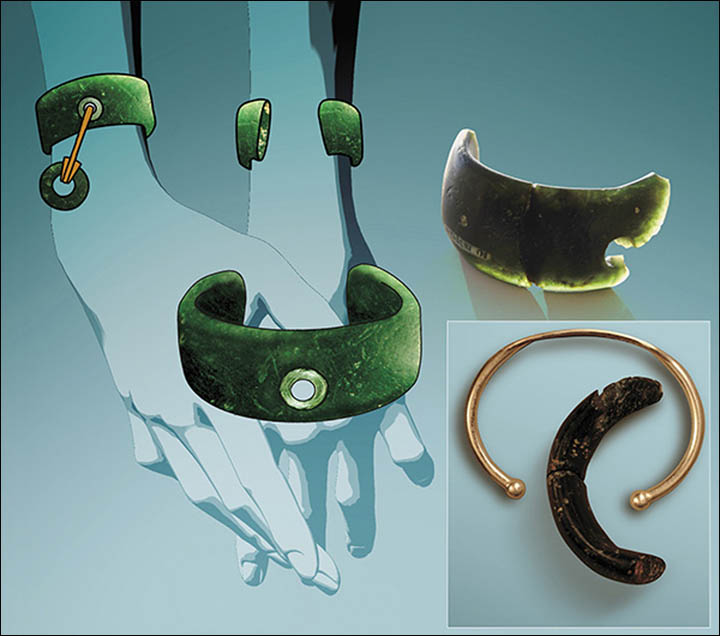
It was a bracelet.
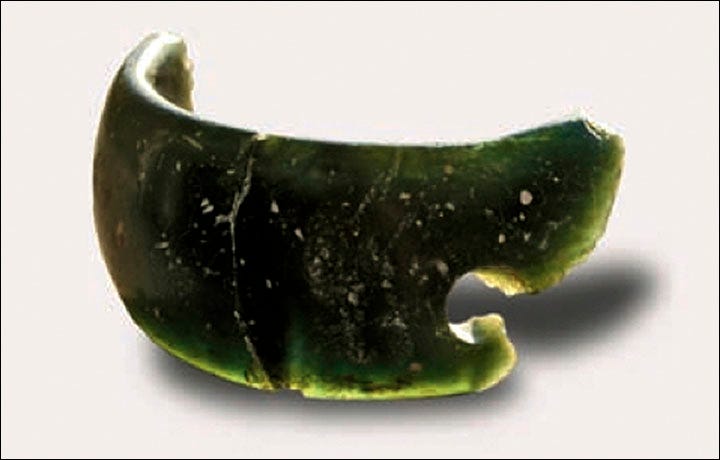
A beautifully crafted ornament carved from polished green stone, shaped with extraordinary care and finished with a level of precision that appeared far beyond what scientists once believed Ice Age humans could achieve.
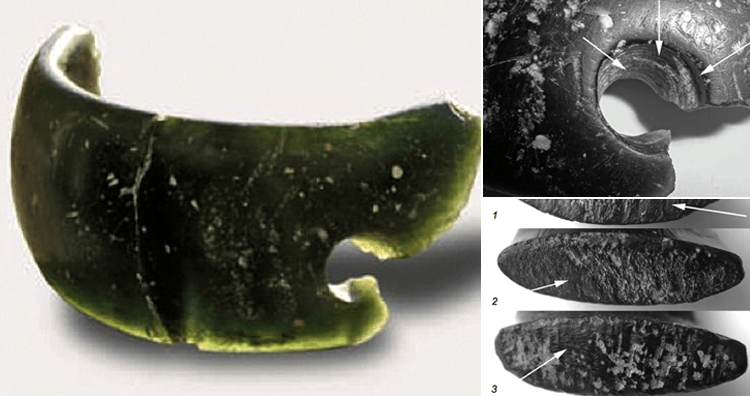
Its existence would challenge one of archaeology’s most enduring assumptions.
A Discovery From a Forgotten World
The remarkable artifact was discovered inside Denisova Cave, a remote site nestled within the Altai Mountains of southern Siberia.
For decades, the cave remained an archaeological mystery.
Then a series of discoveries transformed it into one of the most important prehistoric sites ever found.
Tiny fragments of bone and teeth recovered from the cave revealed the existence of an unknown branch of humanity.
They were neither modern humans nor Neanderthals.
Scientists named them the Denisovans.
At first, Denisovans were little more than a genetic shadow.
No complete skeletons.
No settlements.
No monuments.
Only traces of DNA preserved within ancient remains.
Yet hidden within the same cave was an artifact that suggested a far more complex story.
A delicate bracelet unlike anything researchers expected to find.
The Artifact That Rewrote the Narrative
The bracelet was crafted from a rare green chlorite stone believed to have originated many miles from the cave itself.
Whoever created it carefully selected the material, transported it across the landscape, and transformed it into an object of striking beauty.
Its surface was polished until it reflected light.
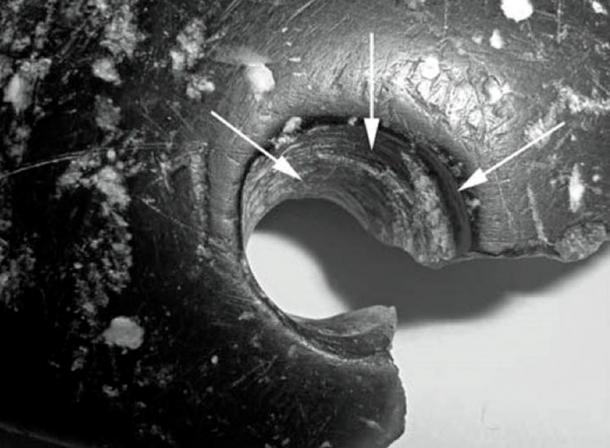
Most astonishing of all was a perfectly drilled hole through the stone.
Microscopic studies revealed evidence of advanced drilling techniques and meticulous workmanship.
The precision was so remarkable that some researchers initially struggled to accept that the object was truly ancient.
For years, many experts believed symbolic expression, personal ornaments, and sophisticated craftsmanship were unique achievements of Homo sapiens.
The Denisova bracelet challenged that belief.
If Denisovans were indeed responsible for its creation, they possessed not only technical skill but also an appreciation for beauty, symbolism, and personal identity.
This was not a tool made for survival.
It was an object made for meaning.
The Lost People Who Still Live Within Us
The Denisovans disappeared long ago.
No cities remain.
No written records survive.
No monuments bear their names.
Yet they are not entirely gone.
Modern genetic research has revealed that Denisovan DNA still exists within millions of people across Asia and Oceania.
Fragments of their ancient legacy continue to live within human populations today.
In a sense, they never completely vanished.
Part of them survives within us.
And now, this mysterious bracelet offers something even more valuable than genetic evidence.
It offers a glimpse into how they may have thought, created, and viewed the world around them.
A Message From 40,000 Years Ago
Imagine the scene.
A skilled artisan sits beside a fire deep within a Siberian cave.
Beyond the entrance, Ice Age winds sweep across a frozen wilderness inhabited by mammoths, woolly rhinoceroses, and predators that have long vanished from the Earth.
Patiently, the craftsperson shapes a piece of green stone.
Hours become days.
The surface is smoothed.
The hole is carefully drilled.
Slowly, the bracelet takes form.
Then time takes over.
Thousands of generations pass.
Empires rise and collapse.
Civilizations appear and disappear.
The bracelet remains.
Silent.
Waiting.
Buried beneath the earth for more than 40,000 years until modern archaeologists finally bring it back into the light.
Today, it remains one of the most fascinating artifacts ever associated with the Denisovans.
A powerful reminder that intelligence, creativity, and culture may have flourished across multiple branches of humanity—not just our own.
Because history is not always written by those who survive.
Sometimes it is hidden beneath stone and soil, waiting for someone to uncover its story.