A Discovery That Shouldn’t Exist
Imagine opening a tomb that has remained untouched for hundreds—or even thousands—of years.
You expect dust.
Ancient bones.
Perhaps a few forgotten artifacts.
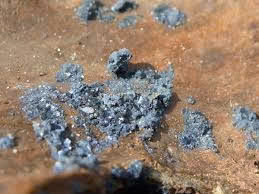
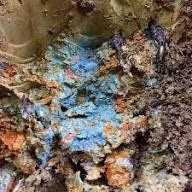
Instead, archaeologists sometimes uncover something far more extraordinary.
Brilliant blue crystals.
Clusters of electric sapphire, turquoise, and deep indigo shimmer among skeletal remains, glowing against the darkness of ancient burial chambers.
At first glance, they look like precious gemstones placed beside the dead as part of a forgotten ritual.
But the truth is even stranger.
These crystals were not buried with the dead.
They were created by the dead.
Their name is Vivianite—a rare mineral so unusual that it has earned one of the most haunting nicknames in archaeology:
“The Death Crystal.”
The Crystal That Grows From Human Remains
Unlike most minerals, Vivianite is not born in volcanoes or deep underground caverns.
Instead, it forms in places where life has ended and nature has begun its slow work of transformation.
Ancient graves.
Waterlogged tombs.
Peat bogs.
Forgotten wetlands.
In these oxygen-poor environments, a remarkable chemical process unfolds.
As bones and teeth slowly decompose, they release phosphorus into the surrounding soil.
When that phosphorus encounters iron-rich sediments in the absence of oxygen, a new mineral begins to form.
Over decades, centuries, and sometimes millennia, delicate crystals emerge from the very elements that once made up a living being.
The result is Vivianite—a crystal literally born from the chemistry of death.

The Hidden Color That Awakens in the Light
Perhaps the most astonishing feature of Vivianite is that its beauty remains hidden for most of its existence.
Freshly formed crystals are often colorless, pale gray, or nearly transparent.
Buried beneath the earth, they reveal little of the spectacle they contain.
Then something extraordinary happens.
When exposed to oxygen and light, the mineral begins to transform.
A slow chemical reaction sweeps through its crystal structure.
The dull surfaces suddenly awaken into dazzling shades of electric blue, teal, emerald green, and deep violet.
The colors are so vivid they appear almost artificial.
Yet every shade is produced entirely by nature.
It is as if the crystal spends centuries sleeping beneath the earth, only to reveal its true form when finally brought back into the light.

Archaeologists Were Not Prepared for What They Found
Across the world, archaeologists have encountered Vivianite in ancient cemeteries and burial sites.
In some excavations, blue crystals appear directly on human bones.
In others, they fill spaces where soft tissues once existed, preserving a chemical memory of bodies long vanished.
The sight can be breathtaking.
Imagine brushing away layers of soil from a skeleton that has lain undisturbed for thousands of years.
Suddenly, brilliant blue mineral formations emerge from the darkness.
The scene feels less like archaeology and more like something from a forgotten legend.
Yet these crystals are completely real—and they continue to appear in archaeological discoveries today.

Nature’s Most Beautiful Transformation
The nickname “Death Crystal” sounds ominous.
But Vivianite tells a story that is surprisingly beautiful.
It is evidence of nature’s endless cycle of renewal.
Nothing is truly lost.
The elements that once formed living organisms do not disappear.
They change.
Bones become phosphorus.
Phosphorus becomes crystal.
Decay becomes beauty.
What appears to be an ending is transformed into the raw material for something entirely new.
Vivianite is one of the clearest reminders that nature wastes nothing.
Every ending becomes the beginning of another story.
A Mineral That Helps Unlock Ancient Secrets
Beyond its stunning appearance, Vivianite has become an important tool for scientists.
Researchers study the mineral to reconstruct ancient burial conditions and understand how bodies decomposed over time.
Its presence can reveal whether a grave remained waterlogged, how much oxygen was available, and what environmental conditions existed centuries ago.
In some archaeological sites, traces of Vivianite have even helped identify where organic materials once existed after all visible evidence had disappeared.
The crystal acts like a chemical fingerprint left behind by history itself.

The Ancient Message Hidden Inside the Death Crystal
Perhaps the most fascinating aspect of Vivianite is not scientific at all.
It is symbolic.
A crystal born from ancient bones challenges our understanding of life and death.
It transforms decay into beauty.
Darkness into color.
An ending into a beginning.
Deep beneath forgotten graves and silent archaeological sites, nature continues its work—slowly, patiently, and without interruption.
And there, hidden among the remnants of the past, the Earth creates one of its most extraordinary treasures.
A brilliant blue crystal born from the dead.
A reminder that transformation is one of nature’s oldest and most powerful secrets.
#Archaeology #AncientMysteries #Vivianite #DeathCrystal #AncientHistory #LostCivilizations #HiddenHistory