Some secrets don’t stay buried in the ground. Some of them get lifted into the sky — wedged into a crack in the rock where no human hand could ever reach, waiting more than a hundred years for the right pair of eyes to look up at exactly the wrong moment.

That moment came on an ordinary afternoon in a remote Utah slot canyon, when a single tourist tilted their head back, squinted into the shadows above, and unknowingly reopened a case the West had given up on a century ago.
What rangers eventually pulled out of that canyon would rewrite a legend.

A Shadow 50 Feet Up the Canyon Wall
Ranger William Perkins had walked this canyon more times than he could count. The towering sandstone walls, the cool ribbon of shade, the silence so complete you could hear your own pulse — it was routine. Beautiful, but routine.
Until a hiker near the back of his group went quiet, then pointed straight up.
High above the dry riverbed, roughly fifty feet up the sheer canyon wall, something dark was lodged in a vertical crevice. It didn’t belong. It wasn’t a boulder. It wasn’t a shadow. The shape was too deliberate — angular, framed, built.
Perkins raised his binoculars. His hands went still.
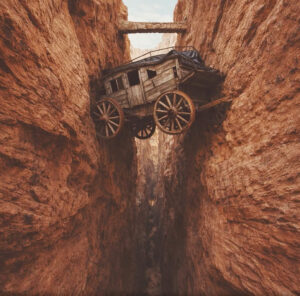
Pressed into the rock, impossibly, was the unmistakable silhouette of a 19th-century stagecoach. Weathered oak. The curved roofline. The ghost of a door. A vehicle that belonged on a dusty frontier trail — somehow suspended in stone, far beyond the reach of any road that had ever existed.
The first question hit him immediately, and it refused to let go: How does an entire stagecoach end up fifty feet in the air, inside a canyon you can only reach on foot?
The Climb Into the Crevice
There was no logical way up. No trail, no ledge, no path a horse or wagon could have ever climbed. The coach was simply there, as if the canyon had swallowed it whole and then frozen mid-bite.
Perkins called in a climbing team.
Over the following days, ropes were anchored at the rim and a small crew rappelled down the face of the wall, inch by careful inch, toward the wreck. Up close, the mystery only deepened. The coach was jammed into the crevice at an angle, its frame battered and split, packed in tight by debris and decades of grit — the way a stick gets caught and held by a river current, except this current had been dry for a very long time.
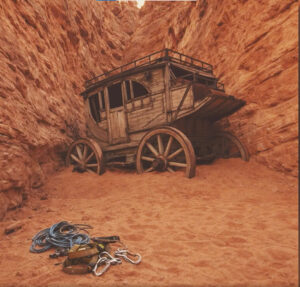
They worked slowly. One wrong move and the whole thing could shatter and rain down onto the riverbed below. With straps, pulleys, and a great deal of patience, the team finally dislodged the carriage from its stone grip and lowered it down to the canyon floor.
When it touched the dry riverbed, the crew stood around it in silence.
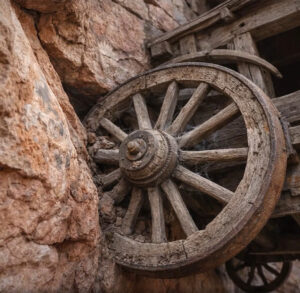
The oak frame was beaten and gray with age. But the structure had held. After more than a century trapped in the rock, the coach was, against all odds, still intact — and still locked.
Behind the Rusted Door
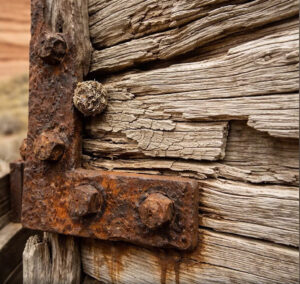
Perkins crouched at the side door. The latch was fused with rust, the metal flaking under his fingers. He worked it loose, the old mechanism finally surrendering with a dry, grinding snap.
The door swung open. He clicked on his flashlight and leaned in.
Dust drifted through the beam like slow smoke. And then the light fell on the floor of the cabin — and on what was stacked there.
Heavy leather bags. Rows of them. Slumped against one another, rotted soft at the seams, far too heavy for anything ordinary.
Perkins froze.
He didn’t touch them. He backed out, reached for his radio, and called historical authorities. Because somewhere in the back of his mind, an old story he’d half-heard years ago was clawing its way to the surface — and he suddenly understood exactly which legend he might be standing inside of.
The Legend of the Lost Railroad Payroll
When historians arrived and the leather bags were carefully opened, the dust gave way to a dull golden glint.
Gold coins. Thousands of them.
Bag after bag, more than anyone in that canyon had ever seen in one place. And as the experts examined the dates, the markings, and the sheer scale of the haul, the conclusion became impossible to deny.
This was the Lost Railroad Payroll — a fortune that frontier history had whispered about for generations but never found.
According to the records historians pieced together, the stagecoach had been carrying the wages for five thousand railroad and mining workers when it simply vanished. One day it was rolling toward a hard-working frontier town with everyone’s pay locked inside. The next, it was gone — coach, horses, gold, and all. No wreck. No bodies. No money. Nothing.
For over a hundred years, the only thing the payroll left behind was a question.

The Town That Burned
The disappearance didn’t just rob five thousand workers of their wages. It lit a fuse.
When the payroll never arrived, the town it was meant for boiled over. Men who had labored for months with nothing to show for it wanted answers no one could give. Rumors turned to accusations. Accusations turned to fury.
The unrest exploded into a full-scale riot — and by the time the chaos burned itself out, the mining town had burned with it. Buildings, livelihoods, and an entire community reduced to ash, all because a single coach failed to come around the bend.
The town was never the same. And the story hardened into legend: a cursed payroll that destroyed everything it was supposed to save, then disappeared off the face of the earth.
Now, finally, the earth was giving it back.
The Sabotaged Axle: This Was No Accident
The biggest revelation wasn’t the gold. It was how the coach had died.
When investigators examined the battered frame, one detail stopped them cold. The wheel axle hadn’t simply broken from age or impact. It had been deliberately sabotaged — cut and weakened by human hands.
Someone had wanted this coach to fail.
The evidence pointed to a robbery in motion. Bandits had tampered with the axle to force the stagecoach to a halt out in the open canyon country, far from help, where they could take the payroll at their leisure. The heist of the century was already underway.
But the canyon had other plans.
The Flash Flood That Hid a Fortune
Slot canyons are beautiful, and they are deadly. A storm miles away — a storm you can’t see or hear — can send a wall of water roaring through a narrow canyon with almost no warning. Hikers know the rule today: when the sky changes, you get out.
The bandits, it seems, learned that rule too late.
The reconstruction suggests that just as the sabotaged coach was stopped in the canyon, a sudden flash flood tore through the gorge. In an instant, a churning torrent slammed into the stagecoach and swept it off the canyon floor — gold, leather bags, and all — and rammed it upward into a crevice in the wall, fifty feet above where any flood should reach.
Then the water drained away. The canyon dried. And the coach stayed exactly where the flood had jammed it, sealed in stone, lifted out of reach of every searcher, every treasure hunter, and every tall tale for more than a century.
The bandits never got their fortune. The town never got its wages. And the canyon kept the secret — until a tourist happened to look up.

Why This Discovery Matters
The Lost Railroad Payroll was never just about gold. It was about a vanished moment of the Old West — a heist, a flood, a riot, and a fortune all tangled into one event that the frontier could never explain.
This stagecoach, frozen in the cliff, is the rare kind of discovery that closes a loop history left dangling. It turns a campfire legend into something you can touch. And it’s a reminder that the wild country of the American West still has its mouth full of secrets, waiting for the next person who decides to look in the one direction nobody else thought to check: up.
How many more coaches, caches, and fortunes are still wedged in the rock out there, hidden in plain sight above our heads?