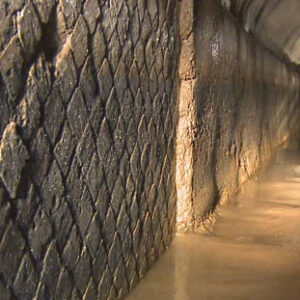
The desert is the best liar in the world. It buries things gently, smooths the surface flat, and lets you walk over a secret a thousand times without ever knowing it’s beneath your boots. For more than a hundred years, the Nevada dunes kept one secret perfectly still — until a single windstorm decided it was time to talk.
What the wind uncovered didn’t just reveal an old building. It reopened a case that had haunted the West since 1906, and the answer was waiting in the dark, behind the bar, beneath a heavy rug no one had touched in a lifetime.
A Timber Skeleton in the Dunes
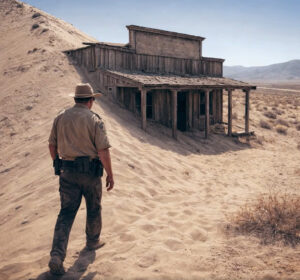
Sheriff Walter Hutton was patrolling the dunes the morning after a brutal sandstorm. The wind had scrubbed the landscape into something almost unrecognizable — old ridges flattened, new ones raised, the whole desert rearranged overnight like furniture moved by an invisible hand.
That’s when he saw it: a dark edge of weathered timber jutting up out of the sand where, the day before, there had been nothing but smooth dune.
He stopped the vehicle and walked closer. The wood was old — hand-cut, square-nailed, gray with age. As he brushed away the loose sand, the shape resolved into something unmistakable: a doorframe. A roofline. The buried bones of a building that had been swallowed whole by the desert.
It was a saloon — an honest-to-goodness 1900s frontier saloon, sealed under the dunes for generations.
Hutton radioed his deputy. For hours the two of them dug, shovel by shovel, clearing the drifted sand away from the entrance until the old door could finally swing inward. Then they clicked on their flashlights and stepped inside.
Stepping Into a Frozen Moment
What waited inside stopped them both cold — not from fear, not yet, but from sheer disbelief.
The saloon hadn’t decayed into ruin. It had been preserved. The dry desert air and the airtight blanket of sand had turned the place into a perfect time capsule, frozen at the exact moment it was abandoned.
Whiskey bottles still stood on the tables, their contents long evaporated, the glass furred with a century of dust. Poker chips sat scattered across the felt, mid-game, as if the players had stepped out for a single hand and simply never come back. Chairs were pushed away from tables at careless angles. A long mahogany bar ran down one wall, dull but unmistakably grand, the kind of centerpiece a frontier town built its whole evening around.
Every detail whispered the same eerie thing: people were here, and then suddenly they weren’t.
It was beautiful. It was haunting. And Hutton, a lawman to the core, couldn’t shake the feeling that something about the room was wrong.
The Scratches Behind the Bar
He made his way slowly toward the mahogany counter, his flashlight sweeping the floorboards.
That’s when the beam caught them.
Deep gouges raked across the wood behind the bar — long, dragging scratch marks, the kind made by something heavy being hauled across the floor. Or by something fighting not to be.
The marks didn’t scatter randomly. They led somewhere. They traced a path straight to a heavy, dust-caked rug lying flat against the floorboards, exactly where a rug had no reason to be.
Hutton crouched. He set his jaw. And he kicked the fabric aside.
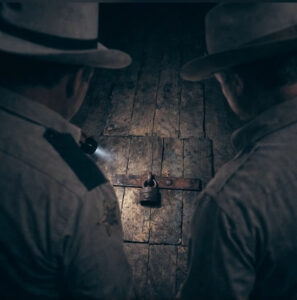
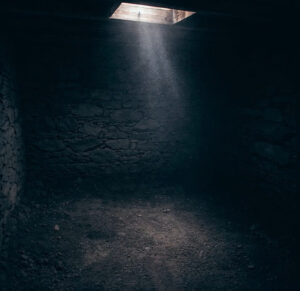
Underneath was a reinforced trapdoor — thick timber banded with iron, far sturdier than anything a saloon would need for a wine cellar. And it was locked. A heavy, rust-eaten padlock held it shut, sealing whatever lay below away from the world.
Cellars don’t usually need to be locked from the outside.
Behind the Trapdoor
Hutton fetched the bolt cutters from his vehicle. The padlock resisted, then surrendered with a sharp metallic crack that echoed strangely in the buried room.
He worked his fingers under the edge of the trapdoor and heaved. The wood groaned, swollen and heavy with age, and finally lifted. A breath of cold, stale air rose out of the opening — air that hadn’t moved in over a hundred years.
He raised his flashlight and aimed the beam down into the darkness.
And then Sheriff Walter Hutton froze in absolute terror.
Three Stars in the Dark
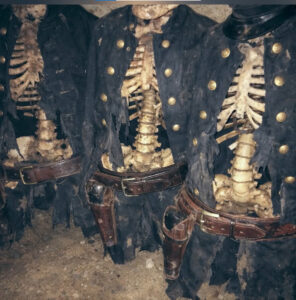
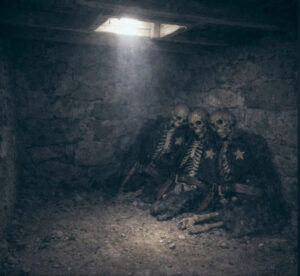
In the corner of the cramped cellar, huddled together against the wall, were three human skeletons.
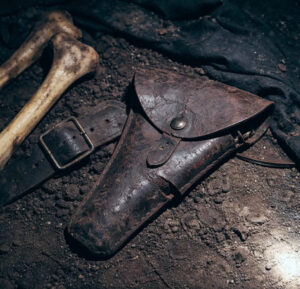
They were still dressed — the rotted remnants of uniforms clinging to old bones, fabric gone to threads, boots collapsed where feet had once been. They hadn’t been dumped or scattered. They were pressed into the corner, side by side, in the unmistakable posture of men who had spent their final hours waiting for a door that would never open.
Hutton’s light drifted upward, across the ribs, to the chests.
And there it caught a dull, tarnished glimmer. Pinned to each rotting uniform was a brass star.
Not the badge of a town sheriff. The unmistakable insignia of Federal Marshals — and the moment Hutton understood what he was looking at, an old, cold piece of frontier history clicked into place.
Three federal lawmen, locked in a cellar beneath a saloon, in the middle of the Nevada desert.
The Case That Vanished in 1906
When historians and investigators examined the remains and the records, the pieces assembled into a story the West had given up trying to solve.
In 1906, three Federal Marshals had ridden into the region and then simply vanished. No trail. No bodies. No final report. Lawmen didn’t just disappear into thin air — and yet these three had, leaving behind nothing but rumors and an open file that slowly went cold.
What the records eventually revealed was their assignment: the marshals had been investigating a corrupt local gang with its hooks deep in the town. They were closing in. They were asking the wrong questions of the wrong people in a place where the wrong people owned the law, the land, and apparently the saloon.
They got too close. And someone decided the only way to bury the investigation was to bury the investigators.
A Soundproof Tomb
The cellar told the rest.
According to the reconstruction, the marshals were ambushed and forced down into the reinforced room beneath the bar — a space built thick and tight enough to be effectively soundproof. The trapdoor was dropped. The padlock was snapped shut. The heavy rug was dragged back over the top.
And then the gang walked back up the stairs, into a saloon full of poker chips and whiskey and ordinary noise, and let the desert do the rest.
The scratch marks on the floorboards behind the bar suddenly made a terrible kind of sense. So did the bottles left mid-pour and the game left mid-hand. Whatever happened that night, it happened fast, and the people who knew the truth had every reason to scatter and never speak of it again.
Above them, life carried on. Below them, three lawmen ran out of air in the dark.
Why the Desert Kept the Secret
The crime should have surfaced eventually. Buildings get torn down. Floors get pulled up. Someone, someday, finds the door.
But the desert intervened.
Over the years, the shifting sands crept higher around the saloon, drifting through cracks, climbing the walls, until the entire building — bar, bottles, trapdoor, and tomb — disappeared beneath the dunes entirely. The town faded. The story died with the people who’d buried it. And the marshals’ fate was sealed twice: once by the gang, and again by the sand.
For over a century, it stayed that way. A perfect, silent cover-up, hidden under a landscape that rearranges itself with every storm.
Until one windstorm blew the wrong way, lifted the right ridge of sand, and exposed a single edge of timber to the morning light — and a sheriff happened to be patrolling close enough to see it.
Why This Discovery Matters
This wasn’t just a grim find in the dunes. It was the answer to a question that had outlived everyone who first asked it: what happened to the three marshals who vanished in 1906?
The buried saloon turned a cold case into a closed one. It gave three forgotten lawmen their story back — and it stands as a chilling reminder that the desert doesn’t destroy secrets. It keeps them, patient and perfect, until the wind decides we’re finally ready to know.
How many more cover-ups are still out there, sealed under the sand, waiting for the next storm to talk?