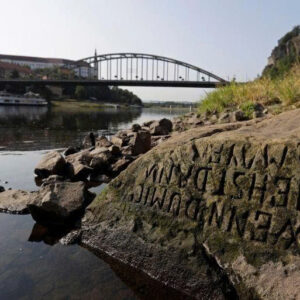
The river looks innocent enough today. The Tollense winds through northern Germany in slow, silver curves, fringed with reeds and alder trees, the kind of place you’d paddle a canoe on a warm afternoon. Locals have fished these waters for centuries. Children have swum in them. No monument marks the banks. No legend was ever written down.
![Die Erfindung des Krieges: Darum führten Menschen erste Schlachten - [GEO]](https://images.openai.com/static-rsc-4/fnZ1XSc-J9smhsCY6yNbMY4q0L_U3cOZNPP-dffyULooU0ZKeSkJrExOqXtIOCWXgkBHD2T8xIlskIz-_YddJveJyAckvxO0sWBDgcqQDqxTPQeuX-onIq-lyWv-_CxF-3dO27BqwpTH_x1usHZ-r91jEqgwwjX7DVrfrmRwyn72qA83wF9QWxKhTdX9KnR8?purpose=fullsize)
And yet, somewhere beneath the silt and the slow brown current, the dead have been waiting for more than three thousand years.
They number in the hundreds — perhaps the thousands. Young men, mostly, struck down in a single, catastrophic afternoon around 1250 BC. Their skulls are cracked. Bronze and flint arrowheads are still lodged in their bones. They were never buried. They were simply swallowed by the river and forgotten by history.
This is Tollense Valley — and what happened here may be the oldest large-scale battle ever discovered in Europe.

A single bone that rewrote prehistory
The mystery began, as the best ones do, by accident.
In 1996, a volunteer searching the riverbank pulled something strange from the mud: a human arm bone with a flint arrowhead still buried in it. One bone. One arrowhead. A wound that had killed its owner more than three millennia before — and then frozen there, mid-violence, like a photograph of a murder no one remembered.
Archaeologists came to look. Then they came back. Then they started digging in earnest, and the ground began to give up its secret.
The single bone became a dozen. The dozen became hundreds. Today, excavators have recovered more than 12,000 fragments of human bone from a narrow stretch of the valley — the remains of at least 150 individuals, and almost certainly far, far more. Less than a tenth of the site has been excavated. The rest still sleeps under the water.
What they had stumbled onto was not a graveyard. It was a kill zone.

The wounds tell the story
Bones are honest witnesses. They cannot lie about how a person died, and the bones of Tollense speak of horror.
Skulls bear the unmistakable signatures of violence: blunt-force fractures from wooden clubs, puncture wounds, blades that bit clean through. Arrowheads of bronze and flint are embedded in ribs, in shoulder blades, in the dense bone of the upper arm. One skull carries a hole punched straight through it. These were not accidents. These were not isolated murders. This was combat — coordinated, sustained, and astonishingly large.
The victims share an eerie profile. Almost all are men, fit and battle-ready, between the ages of 20 and 40. A few women lie among them too, their presence still unexplained. The placement of the arrow wounds offers a chilling tactical clue: many struck the back rather than the front, hinting that shields guarded the warriors’ chests while their unprotected backs were exposed as the fighting collapsed into a rout — men cut down as they tried to flee across the water.
And the scale is what stops historians cold. Based on bone density across the excavated zone, researchers estimate that as many as 4,000 fighters clashed here — perhaps 2,000 on each side. For the Bronze Age in northern Europe, that is not a brawl between villages. That is an army.
The arrowheads betray a hidden invader

For years, the central question haunted every researcher who waded into the Tollense mud: who fought here, and why?
Then, in a study published in 2024, archaeologist Leif Inselmann and his colleagues went looking for the answer in the weapons themselves. They examined 54 bronze and flint arrowheads pulled from the battlefield, treating each one like a fingerprint.
Most of the arrowheads matched the local style — the kind made and used by communities in the region. But a handful did not. Their shapes were foreign, belonging to a tradition rooted hundreds of kilometers to the south, in territory that today spans Bavaria and Moravia.
The implication is electric. Those alien arrowheads were not trade goods or souvenirs. They arrived the hard way: fired by an outside army that had marched north to fight. Tollense was not a private quarrel between neighbors. It may be the earliest evidence of an interregional war on European soil — strangers from distant lands meeting local warriors in a fight to the death by a river most of them had likely never seen before.
Someone organized this. Someone fed, armed, and moved thousands of men across the landscape with a purpose we can only guess at. A river crossing? A trade route? A bronze causeway worth killing for? The motive drowned with the men.
Professional fighters, not frightened farmers
Earlier analysis of the remains deepened the puzzle. Some of the dead carried healed injuries — bones that had been broken and mended long before the day they died. These were not first-timers. They were men who had survived earlier violence and walked back into it. Experienced warriors.
Chemical signatures locked in their bones suggest that not all of them grew up nearby; some came from far away, consistent with the foreign arrowheads. Together, the evidence paints a portrait that overturns a century of assumptions: that Bronze Age Europe was a patchwork of small, peaceful farming communities, where violence meant a few men with spears settling a local score.
Tollense detonates that idea. It reveals a world capable of mobilizing organized forces, recruiting fighters from distant regions, and waging warfare on a scale no one believed possible a thousand years before Rome, before the Greek city-states, before a single word of it was ever written down.

Why Tollense still matters
We tend to think of “history” as the part that was written. Everything before the first scribes is filed under prehistory — assumed to be simpler, smaller, quieter.
The river of bones argues otherwise. It hands us physical proof of a society sophisticated enough to plan, supply, and execute mass violence at a moment when, supposedly, no such thing could exist. It speaks to mobility, to interconnected cultures, to social structures complex enough to send armies marching toward a horizon. Every skull and arrowhead pulled from the Tollense is a sentence in a story that was never meant to be told — written in bone instead of ink.
Most of the battlefield remains underwater, untouched. The reeds still sway. The current still slides past, patient and indifferent, holding the rest of the dead in its keeping.
We may never know their names, their banners, or the cause they died for. But the river remembers. And one bone at a time, it is finally beginning to talk.