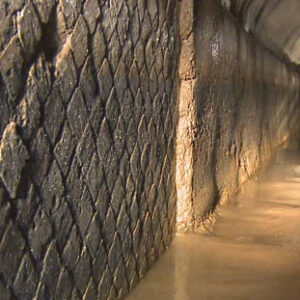
For two days, the sky over the Bay of Naples rained fire and stone. When it finally cleared, one of the Roman Empire’s most vibrant cities had simply ceased to exist. Pompeii — its streets, its shops, its temples, its people — was gone, sealed beneath meters of volcanic ash. It would stay buried for almost 1,700 years.

And when it finally returned to the light, it revealed something no other ruin on Earth could offer: not just broken columns and silent stones, but an entire civilization frozen in the exact moment of its death. This is the story of Pompeii — the most haunting archaeological site in the world, and the closest thing we have to a doorway into the ancient past.
A City Living in the Shadow of a Giant
By the 1st century AD, Pompeii was a thriving Roman town on the coast of Campania, in southern Italy. Estimates of its population vary, but somewhere between 11,000 and 15,000 people lived inside its walls — merchants, bakers, politicians, enslaved workers, gladiators, and wealthy families who built lavish villas decorated with brilliant frescoes.
It was a city alive with noise and color. Bakeries turned out fresh bread each morning. Taverns served wine to travelers. Election slogans and crude jokes were painted across the walls. Fountains splashed at street corners, and the forum buzzed with business and gossip. Above it all rose Mount Vesuvius, green and fertile, its slopes thick with vineyards.
What the people of Pompeii did not know — what no one in the Roman world fully understood — was that Vesuvius was not a mountain at all. It was a sleeping volcano. And it was about to wake up.

The Day Vesuvius Woke (79 AD)
The catastrophe struck in 79 AD — long thought to have been in August, though more recent evidence, including autumn fruits and a charcoal inscription found at the site, suggests it may have happened in October. Either way, the day began like any other. Then the mountain split the sky.
Vesuvius erupted with the force of many atomic bombs, blasting a towering column of ash, gas, and pumice an estimated 30 kilometers into the air. For hours, a relentless rain of volcanic stone fell on Pompeii. Roofs groaned and collapsed under the accumulating weight. Day turned to a terrifying, choking night.
Many residents fled in those first hours. But thousands stayed — sheltering indoors, waiting for the horror to pass, or simply trapped. They made a fatal choice. In the early morning, the eruption entered its deadliest phase: surges of superheated gas and ash known as pyroclastic flows came roaring down the mountainside at incredible speed. Moving faster than anyone could run and hot enough to kill instantly, these waves swept through the streets of Pompeii and the neighboring town of Herculaneum.
When it was over, Pompeii lay buried beneath roughly four to six meters of volcanic debris. The bustling city — and everyone who had remained — was gone.

The Eyewitness Who Recorded the Apocalypse
Remarkably, we have a first-hand account of the disaster. A young man named Pliny the Younger watched the eruption from across the bay at Misenum. Years later, he wrote two letters to the Roman historian Tacitus describing what he saw: the strange cloud shaped “like an umbrella pine,” the panicked crowds, the darkness “not like a moonless night, but like a sealed room with the lamp put out.”
His uncle, the famous naturalist and naval commander Pliny the Elder, sailed toward the eruption — partly to study it, partly to rescue those trapped along the coast. He never returned, dying in the ash near Stabiae. Thanks to his nephew’s vivid letters, the type of volcanic eruption that destroyed Pompeii is now called a “Plinian” eruption to this day.

Buried and Forgotten for 1,700 Years
After the eruption, Pompeii disappeared — not just physically, but from memory. Survivors and looters dug into the ash for a time, but eventually the city slipped out of history altogether. Grass and vineyards grew over the buried streets. Generations passed. The very name “Pompeii” faded into a vague local legend.
It was not until 1748 that systematic excavation began (the nearby town of Herculaneum had been uncovered a decade earlier). What workers found astonished the world. Beneath the hardened ash lay not a destroyed city, but a perfectly preserved one.

A City Frozen in Time
This is what makes Pompeii unlike any other archaeological site on the planet. The same volcanic ash that killed the city also protected it, sealing it away from air, light, and decay. When archaeologists dug down, they did not find scattered rubble. They found a moment.
Loaves of bread still sat inside the ovens of bakeries, carbonized but intact — some even stamped with the baker’s name. Wine and oil waited in sealed jars. Frescoes glowed on the walls in reds, blues, and golds as vivid as the day they were painted. Graffiti covered the streets: love notes, political endorsements, advertisements for gladiator games, and insults scratched by bored passersby nearly 2,000 years ago.
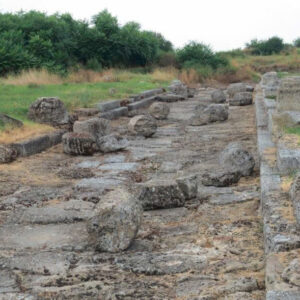
Walking through Pompeii today, you can still trace the ruts that cart wheels carved into the stone roads. You can step across the raised stones that let pedestrians cross the street without touching the mud. You can enter the homes of the rich, like the sprawling House of the Faun, and the cramped rooms of the poor. You can visit shops, bathhouses, temples, a 20,000-seat amphitheater, and even brothels with frescoes still on the walls. Few places on Earth let you walk so completely into the daily life of an ancient people.
The Haunting Plaster Casts
But Pompeii’s most powerful — and most chilling — discovery was not its buildings. It was its people.
As the bodies of the victims decayed over the centuries, they left hollow voids in the hardened ash, perfectly shaped around where they had fallen. In the 1860s, an archaeologist named Giuseppe Fiorelli devised a brilliant and eerie technique: he poured liquid plaster into these cavities. When the ash was carefully removed, the plaster revealed the victims in their final moments.
The casts are devastating to see. A man shielding his face. A mother cradling her child. Couples and families huddled together. A chained dog, twisting in its last struggle, unable to escape. These are not statues or art. They are the exact poses of real human beings caught in the instant of death — emotion frozen in plaster, reaching across two thousand years.
In them, the abstract tragedy of Pompeii becomes painfully, unforgettably human.

Why Pompeii Still Captivates Us
Pompeii is far more than a ruin. It is a time capsule, a crime scene, and a memorial all at once. For historians, it is the single richest source of information about Roman daily life ever discovered — revealing how ordinary people ate, worked, worshipped, loved, and died. Every wall, every loaf of bread, every scrawled message tells us something the grand monuments of Rome never could.

And the site is far from finished giving up its secrets. Excavations continue to this day, and large portions of the city still lie unexcavated beneath the ash. In recent years, archaeologists have uncovered stunning new frescoes, an intact ceremonial chariot, a “fast-food” counter with food still in its containers, and the remains of victims who never made it out. Each discovery adds another piece to the story — and reminds us that Pompeii is a city that is still, slowly, coming back to life.
Mount Vesuvius, meanwhile, has not gone anywhere. It remains one of the most dangerous volcanoes on Earth, looming over the millions of people who live around modern Naples. One day, it will erupt again. Pompeii stands as both a wonder and a warning — proof of how quickly even the mightiest civilization can be swept away in an afternoon.

Step Into the Frozen City
Two thousand years ago, the people of Pompeii went about an ordinary day, never imagining it would be their last. Today, their city offers us something almost no other place can: the chance to walk through the ancient world exactly as it was, in the final breath before catastrophe.
If you could stroll down one silent street of Pompeii, peer into a long-abandoned home, and stand before the plaster shapes of its lost inhabitants — would you dare to go?