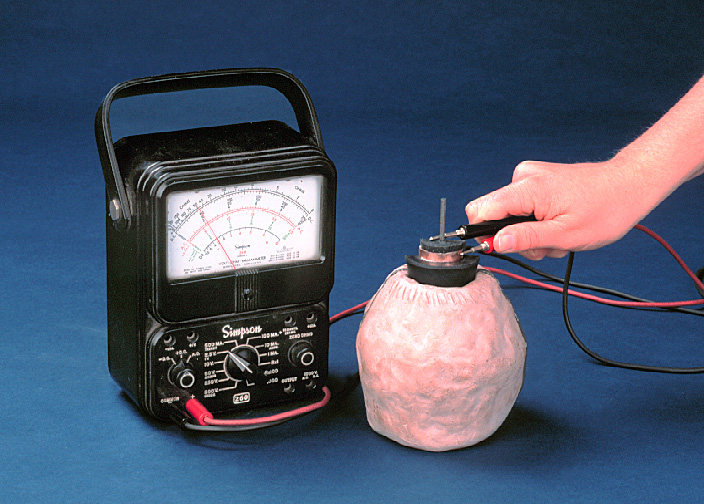
Fill a certain small clay jar with vinegar, and something unsettling happens: a meter twitches. A faint electric current — around a volt — flickers to life.

The unsettling part? This jar is roughly 2,000 years old. It was made, by most estimates, well over a thousand years before anyone is supposed to have “discovered” electricity.
It’s called the Baghdad Battery, and it might be one of the most misunderstood objects in archaeology. Because the real story isn’t “ancient people had batteries.” It’s something far more interesting — and a lot more honest.
What the jar actually is
Strip away the legend and you’re left with something deceptively simple.
Discovered at Khujut Rabu, near ancient Ctesiphon in modern Iraq, and generally dated to the Parthian or early Sasanian era (very roughly 250 BCE–650 CE), the object is a clay jar about 13 cm tall. Inside sits a copper cylinder, and inside *that*, an iron rod — the whole thing capped with an asphalt stopper.
Here’s the thing that launched a thousand theories: that arrangement — two different metals, a sealed container, room for a liquid — is, by coincidence or design, the basic recipe for a galvanic cell. A battery.
The experiment that started it all
In the late 1930s, the jar’s excavator, Wilhelm König, looked at that copper-and-iron setup and proposed something bold: maybe these were ancient batteries, perhaps used to electroplate thin layers of precious metal onto objects.
Modern experimenters couldn’t resist testing it. Replicas filled with an acidic liquid — vinegar, or grape juice — reportedly produce somewhere around 1.1 volts. In 1978, German researcher Arne Eggebrecht is said to have built a replica and used it to deposit a thin layer of silver, suggesting ancient electroplating might have been possible.
And that’s where the legend took off, especially once sensational TV ran with it.
**But here’s the catch the headlines skip: “it can work as a battery” and “it was used as one” are two completely different claims.**
This is where most viral versions of the story quietly stop. The honest version keeps going — and gets more interesting.
Because among actual archaeologists, the “battery” idea is far from accepted. In fact, it’s widely doubted. As one expert on Iraqi archaeology, Professor Elizabeth Stone, reportedly put it, she didn’t know a single archaeologist who believed these jars were really batteries.
The problems are hard to wave away. No wires, conductors, or anything resembling electrical equipment were found with the jars. There are no ancient texts describing electricity or electroplating. And a thin layer of silver can be applied with fire-gilding — a well-known ancient technique — with no electricity required at all.
What it probably was
So if not a battery, then what?
Metallurgists at the British Museum and others have pointed to a far more mundane — but far better-supported — explanation: the jars may simply have been containers for storing sacred scrolls or papyrus. The iron and copper could be the remains of rolled documents and their casing, long since decayed. Tellingly, very similar vessels are known from nearby Seleucia, where they’re understood as scroll holders, and the Baghdad jar was reportedly found alongside “magical” bowls — a religious context, not a workshop.

It’s less thrilling than a secret ancient power source. But it fits the evidence.
Why the mystery refuses to die
If experts mostly doubt it, why does the Baghdad Battery keep coming back?
Partly because it’s a wonderful “what if.” The idea that someone, two millennia ago, might have brushed up against electricity is irresistible. And partly because the artifact genuinely *does* generate a current in replicas — so the door never fully closes. We’re left in that maddening space between possible and proven.
But that uncertainty is exactly why it deserves an honest telling. The Baghdad Battery isn’t proof of lost super-science, and it certainly isn’t evidence of anything from beyond Earth. It’s a real, strange, beautifully ambiguous object that reminds us how easily a coincidence of copper and iron can spark a legend.
So here’s the real question — the genuinely open one: was it a forgotten spark of ancient ingenuity, or just an ordinary jar that we, with our modern obsession with electricity, desperately wanted to be something more?