Stand on the summit of Mount Everest — nearly nine kilometres above sea level, in air so thin it can kill — and you are standing on the bottom of an ancient ocean. The grey rock beneath the highest boots on Earth is limestone, and crack it open and you may find the remains of creatures that lived and died on a warm tropical seafloor, hundreds of millions of years before there were mountains here at all.
It sounds impossible. Seashells, on the roof of the world. Yet it is one of the most quietly astonishing facts in all of geology — and the explanation is a story so vast and so slow that it stretches the human imagination almost to breaking point.

A summit made of seabed
The very top of Mount Everest is capped by a band of pale rock that geologists call the Qomolangma Formation — using the mountain’s Tibetan name. It is limestone, and limestone is, by its nature, a rock of the sea. It forms over enormous spans of time from the calcium-rich remains and sediments that settle on the floor of shallow, warm oceans.
In other words, the highest rock on the planet was not born in the sky. It was born at the bottom of the water.
Locked inside that summit limestone are fossils — the unmistakable traces of marine life. Researchers studying Everest’s rocks have reported the remains of animals such as crinoids, the delicate “sea lilies” that anchored to the seabed; brachiopods, shelled creatures resembling clams; and trilobites and other tiny invertebrates. These were the inhabitants of an ancient ocean, and their shells and skeletons rained down onto the seafloor and slowly hardened into stone.
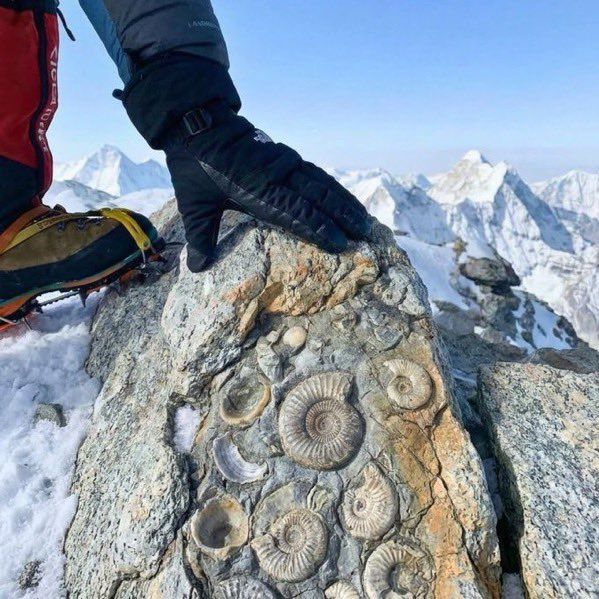
That stone is now the summit of Mount Everest.
The ocean that no longer exists
To understand how, we have to travel back roughly four hundred and fifty million years, to a world you would not recognise. The continents were arranged completely differently, and where the Himalayas now stand there was open water — part of a vast ancient sea that geologists call the Tethys Ocean.
This was during the Ordovician period, a time when the seas were teeming with an explosion of early life. The region that would one day become Everest lay submerged beneath warm, shallow, tropical water, somewhere far to the south of its present position. On that sunlit seabed, generation after generation of marine creatures lived, died, and settled into the mud. Over millions of years their remains, together with sediment, built up into thick layers of limestone — an entire ocean floor, slowly turning to rock.
For hundreds of millions of years, that future summit lay quietly underwater. There was no mountain. There was only the sea, and the slow rain of shells.
**The highest point on Earth is the floor of an ocean that vanished long before the first dinosaurs ever walked the planet.**
A continent on a collision course
So what lifted the seabed into the sky? The answer is one of the most dramatic events in the planet’s history — a collision in extreme slow motion.
The land that is now India was once part of a great southern supercontinent. Tens of millions of years ago, it broke away and began drifting northwards across the globe, riding on a moving plate of the Earth’s crust. It was, in effect, a continent on a slow-motion collision course with Asia.
When the two landmasses finally met — researchers generally place the collision at around fifty million years ago — there was nowhere for the rock to go but up. The Tethys Ocean between them was squeezed out of existence, and its seabed, that ancient limestone full of shells, was caught in the middle of the crash. Crushed and folded under unimaginable pressure, the old ocean floor buckled and rose, layer upon layer, thrust higher and higher into the sky.

That crumpling of the Earth’s crust built the entire Himalayan range — and pushed a slab of fossil-filled seabed to the highest point on the planet. The shells didn’t climb the mountain. The mountain rose up around the shells.
A mountain that is still growing
Here is perhaps the most humbling part of all: the collision is not over. India is still pushing relentlessly northward into Asia, and the immense forces unleashed by that ongoing crash are still at work today.
As a result, Mount Everest is reportedly still rising — by something on the order of a few millimetres each year. It is a tiny figure, far too small to notice in a human lifetime, but multiplied across the deep time of geology it is enormous. The roof of the world is not a finished monument; it is a work in progress, inching upward even now, carrying its cargo of ancient sea creatures a fraction higher with every passing year.

It also means the fossils on the summit are not a one-off accident. Marine fossils turn up throughout the Himalayas, scattered across a mountain range built almost entirely from the floor of a drowned ocean. Climbers crossing the famous “Yellow Band” — a distinctive layer of pale rock high on Everest — are quite literally clambering over compressed seabed on their way to the top.
What the shells are really telling us
It’s tempting to treat “seashells on Everest” as a fun piece of trivia, but the truth it points to is profound. Those fossils are direct, physical evidence of something almost impossible to feel in our daily lives: that the surface of the Earth is not fixed. Continents drift. Oceans open and close. Mountains rise and erode away. The solid ground beneath our feet is, on the scale of deep time, as restless as the sea.
The shells on the summit are a message from a world that no longer exists — a warm, shallow ocean from before the age of dinosaurs, lifted bodily into the freezing thin air of the modern sky. They tell us that the planet keeps no permanent shape, and that given enough time, even an ocean floor can become a mountain peak.
There is something almost poetic in the image: the lowest place on the ancient Earth becoming the highest place on the modern one. A reminder that “permanent” is a human idea, not a geological one.
Why it still grips us
The reason this fact lodges so deeply is that it collides two things our minds keep firmly apart — the deep ocean and the highest mountain — and reveals that they were once the same place. It makes the ground itself feel alive, capable of change on a scale that dwarfs anything in human experience.
Next time you see a photograph of Everest’s summit, try holding this thought: somewhere in that grey rock, just below the snow, lie the shells of creatures that drifted through a tropical sea before the dinosaurs were born. They have been carried, over half a billion years, to the very top of the world.
So here’s the question to sit with: if the highest point on Earth was once the bottom of the sea, what is the ground beneath your feet right now slowly, silently becoming?