It was carved into the inside face of a wooden sandal — the surface that rests against the sole of the foot, hidden from view whenever the sandal is worn. Only one person would ever feel it against their skin, turn the shoe over in a private moment, and trace the letters with a finger.

Use in health, lady. Wear in beauty and happiness.
Someone carved that wish for a woman in Constantinople more than a thousand years ago. Then the city swallowed the sandals, and the sea sealed over them, and they lay beneath what is now Istanbul for centuries — until the engineers digging an undersea railway tunnel broke through and delivered them, along with 60,000 other objects, back into the light.
The Tunnel That Became an Excavation
The Marmaray project — a rail link connecting the European and Asian sides of Istanbul beneath the Bosphorus — was one of the most ambitious infrastructure projects in modern Turkish history. It was also, almost immediately, one of the most significant archaeological excavations of the 21st century.
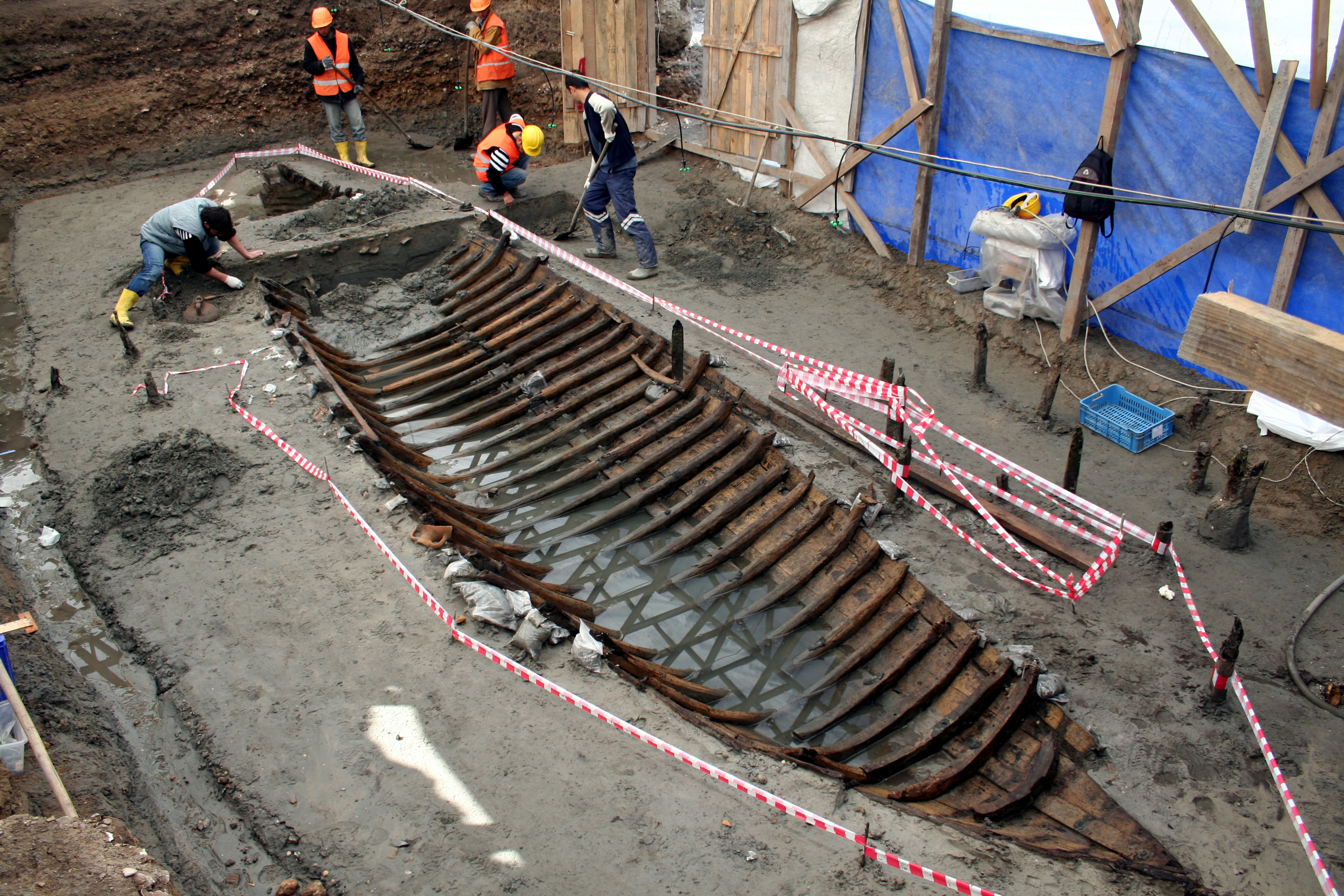
When construction began at Yenikapı on Istanbul’s European shore in 2004, workers hit ancient sediment almost at once. Archaeologists were called in. The excavation that followed ran for nearly a decade alongside the construction work, recovering artifacts that span more than eight millennia of continuous human habitation in one of the world’s most historically layered cities.
The numbers alone are extraordinary. Over 60,000 objects were recovered: ceramic vessels, tools, jewelry, coins, personal effects. 37 Byzantine shipwrecks — the largest collection of medieval ships ever found in a single location — lay beneath the harbor sediment, some with their cargo still intact. Human skeletal remains were found at multiple levels. And at the deepest accessible stratum, investigators found something almost surreal: 8,500-year-old human footprints, pressed into the mud of a Neolithic shoreline that is now deep below the modern city.

Yenikapı was the ancient harbor of Theodosius — one of the great commercial ports of the Byzantine capital, built in the 4th century AD and used for centuries as the main gateway for trade arriving from across the Mediterranean and beyond. It was eventually filled in and built over as the city expanded. The Marmaray excavation reached down through that fill and found it again, intact.
Among the thousands of objects pulled from the harbor sediment: a pair of women’s wooden sandals, Byzantine-era, with an inscription in Greek carved into the upper surface.
The Message No One Was Supposed to Read
The Greek letters spell out a blessing in a style typical of the late Roman and Byzantine world — direct, warm, personal.
ΥΓΙΕΝΟΥCΑΧΡΩ ΚΥΡΙΑΚΑΛΕ — transliterated and translated as: “Use in health, lady. Wear in beauty and happiness.”
Below the inscription, carved into the same face: a bird motif, possibly a dove or a pelican, flanked by what appear to be flowering branches. A small visual prayer to accompany the written one.
The sandal is made of wood — likely a single piece shaped by a craftsman and fitted with straps, in a style common across the Byzantine world. It is not a luxury object. The woman who wore it was not aristocratic — no gold threading, no fine leather, none of the expensive colored dyes that marked Byzantine footwear of the very wealthy. She was, most likely, a woman of moderate means in one of the world’s great cities: someone who lived, worked, walked the flagstones of Constantinople, navigated its markets and churches and harbor districts.
Someone who received a pair of sandals with a blessing carved into them, from someone who wanted her to know, at the moment she put them on each morning, that she was loved.

Footwear as Intimacy
The detail that makes this object so striking — in a dig that produced shipwrecks and ancient footprints and thousands of artifacts — is the location of the inscription.
Inside a shoe. Facing the foot.
Not on the outside of the sandal, where passersby might admire the craftsmanship. Not engraved on a ring or pendant that could be shown to the world. On the inner surface, pressed against the sole of the foot, invisible whenever the sandal is worn. A message entirely private: shared between the giver, the maker, and the wearer.
We don’t know who gave the sandals. A husband, perhaps. A mother. A close friend. A craftsman who made them as a gift for someone he cared for. Byzantine culture was warm on this kind of private expression — personal blessings carved into objects, good wishes inscribed on intimate items, the language of affection rendered in small, hidden gestures. Several comparable objects have survived from the period: rings with inscriptions on the inner band, combs with blessings on the spine, amulets worn close to the skin.
What distinguished this practice was the belief — present in Roman and Byzantine culture alike — that words have power, that a blessing spoken or carved is more than sentiment. The inscription on the sandal was not merely decorative. It was, in the worldview of its maker, an act of protection: a wish pressed against the body of the person who needed it, renewed every morning when the sandal was put on.
Every step this woman took in Constantinople, she walked on a blessing.
A Woman in Constantinople
Constantinople in the Byzantine period was among the largest and richest cities in the world — at its 6th-century height under Justinian, home to perhaps half a million people, the center of a Christian empire that considered itself the direct continuation of Rome.
Its streets ran from the imperial palace on the Propontis shore to the great forum districts, the Hippodrome where crowds of tens of thousands gathered for chariot races, the Church of Hagia Sophia whose dome seemed to float on light. The harbor of Theodosius would have smelled of salt and pitch, fish and grain and spices, the ropes and timber of ships from Alexandria and Antioch and Carthage.
The woman who wore these sandals walked through some version of that city. She walked to market, to church, to the harbor, perhaps through its narrow residential streets. She wore sandals that someone had carved a wish for her into — and she took them off at the end of each day, and put them on again each morning, and eventually they were lost or discarded or left behind in the harbor sediment, where they remained for more than a thousand years.
The engineers who came for the railway found them. The inscription, when cleaned, was still legible. The Greek is still grammatically correct. The wish still works, in every language it has been translated into since.
Use in health, lady. Wear in beauty and happiness.
She has been dead for a thousand years. She is still being wished well.