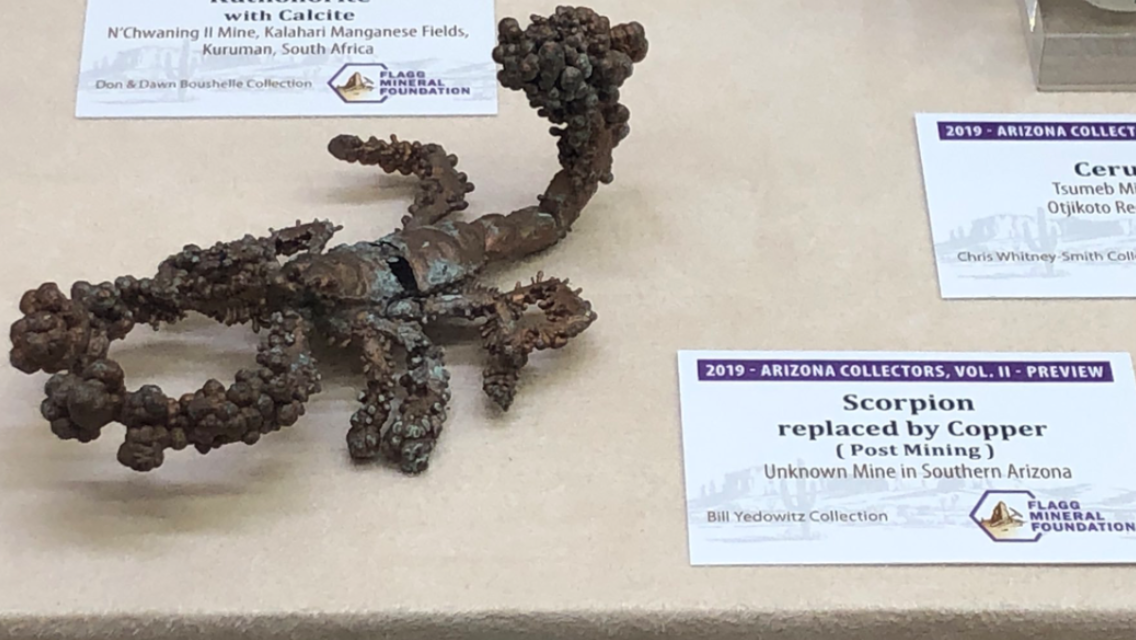
The first thing people notice is the tail.
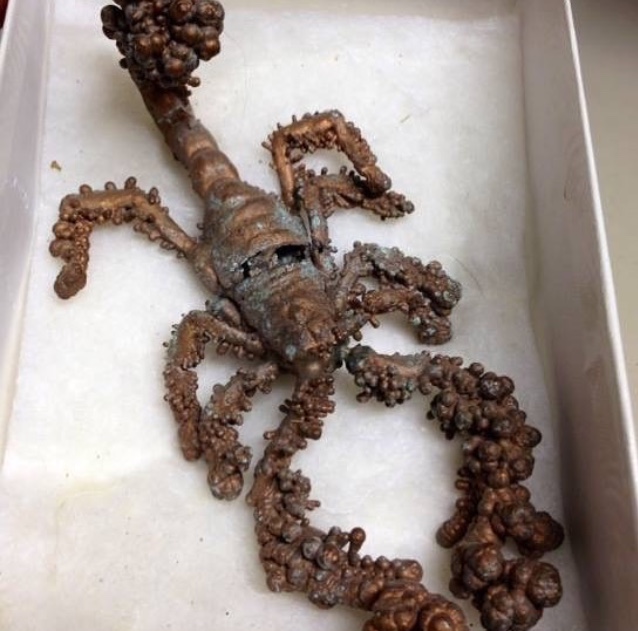
Every segment is there. The curve of it, the barb at the tip, the joints that should flex — all frozen mid-arch, catching the light with the dull warm gleam of raw copper. Then the claws. Then the legs, each tiny hair somehow rendered in metal. It looks less like a fossil than like something a master jeweler spent a lifetime casting. Except, according to the story, no human hand shaped it at all.
It’s a scorpion. And somehow, it appears to have become solid copper. The question that has followed it for years isn’t just how — it’s whether the story is even true.

What we were told
The tale usually begins in a copper mine in southern Arizona, sometime in the late 1990s. A worker, it’s said, found a scorpion entombed in the rock — except this one didn’t crumble or rot. It had the weight and sheen of metal.
The specimen later surfaced at the 2019 Tucson Gem and Mineral Show, one of the most respected mineral gatherings on Earth, the kind of event frequented by museum curators and university geologists. Photographs circulated. Collectors marveled. The piece, reportedly, passed from hand to hand and into a private collection, with no price ever placed on it.
But that’s not the whole story.
What was actually found
What the object seems to show is staggering. Not a scorpion covered in copper, but a scorpion that has, in effect, become copper — every external detail preserved with a fidelity that borders on the absurd.
There’s even a name for how this could happen: encrustation pseudomorphism. It’s the same family of processes that gives us petrified wood. A creature dies and is sealed in rock. Mineral-rich water — here, water heavy with dissolved copper — seeps through the cracks. As it evaporates, it leaves metal behind, molecule by molecule, plating every surface. The organic body slowly breaks down and vanishes. What’s left is a hollow, perfect metal shell. A cast made by chemistry alone.
Nature, in this telling, performed its own lost-wax sculpture — and signed it in copper.
And Arizona, of all places, is where it might happen. The region sits atop some of the richest copper deposits on the planet, the legacy of ancient hydrothermal activity that forced metal-laden fluids up through the crust for millions of years. If there is anywhere on Earth a scorpion could plausibly be drowned in copper, it is here.
The detail that changes everything
And here is what no one has satisfactorily explained.
There is no verified record of the find. No documented mine, no name attached to the worker, no excavation report, no chain of custody before the specimen simply appeared at a gem show. For an object this extraordinary, the paper trail is almost eerily thin.
Skeptics point to something else, too. There is a well-known craft technique — electroforming — in which a real object is coated in metal in a chemical bath, building up a flawless copper skin in hours. Hobbyists do it to leaves, insects, and yes, scorpions, selling the results as jewelry and curios. The end product can look exactly like a natural pseudomorph.
So which is it? A million-year accident of geology — or an afternoon’s work in someone’s garage?
The mystery
This is where the copper scorpion stops being a specimen and becomes a puzzle.
Examine the photographs and you can argue it either way. The detail is too perfect, say the doubters — too even, too complete, more like a deliberate plating than the patchy, messy work of seeping groundwater. The detail is exactly what you’d expect, counter the believers — encrustation follows every contour it touches, and Arizona’s chemistry is uniquely suited to it.
The unsettling part is that, without cutting the thing open and analyzing its core, no one can be certain. A natural pseudomorph would be hollow or rock-cored where the body decayed. An electroformed fake would have a different signature entirely. But the specimen sits in a private collection now, unexamined, unpriced, possibly never to be tested.
It is famous precisely because it cannot be resolved.
So what could it really be?
Three possibilities hang over it, and each has its defenders.
The first: it is genuine — a true encrustation pseudomorph, a once-in-a-generation freak of Arizona’s copper-soaked geology, exactly as the story claims.
The second: it is electroformed — a real scorpion turned into art in a chemical bath, beautiful and entirely man-made, its “discovery” story added later to give it mystique.
The third, and perhaps the most honest: it is real metal over a real scorpion, but the line between “nature did it” and “a person did it” has simply been lost — the truth dissolved along with the original creature’s body.
No one can say for certain. And that may be the point.
Why it still haunts us
What makes the copper scorpion linger isn’t the metal. It’s the doubt.
We like our wonders authenticated — stamped, dated, filed in a museum drawer. This one resists all of that. It is gorgeous and plausible and completely unverifiable, sitting in the exact gap where science, craft, and storytelling blur into one another. It asks an uncomfortable question: how many of the marvels we share online are real, how many are made, and how often can we actually tell the difference?
Maybe the Earth really does make art, slowly and without asking for credit. Or maybe we just want it to so badly that we’ll believe a scorpion can turn to copper on the strength of a photograph and a good story.
So here’s the thought to sit with: if you’d pulled this gleaming thing out of the dark of a mine, turning it over in your hand — would you have believed it was real? And how would you ever prove it?