At nearly 16,000 feet above sea level, in a bowl of rock and snow in the Indian Himalayas, there is a small glacial lake less than 50 meters across.
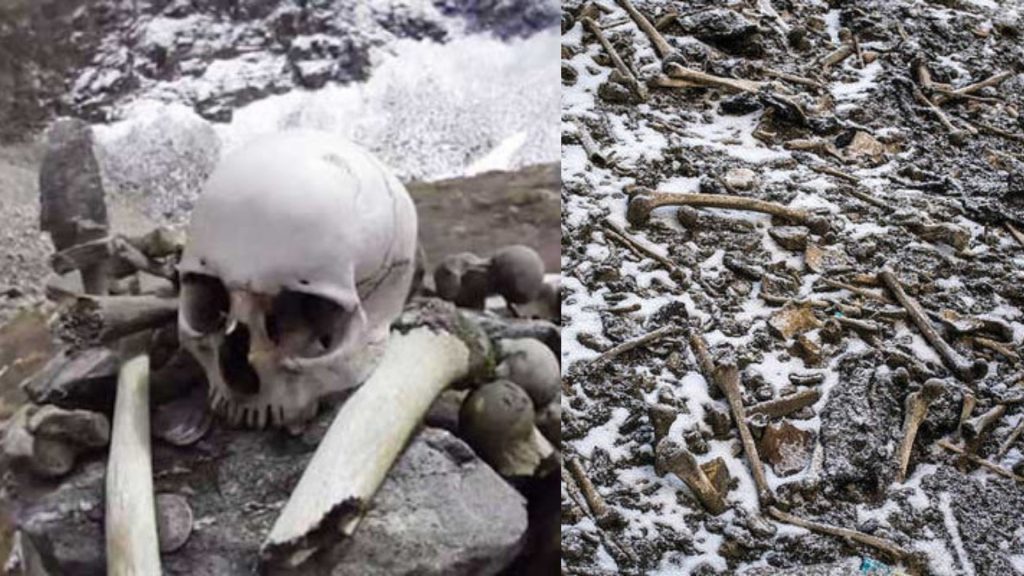
For most of the year, it is frozen solid and invisible — buried under snowpack, unreachable, unknown to anyone passing beneath the ridgeline. But for a few weeks each summer, the snow and ice retreat slightly. The meltwater stirs. And from the shallows and the shoreline, the lake gives back what has been frozen inside it.
Human bones. Hundreds of them. Skulls. Femurs. Ribs. A shoreline scattered with the remains of people who should not be here — who have no reason, by any accounting, to have died this far up the side of a Himalayan mountain.

Welcome to Roopkund. The Skeleton Lake.
The Discovery That Launched a Mystery
The site was first brought to international attention in **1942**, when a British forest ranger named H.K. Madhwal came across the remains during a patrol. The scale of what he found — hundreds of skeletons, with weapons, leather goods, wooden artifacts, and fragments of iron still scattered among them — prompted wartime concern that it might be the remains of Japanese soldiers who had died attempting a covert mountain crossing.
That theory was quickly dismissed. The bones were too old. Whatever had happened at Roopkund had happened long before the Second World War.
The explanation that took hold for the next several decades was elegant, dramatic, and satisfying: a **catastrophic hailstorm**. The lake sits in a natural depression with no shelter, on a route traditionally used by Hindu pilgrims heading to the shrine of the goddess Nanda Devi. The theory held that a large group of pilgrims — perhaps several hundred — had been caught by a sudden storm in this exposed location, and that the stones of ice had killed them where they stood. Damage patterns on some skulls appeared consistent with blunt impact from above. The elevation and terrain would have made escape impossible. A single terrible event, a single group, a single answer.
For decades, this was the story.
2019: DNA Rewrites Everything
In 2019, a team of researchers published findings in the journal *Nature Communications* that shattered the tidy hailstorm narrative.
They conducted genetic analysis on 38 individuals from the Roopkund site — a fraction of the total remains, but large enough to reveal a pattern. What they found was not one group. Not one event. Not one era.
**At least three distinct population groups were present.**
The largest group had **South Asian ancestry** — consistent with pilgrims from the Indian subcontinent — and carbon dating placed their deaths between roughly the **7th and 10th centuries AD**. This group fits the hailstorm narrative reasonably well.
But the second group was something else entirely. These individuals had **eastern Mediterranean ancestry** — genetically similar to populations from **Crete and the broader Greek island region** — and they died not in the medieval period but in the **17th to 19th centuries AD**, more than a thousand years later. They were not traveling with the South Asian group. They arrived separately, at a different point in history, and died at the same remote lake.
A third smaller group had ancestry linked to **Southeast Asia**.
The story was no longer “a group of pilgrims killed in a storm.” It was something far stranger: **multiple groups of people, from radically different parts of the world, across more than a thousand years, all dying at the same spot in the Himalayas.**

The Question That Has No Answer
The Mediterranean group is the one that haunts researchers most.
Roopkund sits at the end of a pilgrimage trail used by Hindu devotees to reach the Nanda Devi shrine — a route with deep religious significance for communities in the Kumaon Himalaya region of Uttarakhand. The presence of South Asian pilgrims, even those who died in a storm a thousand years ago, fits this context.
But eastern Mediterranean individuals — people genetically similar to Cretans, to Greeks, to the island populations of the Aegean Sea — visiting this specific, remote, high-altitude location in the 1700s or 1800s?
There is no historical record of such a journey. No account, in any European archive, of a group from the Mediterranean making a pilgrimage to a remote Hindu shrine in the Indian Himalayas. No obvious reason why Cretan or Greek islanders would have known about this location, let alone traveled to it.
The researchers who published the 2019 findings were explicit about this: they could not explain it. The DNA evidence was clear — these individuals were from the eastern Mediterranean. The dating was clear — they died in the early modern period. But why they were at Roopkund, what brought them there, and how they died in the same place that had already claimed hundreds of lives centuries earlier: **unknown.**
Some researchers have speculated they may have been mercenaries, traders, or travelers caught up in an Indian military or pilgrimage expedition. Others have suggested the pilgrimage route may have had more international traffic than any historical record captures. One fringe theory proposes they were part of a group brought to the site as paid laborers or ritual participants.

None of these explanations is supported by direct evidence.
What the Bones Preserve
Part of what makes Roopkund so remarkable — and so disturbing — is its state of preservation.
At 16,000 feet, in sub-freezing temperatures for most of the year, the lake acts as a freezer. Organic materials that would decay in weeks at lower altitudes can survive for centuries here. Researchers have found not just bones but **hair, nails, flesh fragments, leather sandals, wooden implements, bamboo staves, and iron rings** — a snapshot of what these people were carrying when they died, preserved in the ice for up to fourteen centuries.
Some artifacts match the material culture of Himalayan pilgrimage traditions. Others are anomalous — inconsistent with anything documented in the region. The leather sandals worn by the Mediterranean group are of a style not associated with any known Indian tradition.
The lake is, in the most literal sense, an unsolved crime scene — except that whatever happened here was not a crime, and the victims cannot be interviewed, and the witnesses are bones.
A Lake That Keeps Its Secrets
Every few years, a new study adds a piece to the puzzle — or removes one. The DNA work of 2019 did not answer the mystery. It multiplied it.
What we know: hundreds of people died at Roopkund over more than a thousand years of human history, from multiple different cultures across enormous distances. What we do not know: why they came, what killed each of them, and what connection — if any — links the medieval South Asian pilgrims to the modern Mediterranean travelers to the Southeast Asian individuals found in the same icy shallows.
The lake freezes again every autumn. The bones go back under the ice. The mountain keeps its silence.
And somewhere at the bottom of a 50-meter glacial pool in the Himalayas, 800 people are still waiting for an explanation.