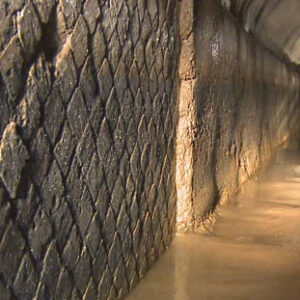
At nearly 8,800 meters, the air holds barely a third of the oxygen your body expects. The cold doesn’t bite — it erases. Climbers say the silence up here is total, the kind that lets you hear your own heartbeat. And it is exactly here, in the most lethally hostile place on the planet’s surface, that a climber can crouch, brush away a skin of ice, and rest a gloved finger on the unmistakable coil of a creature that once drifted through warm seawater.
A seashell. On the roof of the world. Pressed into the stone as casually as a leaf in wet cement. It has no business being there — and yet there it is, woven through the rock of the highest place humans have ever stood.

What the mountain looks like from below
We tell Everest’s story as a story of height. The tallest. The deadliest. The ultimate summit. We measure it in meters above sea level, in oxygen bottles, in the names of those who never came down.
That’s the version everyone knows: Everest as the planet’s great vertical dare, a spike of rock thrust into the jet stream.
But that’s not the whole story. Because the rock itself remembers a completely different life — one spent not in the sky, but at the bottom of a tropical sea.
What the climbers actually walk past
The fossils are not rare curiosities locked in a museum drawer. They are in the mountain. The pale rock near the summit — a unit geologists call the Qomolangma Formation — is limestone, and limestone forms only one way: slowly, on a sea floor, as the shells and skeletons of countless dead sea creatures settle and compress over unimaginable spans of time.
Read that again. The summit of Everest is built, in part, from the graveyard of a vanished ocean.
The highest point on Earth is made of the bottom of a sea.
The detail that changes everything
Climbers even have a name for one layer of it. On the upper mountain runs a conspicuous stripe of pale, marbled limestone known as the “Yellow Band” — so distinct that mountaineers use it as a landmark on the final push toward the top. And that same band is studded with the wreckage of marine life: the broken stems of crinoids, the “sea lilies” that once anchored to the seabed and swayed in the current. In places, geologists say, crinoid fragments make up a measurable share of the rock itself.
They are not alone. The summit limestone also carries trilobites, lamp shells, and the shells of tiny shrimp-like creatures — a whole community of animals that lived, by current estimates, somewhere between 520 and 443 million years ago. That is staggeringly old. Older than the dinosaurs by hundreds of millions of years. Older than almost anything that ever crawled onto land.
And here is what makes the mind stall: every one of those creatures lived and died at the bottom of a warm, shallow sea — a vanished ocean that no map has ever shown.
The force that no one was meant to survive watching
So how does an ocean climb into the sky?

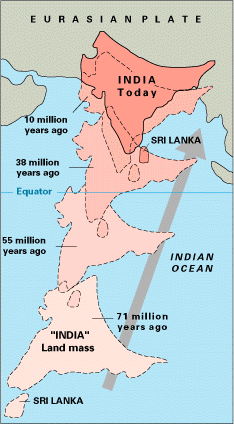
The answer is a collision so slow it makes glaciers look frantic. Around 50 million years ago, the tectonic plate carrying India — drifting north across the planet for ages — slammed into the Eurasian plate. Not in a moment. In a grind that is still happening right now, beneath the feet of anyone standing in the Himalayas.
There was an ocean between those two continents once. Geologists call it the Tethys. As India pressed in, that sea was squeezed out of existence, and the sediment on its floor — the limestone, the crinoids, the trilobites — had nowhere to go but up. The crust buckled and folded like a rug shoved against a wall, and the seabed rose, and rose, and rose.
The mountains we climb are the wreckage of that collision. The fossils are the sea floor that got caught in the wave and froze mid-rise.
So what could it really be telling us?
Some read Everest’s fossils as the single most elegant proof of plate tectonics ever offered — a theory once mocked, now written in stone at the highest address on Earth. The continents move. Here is the receipt.
Others see something stranger and more humbling: a clock. Because Everest is not finished. Driven by that same relentless tectonic shove, the mountain is still creeping upward by a few millimeters every year. The collision that drowned a sea and raised a mountain range has not ended. We are simply living inside one frame of it.
And a few are haunted by the simplest reading of all: that “permanent” is a story the human lifespan tells us. Mountains are temporary. Oceans are temporary. The ground itself is a slow liquid. No one can say what these rocks will be in another fifty million years. And that may be the point.
Why it still haunts us
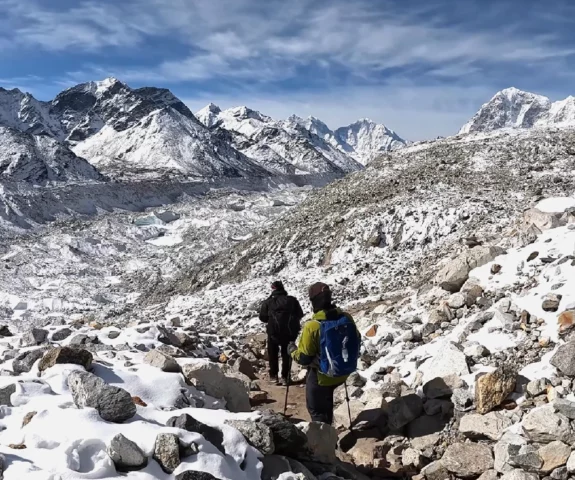
There’s a particular vertigo in standing on something so high and realizing it was once so low. It collapses the story we tell ourselves about a solid, settled world. The summit and the sea floor are not opposites. They are the same rock, caught at two different moments of an argument between continents that has been going on far longer than there have been eyes to watch it.
The climbers who reach the top are chasing the sky. What many don’t realize is that they’ve also reached the deep past — that the last layer they cross before the summit may hold a creature that never saw land, never felt air, and has now spent hundreds of millions of years closer to the stars than to the sea it was born in.
So here’s the thought worth carrying down the mountain: if the highest place on Earth used to be the bottom of the ocean — what is the ground beneath you right now slowly becoming?