The hillside above Montignac smelled of wet leaves and limestone. A dog had vanished down a narrow opening in the ground, and four teenagers were squeezing in after it, scraping their elbows on cold rock, the daylight shrinking to a coin behind them. Then someone lifted a lamp.
The walls moved.
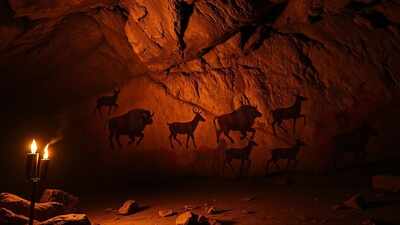
Horses galloped across the stone. Bulls lowered their heads to charge. Deer leapt in mid-stride, frozen but somehow alive in the flickering light. The boys had crawled into a cave looking for a lost pet in 1940. What they found instead, researchers believe, was a gallery roughly seventeen thousand years old.
And the first question is the one that still hasn’t fully gone away: who were the hands that did this, and how did they already understand things we assume were invented much later?
## What We Were Told
For a long time, the standard story about “cave men” was simple and a little condescending. Prehistoric people, we were taught, were crude survivors — grunting, scraping, scratching marks into rock. Art, real art with depth and intention, supposedly belonged to civilization, to cities and temples and much later centuries.
Lascaux, in southwestern France, refused to fit that story.
The paintings on its walls are not random scratches. They are compositions. Animals overlap and interact. There is a sense of motion, of weight, of muscle. According to accounts of the discovery, the work was so sophisticated that some experts initially suspected a hoax — a clever modern fake, because surely no one tens of thousands of years ago could paint like this.
They were wrong. The art was real. And that meant the story about who made it had to change.
## What Was Found
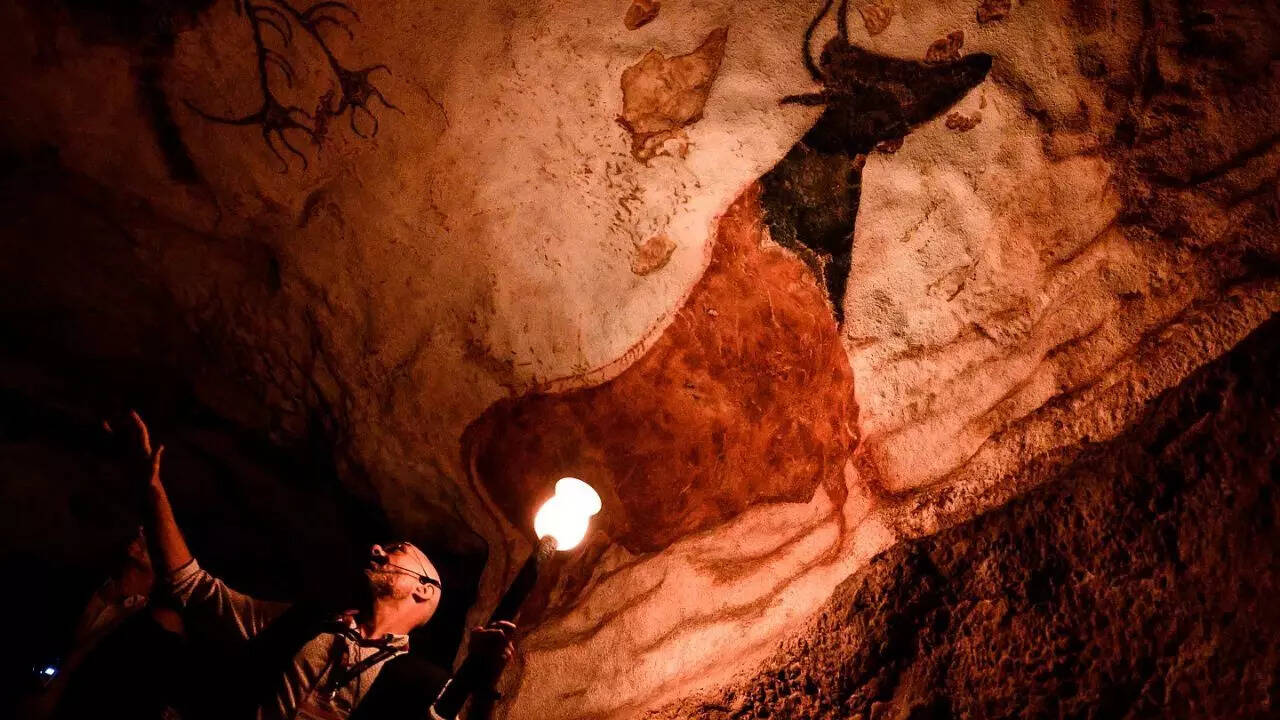
Inside, by lamplight, the chambers opened one into another, each surface crowded with figures. Bulls. Horses. Stags with branching antlers. Painted in warm ochres and dark outlines, layered across the natural curves of the rock so that the bulge of a stone became the swell of an animal’s flank.
Whoever painted Lascaux understood perspective. They understood movement. They used the contours of the cave itself as part of the image — a trick of shading and shape that gives the herds a strange, breathing life.
**These weren’t crude scratches. They were the work of people who understood perspective and motion, painting by firelight tens of thousands of years ago.**
There was no daylight in those chambers. Every line was laid down in the dark, by torch or stone lamp, by artists who had to hold the whole image in their minds while the flame guttered. That detail alone reframes everything.
## The Detail That Changes Everything
Here is the part that lingers. The same quality that makes Lascaux miraculous is now killing it.
For decades, visitors filed through the chambers to stand before the herds. But the human body is a quiet machine of breath, warmth, and moisture. Researchers found that our very presence — the carbon dioxide we exhale, the humidity we carry, the microbes we bring — was encouraging mold and decay to creep across paintings that had survived seventeen thousand years of silence.
So the cave was sealed. The original Lascaux is now closed to the public to protect it. The art that waited so patiently in the dark could not survive being looked at.
There is something almost unbearable in that. The thing that makes the paintings priceless is the same thing that makes them fragile. To love them too closely is to destroy them.
## The Central Mystery
We can describe Lascaux. We cannot fully explain it.

Why was it made? No one can say for certain. The chambers were not comfortable living spaces. People did not dwell deep in those dark galleries. They went in, painted, and left. The effort was enormous — pigments prepared, scaffolding possibly raised, light carried into the black. Something drove them to do it.
But the meaning is gone. We do not have their words, their names, their beliefs. We have only the images and the silence around them. The intention behind every charging bull is a door we can press against but never open.
## Competing Theories
Researchers have offered several careful ideas, and it’s worth holding more than one at once rather than declaring a winner.
Some suggest the paintings were a kind of **hunting magic** — that depicting the animals was an attempt to influence the hunt, to call the herds, to ensure survival. Others lean toward **ritual or ceremony**, the deep chambers serving as sacred spaces set apart from ordinary life, places of initiation or storytelling. A third view treats the cave as something closer to a **record or a map of meaning** — a way of marking the creatures that mattered, the seasons, the shared knowledge of a people.
Each theory fits some of the evidence. None of them closes the case. The honest answer is that we are guessing in the dark, much as the painters once worked there.
## Why It Still Haunts Us
What unsettles us about Lascaux is not that it is old. It is that it is familiar.
Look long enough at those horses and you stop seeing “prehistory” and start seeing a person — someone who saw a living animal, felt something about it, and reached for a way to keep it. That impulse is ours, too. Across seventeen thousand years, the gesture is identical.
The hands that made Lascaux are dust. But they reached forward through all that darkness to be seen, and they succeeded, because here we are, still staring.
So the question we’re left with is a quiet one: if everything you knew were erased — your language, your name, your history — and only the images you made survived, what would they say about you?
Tag someone who’d crawl into that cave with you to find out.