When paleontologists first eased that fossilized shell out of the rock in northern South America, there must have been a moment of stunned silence. This was no ordinary specimen. It was the shell of a turtle — but a shell stretching more than 2 meters (6.6 feet) in length, so large it was hard to believe it belonged to a turtle at all.
They named it Stupendemys geographicus, from the word “stupendous.” And the more they studied it, the more they realized the name was not an exaggeration.

An Eight-Million-Year Reign
The rock layers holding Stupendemys fossils date from the Middle Miocene to the early Pliocene — roughly 13 to 5 million years ago. For nearly eight million years, in one form or another, this turtle patrolled the rivers and swamps of a South America that looked nothing like the continent we know today.
It is the largest freshwater turtle science has ever documented. Its shell alone was longer than an adult human is tall. To stand beside a full-grown Stupendemys would have felt closer to standing beside a small car than beside any turtle alive now.
But it wasn’t the size that most puzzled researchers.
The Horns — and a Question Science Still Can’t Fully Answer
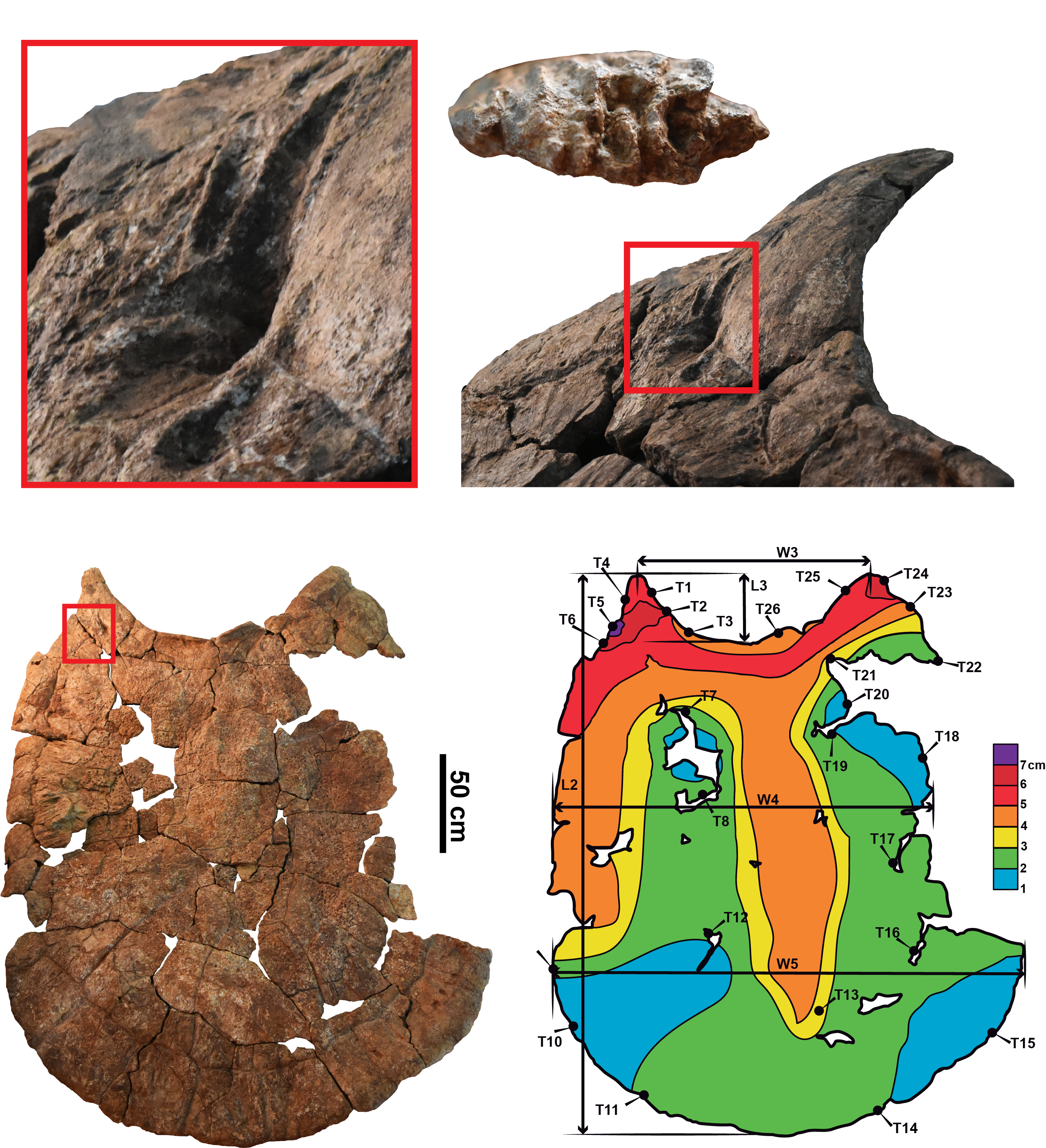
On the male specimens, along the front edges of the shell, sat two bony horns projecting forward — a feature almost unknown in any turtle, living or extinct.
So what were they for? Here is where the scientific method takes over.
Researchers noted exactly where the horns sat — precisely where two males swimming shell to shell would collide — and compared this with scarring found on numerous shells. The leading interpretation: the horns were weapons, used by rival males fighting over territory and mates. It is a reasoned inference, read from marks left in bone — not something ever witnessed. And scientists are careful to stop exactly where the evidence stops.

A 2-meter shell, tipped at the front with a pair of forward-facing horns — on the largest freshwater turtle that ever lived.
Reading a Whole Life From Fossils
One of the most revealing discoveries came from a younger specimen.
Comparing it with the giant adults, researchers realized that the shell flattened with age. Stupendemys did not simply scale up unchanged from hatchling to titan — its very shape shifted across a lifetime, the shell broadening and lowering over the years.
Then a fossil skull, described in recent research, added a crucial piece: its structure indicated that Stupendemys was a generalist feeder — not locked to a single food source, but an opportunist taking whatever the rich wetlands offered. A flexible survival strategy that helps explain how the species endured for millions of years.
Evidence of a Giant Predator
A 2-meter armored turtle should have been nearly untouchable. But the fossils tell a different story.
The same ecosystem was home to Purussaurus — a colossal caiman ranking among the largest crocodilians ever to exist. And direct evidence turned up: on at least one Stupendemys shell, researchers found deep puncture wounds, and in one case, a predator’s tooth still embedded in the bone.
It is a rare, tangible glimpse into an ancient food chain — proof that even a giant in armor had something willing to hunt it.

Why the Discovery Still Fascinates Science
Stupendemys is a reminder that evolution can turn the most familiar creatures into something far beyond imagination. A turtle — the very emblem of slowness and gentleness — once grew immense, grew horns, and had to survive among other giants. No fantastical explanation is required; the natural history is already extraordinary on its own.
The wetlands dried, the giants vanished, and Stupendemys left behind fossil shells for us to study. We can measure the size, read the scars, analyze the skull. But one question keeps science reaching forward:
How much more do those vanished ancient ecosystems still conceal — things we have not yet even imagined?
👇 Tag someone who loves paleontology and the strange, giant life of the prehistoric world.