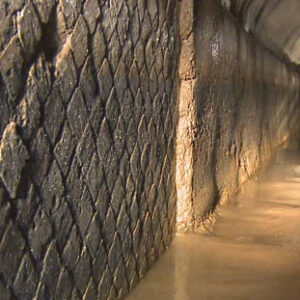
In the span of roughly fifty years — a single human lifetime, a brief chapter in the long story of recorded history — almost every great civilization around the Mediterranean Sea crumbled, burned, or simply ceased to exist. Mighty empires that had endured for centuries vanished. Trading cities that had connected continents were reduced to ash, never rebuilt. Writing systems were lost, and the populations that had used them forgot how to read entirely. A dark age settled over the ancient world and lasted for three hundred years.
This is the Bronze Age Collapse: one of the most dramatic and still-debated catastrophes in all of human history. And for a long time, it had a simple explanation. Then that explanation turned out to be far too simple.

### A World at Its Peak
To understand how catastrophic the collapse was, you first have to understand how sophisticated the Bronze Age world had become. By roughly 1300 BC, the eastern Mediterranean was home to an intricate web of interconnected civilizations that would not look out of place in a modern geopolitical analysis.
The Hittite Empire dominated Anatolia — modern Turkey — from its capital Hattusa, a city of temples, palaces, and archives containing thousands of clay tablets. Egypt under Ramesses II was at the height of its New Kingdom splendor, controlling vast territories and maintaining diplomatic correspondence with every major power from Babylon to the Aegean. The Mycenaean Greeks operated palace-based economies in cities like Mycenae, Tiryns, and Pylos, their Linear B script recording the careful accounting of grain, wool, and olive oil. Cyprus was a hub of copper production and trade. Ugarit, on the Syrian coast, was one of the ancient world’s great cosmopolitan trading cities, where merchants from Egypt, Canaan, Anatolia, Cyprus, and the Aegean all mingled and exchanged goods.

The system worked because of interdependence. Tin from Afghanistan and copper from Cyprus were mixed to make bronze, the essential metal of the age, and the alloy traveled along sea routes maintained by merchants from a dozen different peoples. Grain moved from Egypt to the Hittites. Purple dye from Canaan reached the Aegean. The palace economies of Mycenae depended on trade networks that stretched thousands of miles. Everything was connected.
And then, within a few decades on either side of 1200 BC, it all fell apart.
### The Dominoes Fall
The sequence of collapse is staggering when laid out in order. Ugarit was destroyed around 1185 BC — burned so thoroughly that it was never rebuilt, its final hours preserved in letters found in the ruins asking desperately for emergency grain ships and military aid that never arrived. “Ships from the enemy have been spotted at sea,” reads one letter, interrupted mid-composition; the city fell before it could be sent.

Hattusa, the Hittite capital, was burned and abandoned around 1200 BC. The Hittite Empire, which had once negotiated as an equal with Pharaonic Egypt, simply ceased to exist. Its texts and its language vanished from the historical record for over three thousand years, until archaeologists rediscovered them in the nineteenth century.
The Mycenaean palace centers were destroyed one after another — Mycenae, Tiryns, Pylos, all burned, their Linear B archives preserved ironically because the clay tablets were fired hard by the flames that destroyed the buildings around them. The scribal tradition that had maintained them died. Greece entered what historians call a Dark Age: centuries of sharply reduced population, simpler material culture, and complete illiteracy. The knowledge of how to write was lost, not recovered until the Greeks adapted the Phoenician alphabet around 800 BC, three centuries later.
Cyprus collapsed. The Canaanite city-states were destroyed or severely disrupted. Egypt survived, but weakened dramatically — the New Kingdom never fully recovered, and Egypt’s empire in the Levant contracted and eventually evaporated.

### The Sea Peoples: Villains of the Collapse?
The traditional explanation for all of this was a single dramatic cause: the Sea Peoples. Egyptian records, particularly the detailed inscriptions at Medinet Habu commemorating Ramesses III’s wars in the early twelfth century BC, describe waves of seafaring raiders and migrants sweeping down from the north, destroying everything in their path. The texts name specific groups — the Peleset, the Tjeker, the Shekelesh, the Denyen, the Weshesh — and describe them as an unstoppable force that had already destroyed the Hittites and the cities of the Levant before Ramesses turned them back at the borders of Egypt.
For a long time, scholars treated the Sea Peoples as the primary cause. They were the barbarians at the gate, the force that toppled a civilization. Their identity was debated endlessly — were the Peleset the later Philistines? Were some of them displaced Mycenaeans? Were others from Anatolia, or the Aegean islands, or somewhere further afield? The debates continue today.
But as more evidence accumulated, the Sea Peoples began to look less like a cause and more like a symptom. They appear in Egyptian records as a coherent threat, but the destruction at sites like Ugarit and Hattusa does not always match the pattern of external raid and conquest. Some sites show evidence of internal fire, possibly set by the inhabitants themselves. Others show signs of gradual abandonment rather than sudden attack. The Sea Peoples may have been real and genuinely disruptive — but they were probably not the whole story.

### A Systems Collapse
The modern consensus, articulated most compellingly by archaeologist Eric Cline in his 2014 book *1177 B.C.: The Year Civilization Collapsed*, is that the Bronze Age collapse was a systems collapse — not the result of a single cause, but of multiple stresses hitting an interconnected, interdependent world simultaneously, each one amplifying the others.
The evidence for this view is now substantial. Paleoclimatological data — pollen records, stable isotope analysis of lake sediments, tree ring studies — shows a prolonged drought gripping the eastern Mediterranean during the period of collapse, probably lasting for decades. Famine in a system dependent on grain redistribution from Egypt would have cascaded rapidly through every civilization that depended on that trade. Seismic evidence at several sites suggests earthquake activity. Internal social stresses, including possible revolts against palace economies that controlled access to resources, may have added to the pressure.

The Late Bronze Age world was an extraordinarily sophisticated system, but it was also an extraordinarily fragile one. Its strength — deep interdependence — was also its fatal weakness. When multiple threads began to fray simultaneously, the whole fabric came undone with terrifying speed.
A famous last letter from Ugarit captures the moment perfectly. Found in a kiln where it had been left to bake — and was therefore preserved when the city burned — it was sent from the king of Alashiya (probably Cyprus) to the king of Ugarit, warning of enemy ships sighted at sea and asking for grain. “There is no grain,” it ends. The king of Alashiya adds that he has no ships to spare — he needs them all himself.
No one ever replied. Ugarit was gone before the letter could be answered.
### The World That Came After
The collapse left scars that lasted for centuries. Greece’s Dark Age is the most dramatic example — three hundred years of dramatically reduced population, minimal long-distance trade, and lost literacy. But the Hittites simply ceased to exist as a political entity. The elaborate Bronze Age trading networks, the palace economies, the interconnected diplomatic world of the fourteenth and thirteenth centuries BC: all of it was gone, and it did not return in the same form.
When civilization re-emerged around the Mediterranean — the Iron Age civilizations of Phoenicia, Assyria, Neo-Babylonia, archaic Greece — it was a different world, built on different technologies, different political structures, different economic systems. The Bronze Age world was not merely disrupted. It was ended.

### Why It Still Matters
The Bronze Age Collapse carries an uncomfortable resonance for the modern world. We too live in a deeply interconnected global civilization, one in which the disruption of supply chains, the failure of critical systems, or the compounding of multiple simultaneous crises can have consequences that cascade far beyond their point of origin. The Late Bronze Age world had sophisticated diplomacy, long-range trade, advanced agriculture, and complex administrative systems — and it collapsed anyway, within living memory, leaving centuries of darkness behind it.
Eric Cline’s systems collapse thesis is not a counsel of despair. It is an argument for understanding the fragility of complexity — and for recognizing that when a civilization falls, it rarely falls for just one reason. It falls because many things went wrong at once, and no one could fix them all in time.
The last king of Ugarit was still waiting for his grain ships when the end came. He never saw them arrive.