It was found lying on top of a nest of eggs, in the Gobi Desert, in 1923.
The obvious story wrote itself. A small, sharp-beaked dinosaur, sprawled over a clutch of eggs that everyone assumed belonged to a plant-eater called Protoceratops. Caught in the act. A raider that died mid-robbery, buried by a collapsing dune with its crime frozen underneath it.
So in 1924 the great American palaeontologist Henry Fairfield Osborn gave it a name that fit the scene: Oviraptor — “egg thief.”
Here is the part almost nobody knows. Osborn didn’t fully believe it.

Quick Facts
| Name | Oviraptor philoceratops — “egg thief, lover of ceratops eggs” |
| Found | 1923, Gobi Desert, Mongolia — Central Asiatic Expedition |
| Named | 1924, by Henry Fairfield Osborn |
| The accusation | Caught on a nest, assumed to be stealing another dinosaur’s eggs |
| The correction | 1990s — the eggs were its own; it was brooding them |
| Sentence | The name can never be changed. It is a thief on paper forever. |
What We Were Told
For seventy years, the egg thief was everywhere.
It was in the textbooks and the museum labels. It was in the documentaries, always drawn the same way — crouched low, beak open, sneaking toward a nest that belonged to someone else. A whole generation of children learned the word Oviraptor as a synonym for a small feathered burglar.
The name did what names do. It decided what the animal was before anyone looked closer.
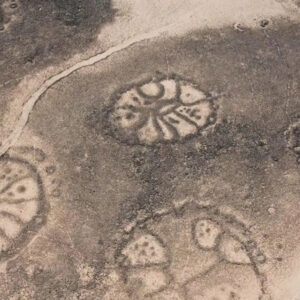
Image caption: The Gobi Desert of Mongolia, where the fossil was found on top of its nest.
What Was Found
The reckoning came in the 1990s, in the same desert.
Expeditions returned to the Gobi and found more of these animals in the same pose — sitting on nests, hindlimbs folded on either side, forelimbs spread out over the eggs. Not lunging at the clutch. Covering it. It is the exact posture a hen takes over her eggs today, and there is no mistaking it for anything else.
Then came the piece of evidence that ended the argument. Inside one of the eggs — the very type of egg the original “thief” had been found guarding — was an embryo. And the embryo was not a Protoceratops.

It was one of them. The eggs the animal was supposedly stealing were its own.
The Oviraptor had not been raiding a stranger’s nest. It had been sitting on its children, keeping them warm, when the sand came down and killed them all together.
Image caption: An oviraptorid preserved on its nest, forelimbs spread over the eggs — a brooding posture, not a robbery.
The Detail That Changes Everything
Go back to 1924, to the moment the name was chosen. Osborn wrote it down — egg thief — and then, in the same breath, he did something scientists rarely get credit for. He warned that it might be wrong.
He noted that the name “may entirely mislead us as to its feeding habits,” and raised the possibility that the animal might not have been eating those eggs at all.
He was right. He was right in 1924, in the same document that convicted the animal. And nobody listened for seventy years, because the name was catchier than the caveat.
The scientist saw the truth and flagged it. The label buried it anyway.

The Central Irony
Here is where it stops being a science story and starts being something harder.
The rules of zoological naming are strict, and they exist for good reason: once an animal has a valid scientific name, that name is permanent. It cannot be swapped out because we later decide it’s unfair, or embarrassing, or simply false. Stability matters more than accuracy of meaning.
Which means Oviraptor — egg thief — is stuck.
We know it wasn’t a thief. We can prove it wasn’t a thief. We have its embryo, its posture, its whole devoted death. And none of it can change the name. On every label, in every database, for as long as the species is discussed, it will be introduced as the thief it never was.
It is one of the few cases in science where we know we got something wrong, and the rules forbid us from fixing it.
Image caption: An Oviraptor skull. The beak once read as a tool for cracking stolen eggs.

Competing Readings
The tidy version is that this is a nice cautionary tale about jumping to conclusions, and it is that.
The harder version is about how much a single word can do. The animal did not change between 1924 and the 1990s. The bones were the same bones. What changed was that we finally read them without the name whispering “thief” in our ear the whole time. For seventy years the label was louder than the evidence, and it took an embryo — a baby dinosaur curled inside its shell, unmistakably the same species as the “robber” — to shout it down.
There is also a quieter point worth making, in fairness. Some of the clinching nest specimens belong to a very close cousin, Citipati, rather than to Oviraptor itself. But the reinterpretation reaches all the way back to the original animal: the eggs it was found on were oviraptorid eggs, its own kind. The thief was a parent. That much is settled.

Why It Still Haunts Us
Picture the last few seconds honestly.
A small animal, feathered, sitting low over a nest in a rising wind. Not fleeing. Not carrying an egg away in its jaws. Staying. Spreading itself over the clutch as the dune above it gave way, choosing, in the only way an animal can choose, to stay on top of its children rather than run.
That is the fossil. That is the actual event preserved in the stone.
And for the crime of dying in that exact position — over its own eggs, in the act of protecting them — it was named a thief, and will answer to that name forever.