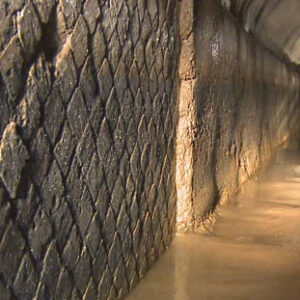
Cold, damp earth. Heavy volcanic stone. The faint scent of ancient dust escaping through a narrow gap. High on a cliffside in central Italy, archaeologists carefully pried back a heavy stone slab that had not budged since the 6th century BCE. Inside lay dark, impenetrable silence. As flashlight beams pierced the gloom, a scene frozen in time revealed itself—an untouched chamber where the dead had rested undisturbed for twenty-six centuries.
Image caption: The rocky cliffs and forested terrain of the San Giuliano necropolis in Lazio, Italy.

Quick Facts
| Field | Details |
| Legend / Subject | Intact Etruscan Rock-Cut Tomb |
| Earliest source | Archaeological excavation by Superintendence of Archaeology, Fine Arts and Landscape (2023–2024) |
| Key artifact | Iron spearhead, bronze ornaments, and intact black bucchero pottery |
| Location | San Giuliano Necropolis, Barbarano Romano, Italy |
| Mechanism / Claim | Hermetically sealed rock burial preserving an unbroken context of ancient funerary rituals |
| Scientific consensus | Undisturbed 6th-century BCE aristocratic Etruscan burial site spared by historic grave robbers |
Image caption: Archaeologists clearing sediment from the heavy volcanic tuff stone door at the tomb entrance.
What We Were Told

For centuries, historians believed virtually every major Etruscan tomb in central Italy had been thoroughly ransacked. From Renaissance tomb raiders to modern tombaroli, illicit diggers systematically plundered ancient necropolises, smashing sarcophagi and stealing precious metal artifacts. Finding a tomb in its original, pristine state was considered an impossibility reserved almost exclusively for Egyptian royal burials.
What Was Found
At the San Giuliano necropolis inside the Marturanum Regional Park, researchers breached a stone-sealed burial chamber. Resting on stone benches were the skeletal remains of at least two individuals—one confirmed as an adult male laid to rest with an iron spearhead. Surrounding the deceased were dozens of ceramic vessels, including pristine examples of high-status, pitch-black Etruscan bucchero pottery.
Every jar, dish, and weapon rested in the exact position it was placed twenty-six centuries ago.
Image caption: Pristine Etruscan bucchero pottery vessels arranged on the stone bench inside the chamber.

The Detail That Changes Everything
Finding a single unlooted burial chamber is a once-in-a-career event for any archaeologist. But this discovery carries a staggering statistical anomaly: it marks the second completely intact, unlooted Etruscan tomb uncovered in this exact same necropolis within a single twelve-month period. In a region where thousands of tombs have been stripped bare over two millennia, a double discovery of sealed chambers in one location is virtually unheard of in Mediterranean archaeology.
Image caption: Close-up of the iron spearhead resting near the skeletal remains of the warrior.
The Central Mystery
Why did this specific section of the San Giuliano cliffs remain entirely hidden from centuries of organized tomb raiders who systematically cleared out the surrounding hilltops? The presence of weapons alongside high-grade bucchero ceramic imports indicates high-status elite burials, yet these tombs lacked the visible monumentality that usually invited pillaging. Were these burials intentionally concealed using advanced rock-engineering, or did a natural catastrophic landslide bury the entrances shortly after the final funeral rites were performed?

Competing Theories
Deliberate Ritual Concealment: Some field researchers suggest the family or clan engineered hidden entrances and backfilled outer corridors with dense volcanic soil to shield their ancestors’ final resting places from rival families or external invaders.
Geological Landslide Event: Environmental archaeologists propose that natural cliff erosion and hillside collapses shortly after the 6th century BCE naturally sealed the tomb entrances beneath tons of rubble, preserving them from medieval and modern detection.
Scientific Consensus: Mainstream archaeologists conclude a combination of dense vegetation growth, natural soil accumulation, and sophisticated rock-cutting techniques rendered these specific chamber entrances invisible to historical grave robbers, preserving an unparalleled archaeological snapshot of Archaic Etruscan burial traditions.
Image caption: Architectural map showing the subterranean chamber layout and rock-cut benches of the San Giuliano tomb.

Why It Still Haunts Us
Stepping into a chamber untouched since the days of archaic Rome offers a hauntingly direct connection to human grief. The arrangements of cups, food offerings, and weapons speak of a family’s final goodbye 2,600 years ago. As excavators continue mapping the San Giuliano cliffs, one unsettling reality remains: how many more sealed doors are still waiting in the dark?