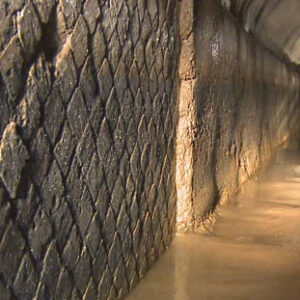
Deep beneath the Nullarbor Plain, ancient Australians left their fingerprints on the walls of a cave no sunlight has ever touched.
Quick Facts
| Detail | Verified Information |
|---|---|
| Location | Koonalda Cave, Nullarbor Plain, South Australia |
| Depth | Roughly 70 meters below the surface |
| Age | More than 22,000 years, confirmed by radiocarbon dating |
| Evidence | Finger flutings (hand-drawn markings), silica/flint mining debris, stone-working tools |
| Significance | First site in Australia to prove human “art” existed beyond the reach of natural light |
| Status | National Heritage listed since 2014; closed to the public since the late 1980s |
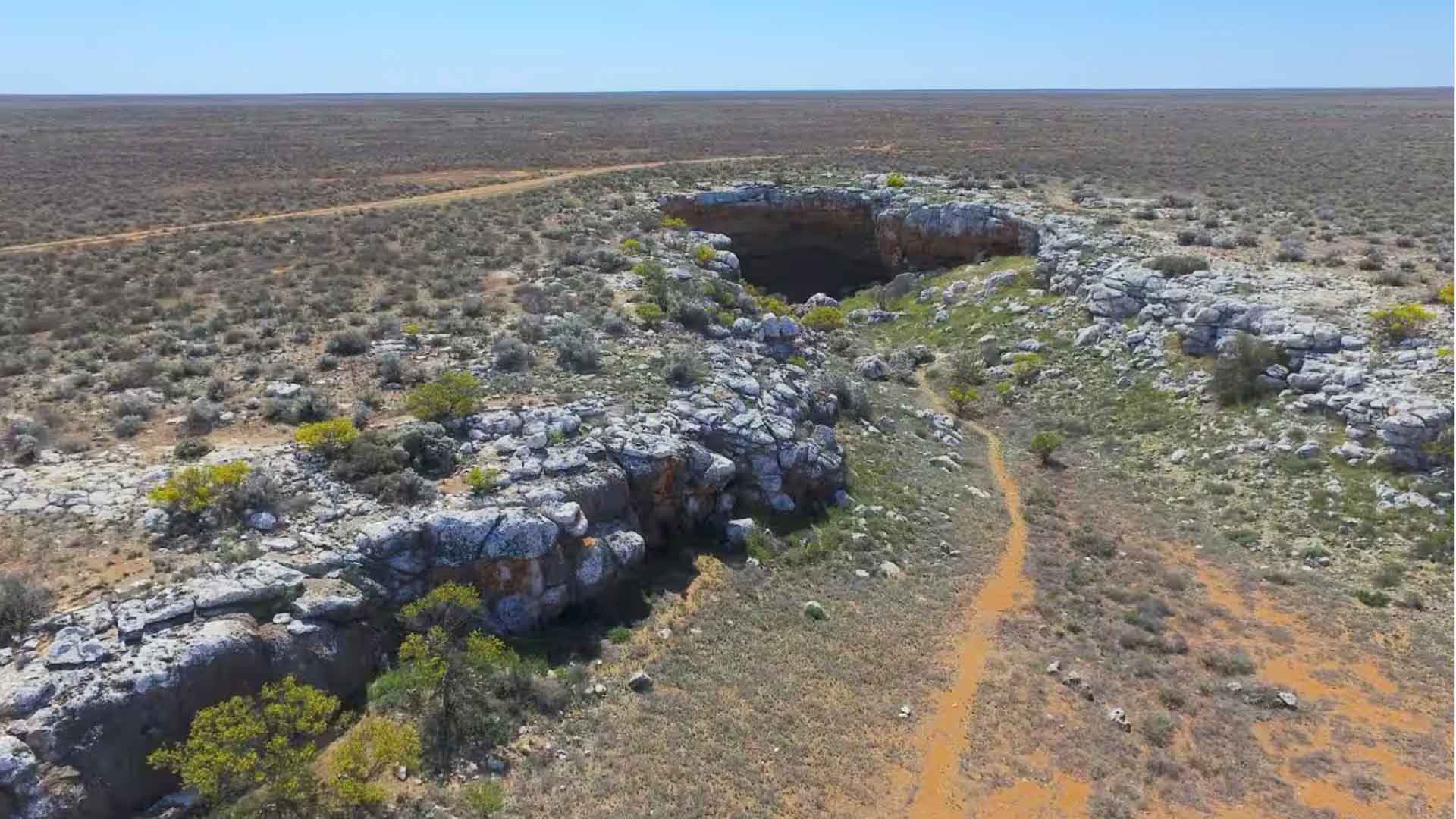
Image caption: The entrance sinkhole leading down into Koonalda Cave’s dark passages.

What We Were Told
Before Koonalda Cave was studied, Australian archaeology had a ceiling. The earliest confirmed human occupation on the continent was believed to date back no more than 8,700 years. Cave art, when it existed at all, was assumed to cluster near entrances — close enough for daylight to still reach the walls.
That assumption held until a Hungarian-born archaeologist, Dr. Alexander Gallus, began excavating Koonalda in 1956.
What Was Found
What Gallus uncovered rewrote the timeline entirely. Deep inside the cave, more than 70 meters below the Nullarbor Plain, he found markings unlike anything documented before in Australia: finger flutings, deliberate lines drawn by hand into the cave’s soft limestone walls, in chambers far beyond where any natural light could reach.
Image caption: Finger flutings — lines drawn by hand into soft limestone — cover sections of Koonalda Cave’s Art Passage.
Radiocarbon dating confirmed what Gallus had first proposed and what much of the archaeological community initially doubted: people had been in this cave, working by feel alone, more than 22,000 years ago.
Alongside the flutings, archaeologists found extensive evidence of silica mining — ancient Australians extracting high-quality stone for sharp tool-making, working through passages with no daylight at all. Stone-working debris and mining areas were found spread through a chamber deep underground, evidence of sustained, repeated visits rather than a single expedition.
The Detail That Changes Everything
The markings weren’t made near an entrance, where dim light might still filter in. They were made in total darkness, in passages requiring people to navigate, work, and create by touch and memory alone — likely aided only by torches or fires that left their own trace in the cave’s archaeological record.
Image caption: The Art Passage, deep within Koonalda Cave, where flutings were made far beyond the reach of daylight.
This is what elevated Koonalda from a significant find to a genuinely rare one: it was the first site in Australia to demonstrate that Aboriginal people were creating marks and mining resources in spaces that demanded deliberate, sustained effort just to reach — let alone work in.
The Central Mystery
The flutings themselves raise a question the archaeological record can’t fully answer: what were they for?
They aren’t figurative. They don’t depict animals, people, or recognizable scenes the way some Palaeolithic cave art in Europe does. They are lines — deliberate, repeated, covering large sections of cave wall in what researchers describe as an extensive “gallery.”
Whether they held ceremonial meaning, marked a rite of passage, recorded something now lost to time, or served a purpose entirely disconnected from what modern viewers assume “art” should do, remains unresolved.

Competing Theories
A functional byproduct. Some researchers have connected the flutings to the mining activity itself — markings possibly made in connection with, or alongside, the extraction of silica for tool-making, rather than as a separate artistic act.
Ceremonial or symbolic space. Early interpretation by Gallus proposed the cave held a form of sacred or symbolic significance, at one point suggesting an “altar” formed from naturally shaped flint nodules deliberately placed within the space. This specific interpretation has since been largely discredited by later researchers reassessing his work.
Comparable practice elsewhere. Similar finger-fluting techniques have been identified in Palaeolithic caves across southern France and northern Spain, suggesting this may reflect a form of human behavior — marking dark, hard-to-reach spaces by hand — that emerged independently in multiple parts of the world, rather than something unique to the Nullarbor.
No single theory has been confirmed. What’s certain is only that people came here, repeatedly, over a sustained period, entirely without the ability to see their own work.

Why It Still Haunts Us
There’s something specific about the darkness that makes Koonalda different from almost any other ancient site. A painted cave wall lit by sunlight is still, in some sense, made for an audience — even if that audience is long gone. A wall marked by feel alone, tens of meters underground, wasn’t made to be seen by anyone standing back and admiring it. It was made by someone who could not see it themselves.
Image caption: Koonalda Cave today — protected, restricted, and still holding markings made by hands that worked entirely in the dark.
Twenty-two thousand years later, we’re still asking what it would have taken to keep working, by feel alone, in a cave with absolutely no light — and why anyone thought it was worth doing at all.
Sources & further reading: Australian Department of Climate Change, Energy, the Environment and Water (DCCEEW); The Past; South Australia Native Title; Government of South Australia.