Imagine smiling and catching the light not on enamel, but on jade. More than a thousand years ago, in the rainforests of what is now Mexico and Central America, the Maya did exactly that. They drilled neat holes into their front teeth and set them with tiny discs of green jade and glittering stone, turning their own smiles into something between jewellery and ritual.

But the same culture that prized those jewelled teeth also lived in a world of war and sacred violence. At one ancient city, archaeologists opened a hidden cave and found the remains of twenty-four people who had been beheaded and dismembered — and among the dead were teeth still set with jade.
Smiles set with stone
Long before modern cosmetic dentistry, the ancient Maya were quietly performing some of the most remarkable dental work in history. The favourite material was jade — the green stone the Maya held sacred and associated with life, water and breath. But they also used pyrite, turquoise and dark hematite. A person might have several front teeth, top and bottom, each set with a single round gem, so that their smile flashed with colour.
This was not a fringe practice for a tiny elite. Studies of Maya remains suggest people across many levels of society modified their teeth in some way, though jewelled inlays were especially common among high-status men.

How they drilled jade into a living tooth
The Maya had no metal drills, no anaesthetic, and no modern understanding of infection — yet their dental work was precise and often successful. Researchers believe they used a drill tipped with hard stone, spun rapidly with a bow drill, with an abrasive slurry of powdered quartz and water doing the actual cutting. Chemical studies of the ancient sealants have found they may have contained compounds with antibacterial properties.
These were not crude carvings. They were delicate operations on living people, performed with stone and skill more than a thousand years ago.
The city called Uxul
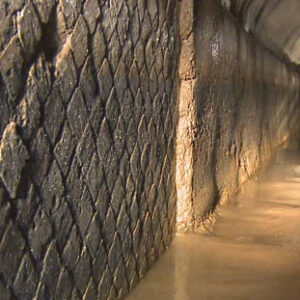
At the Maya city of Uxul in Campeche, Mexico, an archaeological team led by Nicolaus Seefeld of the University of Bonn was investigating an artificial cave that had once served as a water reservoir. What they found inside had nothing to do with water.
Packed into the chamber were human remains: a mass grave dated to roughly 1,400 years ago. Around twenty-four individuals — and the marks on those bones told a story of deliberate, violent death.

What the bones revealed
Cut marks scored the neck vertebrae, consistent with decapitation. Several skulls bore fractures from blows with a blunt instrument. Many bones carried cutting marks from stone axes. Of the fifteen individuals whose age and sex could be determined: thirteen men and two women. Some had teeth set with jade inlays — the mark of high social standing. Others showed signs of long-term malnutrition and tooth decay.
Captives, nobles, or something we can’t yet name
The period of burial coincides with Uxul being drawn into the orbit of the Snake Lords of Calakmul. Scholars offer two possibilities: captured enemy nobles ritually executed, or fallen members of Uxul’s own ruling class. The bones cannot tell us the ceremony, the words, or the beliefs. We have a genuine, carefully excavated record of ritual violence — no more, and no less.

Why these remains still speak to us
To find jade still set in the teeth of someone who died more than a millennium ago is to come face to face with a real individual. The discovery at Uxul holds two truths in the same breath: extraordinary artistry, and ritual violence we will never fully understand. We are not looking at monsters or at gods. We are looking at people — as complex, as contradictory, and as human as we are.