A severe 2026 drought has dragged a set of carved warnings back into daylight — stones meant to be read only when things had already gone wrong.

Quick Facts
| Detail | Verified Information |
|---|---|
| What | “Hunger stones” — boulders carved to mark historic drought and low-water years |
| Where | Elbe River, near Pirna (Germany) and Děčín (Czech Republic) |
| Pirna stone | More than 20 carved dates; oldest from 1707 |
| Děčín stone | Inscription “If you see me, weep,” added in 1904; dates on nearby stones trace back to 1616 |
| Trigger | Severe 2026 European drought, with Elbe water levels dropping sharply |
| Historical meaning | Signaled failed harvests, food shortages, and halted river transport |
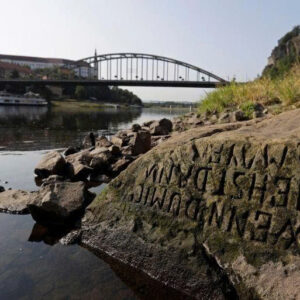
Image caption: A hunger stone exposed along the Elbe riverbed as water levels drop to historic lows.
What We Were Told
Rivers are supposed to be constant — a fixed feature of the landscape, background scenery for everything else that happens along their banks. For most of the year, that’s exactly what the Elbe is: water moving past towns that have depended on it for centuries, for trade, transport, and farming.
But the river has always had a way of telling on itself in the worst years. And in 2026, it did exactly that again.

What Was Found
As water levels on the Elbe dropped sharply across both Germany and the Czech Republic in 2026, a set of centuries-old boulders re-emerged from the riverbed — carved deliberately, over generations, to be visible only when the water fell low enough to expose them.
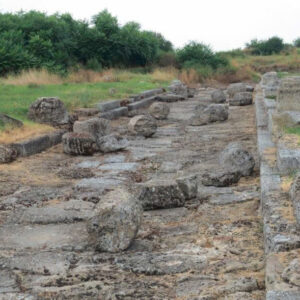
Image caption: The Elbe riverbed near Pirna, where a stone bearing more than 20 historic drought dates was uncovered in 2026.
Near Pirna, Germany, one exposed stone carries more than 20 separate dates, the oldest reaching back to 1707. Further along the same river, near Děčín in the Czech Republic, sits perhaps the most well-known of these markers — a boulder bearing the inscription “If you see me, weep,” added in 1904. Markings on that same stone trace recorded droughts back even further, to 1616.
These weren’t monuments built to be admired. They were practical records, carved by people whose livelihoods depended directly on the water — rafters, boatmen, and rivertown residents who tied specific years to specific hardship.
The Detail That Changes Everything
The stones weren’t warnings in the way a sign or an alarm is a warning. They couldn’t be read in advance. By the time anyone could see the carving, the drought had already arrived — the water was already gone.
Image caption: The inscription “Wenn du mich siehst, dann weine” — “If you see me, weep” — carved into a stone near Děčín in 1904.
That’s what gives the phrase its weight. It isn’t a prediction. It’s a message from people who had already lived through exactly what you’re living through now, addressed to whoever would eventually stand where they once stood — at the edge of a river that had failed them.

The Central Mystery
The stones don’t explain themselves. Most carry no more than a date, sometimes initials, occasionally a short phrase. The people who carved them left almost nothing else behind — no detailed accounts, no names attached to most of the markings, no record of exactly how bad each individual year became.
What survives is the pattern: 1616. 1707. 1904. 2026. A river that keeps returning to the same low point, generations apart, each time prompting someone to reach for a chisel instead of simply waiting for the water to rise again.
Competing Theories
There isn’t real scholarly disagreement about what hunger stones are or why they were made — the practice is documented and well understood. The more open question is what to make of their return today. Some see the resurfacing stones primarily as historical curiosities, a coincidence of hydrology repeating an old pattern. Others frame each reappearance as a more direct signal — that a river carved with generational drought markers is now recording modern droughts at a pace and severity earlier centuries never had to reckon with. Both readings rely on the same physical evidence; they differ only in how much significance to place on the stones showing up again at all.

Why It Still Haunts Us
Most historical warnings are written for people who haven’t experienced the thing being warned about yet. Hunger stones are the opposite. They were carved by people already standing in the exact circumstance — water gone, harvest failing, transport stopped — and addressed, deliberately, to whoever would eventually stand in that same place again.
Image caption: Low water levels along the Elbe in 2026, the conditions that exposed the stone at Pirna for the first time in years.
In 2026, someone did. The stones didn’t predict this drought. They simply outlasted enough of them to still be there when it arrived.
Sources & further reading: Euronews; Associated Press; NPR; Al Jazeera.