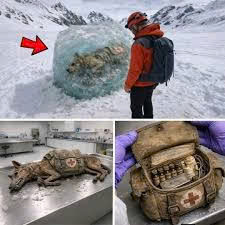
High in the ice, time stopped. Somewhere on a glacier — in terrain where wars were fought at altitude, where cold killed as readily as bullets — a dog lay down and did not rise again. Decades passed. The ice held its shape, its harness, its cargo. And then, without ceremony, researchers found it.
The discovery of a World War II medic dog, preserved in glacial ice with its medical kit still intact, is the kind of find that stops you cold. Not because of its scale — this is a single animal, a single life — but because of what it carries with it: the full weight of a war in which humans were not the only ones who served, suffered, and died.
Dogs at war
To understand what this dog was, it helps to understand what medic dogs did.
During both World Wars, and especially in the difficult mountain and alpine campaigns of World War II, dogs were trained and deployed for a range of military roles: carrying messages, detecting mines, guarding positions, and — most relevantly here — assisting the wounded. Medic dogs, sometimes called casualty dogs or Red Cross dogs, were trained to move across battlefields and locate injured soldiers who could not call for help.
Their role was not to provide treatment — that remained the work of human medics — but to find, signal, and sometimes carry. These dogs were fitted with saddlebag-style packs containing first aid supplies: bandages, antiseptic, perhaps small amounts of morphine. A wounded soldier who could reach the pack could treat himself while waiting for human help to arrive. The dog, meanwhile, would either stay with the casualty or return to guide a medic back.
Working in alpine terrain — steep slopes, thin air, blizzard conditions, the constant threat of avalanche — these animals operated under conditions that would have pushed any living creature to its limit.
They were not soldiers in any formal sense. But they served, and they died, in the same places and the same cold.

What the glacier preserved
What makes this discovery extraordinary is the quality of the preservation. Glacial ice, when it seals a body quickly and completely, can maintain organic material with remarkable fidelity — not quite the anaerobic chemistry of a peat bog, but cold enough and stable enough to prevent the decomposition that would otherwise erase almost everything.
In this case, researchers found not just bone but preserved soft tissue, fur, and — most strikingly — elements of the dog’s harness and the containers it carried. The medical supplies, kept in the pack the dog wore at the time of its death, had survived the decades in the ice. A natural time capsule, sealed at some point during the war and reopened by researchers in our own time.
The supplies themselves tell a story. Their design, materials, and contents reflect the logistics of alpine military medicine in the 1940s — compact, practical, designed to be carried by an animal across difficult ground and accessed by a soldier with cold, injured hands. Studying them gives historians a granular view of how mountain warfare was actually supplied, at the level of the individual casualty.

Reading the remains
Researchers are examining the dog’s remains with the same care they would bring to any significant archaeological find. Analysis of bone and tissue can reveal the animal’s approximate age, diet, and general health at the time of death. The harness and pack can be dated and matched to known military equipment, helping to narrow down which campaign, which unit, and potentially which theatre of the war the dog belonged to.
Alpine warfare in World War II was fought across multiple fronts — in Italy, in the Balkans, in the high passes of the Alps and the Caucasus. The exact location of this discovery, and the specific supplies found, may eventually allow historians to place this dog within a known operation.
What cannot be recovered, of course, is the dog’s name, or the name of its handler, or the precise circumstances of its death. Whether it was caught in an avalanche, died of cold, or fell in the course of some action we will never know, the animal ended its life doing what it was trained to do: somewhere on a glacier, in service.

Why this find moves us
There is a particular quality to animal remains from human conflicts. Unlike human soldiers, these animals had no ideology, no understanding of the cause they served, no choice in their deployment. They were trained, trusted, and sent into danger by the people who worked alongside them — and in many cases, those handlers grieved them as they would grieve any companion.
The frozen medic dog is a reminder that war’s reach extends far beyond the human. Horses, mules, pigeons, dogs — animals of every kind were drawn into twentieth-century conflicts, serving roles that ranged from the mundane to the genuinely heroic. Most of them left no record. Their deaths went unwitnessed, their remains unrecovered.
This one was different. The glacier kept it. And now, decades after the guns fell silent, we can see what it carried — and understand, a little more clearly, what the people who sent it into the cold were asking of the world around them.
Some finds remind us of power and ambition, of empires and dynasties. This one is quieter. It reminds us that in war, loyalty is not only a human quality — and that the cold keeps its secrets for a very long time.