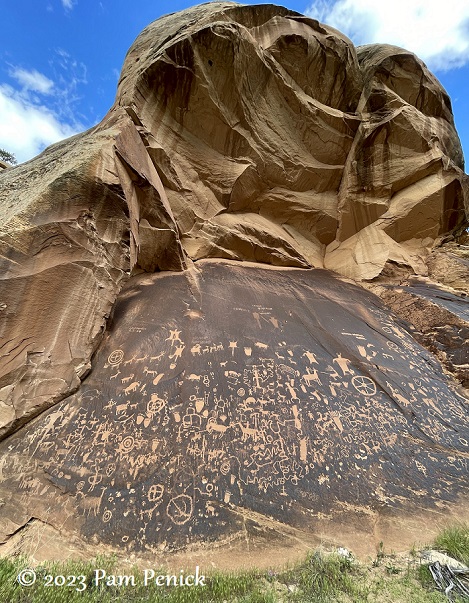
At first glance, it looks like nothing more than a weathered slab of dark stone at the base of a sandstone cliff.
Then your eyes begin to adjust.
Shapes emerge from the surface — animals in motion, hunters with bows raised, spirals, footprints, human figures, geometric symbols whose meanings dissolved with the people who carved them. The longer you stare, the more the stone gives back. And then the thought arrives, quiet and vertiginous: this wasn’t done in a single afternoon. It wasn’t the work of one person, or one generation.
Someone started it. Then someone else came back and added their mark beside it. Then another. Then another — for nearly **two thousand years**.
A Rock at the Edge of the Desert
Newspaper Rock State Historic Monument sits in San Juan County, Utah, along Highway 211 on the way into Canyonlands National Park. The site protects a single sandstone panel, roughly 20 feet across, sheltered by an overhanging cliff that kept it from the worst of the weather.
The rock face is dark — coated in desert varnish, a naturally occurring layer of manganese and iron oxides that builds up over centuries on exposed stone surfaces. Ancient people discovered that scraping through this dark coating revealed the lighter sandstone beneath, creating images that would endure for millennia.
The panel at Newspaper Rock reportedly holds more than **650 individual petroglyphs** — carvings made by multiple cultures across roughly 2,000 years. The Archaic peoples came first. Then the Ancestral Puebloans (also known as the Anasazi). Then the Fremont. Later, Navajo and Ute people added their own marks. Each group found the same wall — already covered in the marks of those who came before — and chose to add to it rather than find a blank surface somewhere else.

Why?
What the Carvings Show
The images at Newspaper Rock are as varied as the centuries that produced them. Some are immediately recognizable: deer, bighorn sheep, horses, human figures with outstretched arms. Others are harder to place — spirals and circles, abstract geometric forms, handprints, footprints both human and animal. A wheel-like symbol appears more than once. Hunters aim at animals. Animals stand alone, calm, as if unaware of the bows trained on them.
There are also images that don’t fit neatly into any known category. Figures with unusual headdresses. Creatures that seem to combine human and animal features. Symbols that archaeologists have studied for decades without reaching agreement on what they represent.
One detail quietly unsettles many visitors: the horse. Horses were not present in the American Southwest until Spanish colonizers reintroduced them in the 1500s. So some of the carvings showing horses are relatively recent — made by Navajo or Ute artists after European contact. They sit side by side with images that are a thousand years older, indistinguishable at a glance.
**The stone holds no dates, no labels. Everything is presented equally, as if time itself has been flattened into one continuous surface.**
The Mystery of the Return
What is harder to explain than the carvings themselves is the compulsion to keep coming back to the same wall.

There are thousands of rock art sites across the American Southwest. Blank stone was never in short supply. And yet, for two thousand years, people from entirely different cultures — speaking different languages, practicing different beliefs, living in different centuries — kept gravitating back to this particular panel in this particular canyon.
Some researchers suggest the site may have held spiritual significance, a place where the boundary between the ordinary world and something else felt thin. Others point to the practical: the canyon was a natural travel corridor, and this sheltered wall may have functioned as a kind of landmark or waypoint — a place travelers stopped and felt the pull to add their names to a growing ledger.
There is also the theory of accumulated importance: that the first carvings drew the second, which drew the third. That once a place becomes a site of human marking, it gathers a kind of gravity. Each new carving was an act of recognition — *I see what you left here. I was here too.*
None of these explanations has been proven. None has been ruled out.
What “Newspaper Rock” Really Means
The name is relatively modern — applied by Euro-American settlers who compared the dense surface to a crowded newspaper page. The Navajo name for the site, *Tse’ Hane’*, translates more honestly: **”rock that tells a story.”**
That name carries a quiet humility the modern one doesn’t. It doesn’t claim to understand the stories. It only acknowledges that they exist.
Because that’s what the site really forces on the visitor: the awareness that there is a story here — many stories, overlapping, contradicting, building on each other — and that we cannot read most of them. We see the marks. We cannot hear the voices.
We don’t know which carvings record a successful hunt and which record a dream. We don’t know which figures are gods and which are people. We don’t know what the spirals meant to the hands that made them, or what the wheel-like symbols were counting, or whether the person who carved a bighorn sheep beside a much older bighorn sheep was referencing the earlier carving deliberately, or simply found the spot beautiful and stopped.

**We are left with a surface covered in communication — and almost none of the language.**
A Conversation Across Two Thousand Years
There is something almost unbearably human about Newspaper Rock. Not the mystery of it — the familiarity.
The impulse to leave a mark. To say: *I was here. This mattered to me. I want whoever comes after to know that someone stood in this spot and felt something worth recording.* That impulse crosses every cultural boundary, every century. The Archaic hunter who scraped the first image into the dark varnish and the Ute artist who added a horse a thousand years later were doing, at some level, the same thing.
What changes is only the content — the particular animals, symbols, and figures each culture brought to the wall. What doesn’t change is the act itself: the choice to come to this exact place, pick up a stone tool, and add one more voice to a conversation that was already old.
We still do it. We carve initials into park benches. We scratch names into wet cement. We tattoo our skins and hang our photographs on walls. We publish and post and broadcast because the alternative — leaving no mark at all, passing through without record — feels like a kind of vanishing.
The people of Newspaper Rock understood that. Two thousand years of them understood it.