Deep inside the caves of Ice Age Europe, alongside the famous paintings of horses and bison and mammoths, there are other marks. Smaller, quieter, easier to overlook.
Dots. Lines. Triangles. Crosses. Spirals. Ladder-like forms and open-angle shapes and symbols that look like a letter Y or the letter P.
For most of the history of cave art research, these geometric signs were treated as secondary — decorative perhaps, or meaningless doodles, or incidental marks made by people testing their pigments on the cave wall. The animals were the message. The signs were noise.
Then a Canadian researcher named **Genevieve von Petzinger** decided to take a closer look.
The Survey
Von Petzinger spent years compiling data from more than **52 cave sites** across Europe — from Spain and France to Italy, Portugal, and beyond — cataloguing every geometric sign recorded at each location. The caves she studied span an enormous time range: the oldest relevant sites date to roughly **40,000 years ago**, and the tradition continues through the end of the last Ice Age, around **10,000 years ago**.

Previous researchers had noted geometric signs at individual sites. What von Petzinger did differently was systematic comparison across sites and time periods. Instead of asking “what do the signs at Lascaux mean?” she asked: “are the same signs appearing at multiple caves across thousands of years and hundreds of kilometers?”
The answer was striking.
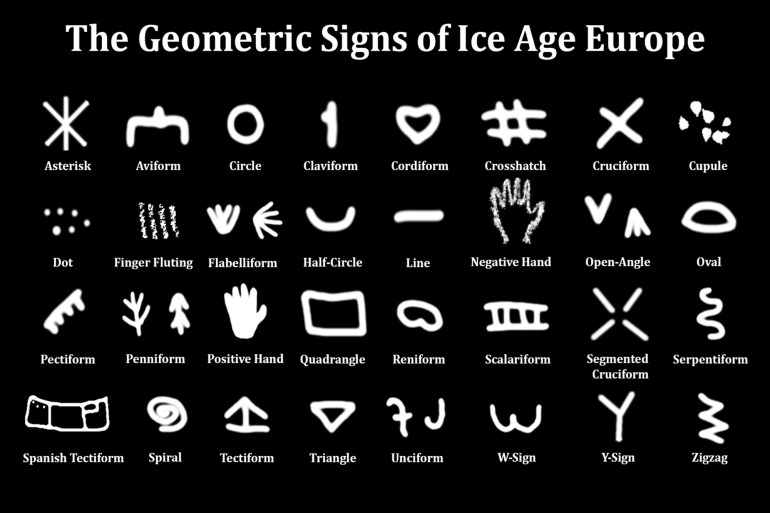
Across all 52 sites, von Petzinger identified **32 distinct geometric sign types** that appear repeatedly. Not a random scatter of idiosyncratic marks, but a consistent inventory of shapes that shows up again and again — the same forms, at the same scale of repetition, across the full span of Ice Age cave art in Europe.

The 32 Signs
The most commonly recurring forms include:
**Lines** — both single and grouped, including what researchers call “finger flutings” (lines traced in soft clay with fingers) and deliberate painted strokes.
**Dots** — appearing singly, in rows, in clusters, and in geometric arrangements.
**Triangles** — both filled and outlined, sometimes arranged in series.
**Spirals** — rare but consistent across multiple sites.
**Open angles** — V-shapes and chevron forms.
**Tectiform signs** — complex roof-like or tent-like shapes that appear consistently at several sites.
**Claviforms** — club-shaped symbols specific to particular regions and time periods.
**Aviform signs** — bird-like symbols.
**Cruciform signs** — cross-like shapes.

Some signs are more geographically distributed than others. Some appear to be more time-specific, clustered in particular periods of the Ice Age. But the core inventory — roughly 32 recognizable types — persists across the full spatial and temporal range of the dataset.
What This Suggests
Von Petzinger’s work raises a possibility that is difficult to dismiss: that the people who made these signs were not working independently, each inventing their own personal marks, but were drawing from a **shared visual vocabulary** that was transmitted across generations and across distances.
A random scatter of marks would show far more variety. If each individual or group were simply making whatever shapes felt natural, you would expect hundreds of different sign types, distributed unpredictably. Instead, you find a constrained set — 32 forms, repeatedly chosen over 30,000 years across a continent.
This is the hallmark of a **symbolic system**: not spontaneous mark-making, but the deliberate use of standardized forms that carry shared meaning.
Whether this constitutes “writing” in the technical sense depends on how you define the term. True writing, as most linguists use the word, encodes specific linguistic content — words, syllables, or phonemes — in a way that can be decoded by a reader who knows the system. We have no evidence that the Ice Age signs encode language in this way. We cannot read them.

But what von Petzinger argues — cautiously, with appropriate qualification — is that the signs represent the earliest phase of a process that eventually leads to writing: a proto-symbolic system in which shared visual forms carry consistent meaning within a community, transmitted through time and space as part of a cultural tradition.
The Oldest Mind We Can Almost Read
There is a deeper implication in this research that goes beyond the debate about writing systems.
Forty thousand years ago, the anatomically modern humans who painted the caves of southern Europe were cognitively indistinguishable from us. They had the same brains, the same neural architecture, the same capacity for abstract thought. What they did not have was writing, agriculture, cities, or the accumulated cultural technologies that we call civilization.
Von Petzinger’s signs suggest that even at this early date — perhaps from the very beginning of the behavioral modernity that defines our species — human beings were already doing something that is distinctly human: organizing experience into shared symbols, transmitting those symbols across generations, and building a visual language that could survive the death of any individual who used it.
The signs in the caves are not primitive. They are not childlike. They are the earliest legible evidence of minds like ours, working with the same fundamental capacity for abstraction that eventually produced alphabets, mathematics, and code.
Why the Animals Got All the Attention

The paintings of animals in Ice Age caves are spectacular. Horses at Chauvet, rendered with extraordinary skill and anatomical accuracy. Bison at Altamira, painted in a gallery so beautiful that when it was discovered in 1879, the academic establishment initially refused to believe it was prehistoric. The animals are vivid, dynamic, emotionally immediate — they hit something in us that responds before the analytical mind engages.
The geometric signs are harder to love. They don’t trigger the same response. They look, at first glance, like marks a child might make.
But they may be the more important discovery. Because the animals could be art — personal, individual, unrepeated. The signs are evidence of something else: a shared system, transmitted over time, encoding meaning in a form that survived the individuals who made it.
That is not decoration. That is language trying to be born.
Where the Research Stands
Von Petzinger’s work has been widely discussed among archaeologists and prehistoric anthropologists, and generally received as an important contribution to the field. Her 2016 book, *The First Signs*, brought the research to a broader audience.
The interpretation remains debated. Some researchers are more cautious about the “proto-writing” framing, preferring to describe the signs as evidence of symbolic behavior without making claims about linguistic encoding. Others have pushed further, arguing that some signs may encode specific information about seasons, animal behavior, or astronomical cycles — a hypothesis that remains controversial.
What is not debated is the basic finding: the same 32 signs, appearing across 52+ sites, spanning 30,000 years. Whatever those signs meant to the people who made them, they were not random. They were chosen. They were repeated. They were carried from one place to another, and from one generation to the next, for three hundred centuries.
We can see that much. The meaning behind it — the actual content of the message — is still in the dark.