For millions of years, it sat in the dark.
Compressed under unimaginable pressure. Subjected to heat that would have liquefied stone of lesser character. Formed in a collision so ancient it predates not only human civilization but the Himalayas themselves — the result of tectonic forces that pushed the Indian subcontinent northward into Asia and, in that slow catastrophic crumpling, created conditions precisely right for something extraordinary to crystallize deep in the earth.
A ruby.

And if the reports coming out of the mountains near Mogok in Myanmar are confirmed, it is one of the largest ever pulled from the ground in human history — a rough crystal reportedly weighing some **11,000 carats**, roughly the size of a closed fist, blazing blood-red even under a layer of mud.
## Mogok: The Valley That Made Rubies Sacred
To understand why this discovery matters, you have to understand the place it came from.
The **Mogok Valley** in northern Myanmar sits at an elevation of roughly 1,100 meters in the Mandalay Region, surrounded by peaks that belong geologically to the same Himalayan collision zone responsible for the gemstones it contains. It is not large. It is not famous for much beyond its mines. But among gemologists, jewelers, and the collectors who pay tens of millions of dollars for individual stones, the name **Mogok** is to rubies what **Bordeaux** is to wine — the origin that changes everything.
For centuries, perhaps longer, the marble-rich soils of Mogok have yielded the finest rubies on Earth. Not just large ones, or many of them, but rubies of a color and clarity that cannot be found at the same intensity anywhere else on the planet. The specific term used in high-end gemology is **”pigeon blood”** — a deep, saturated red with a faint blue undertone, a color produced by the exact combination of trace chromium in the crystal and the way that particular marble matrix filters the geological conditions of formation.
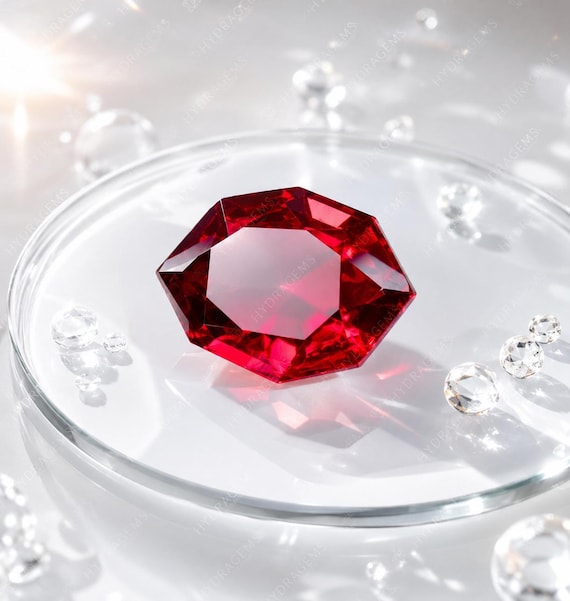
The mines of Mogok have supplied royal families, emperors, and museum collections for a thousand years. The famous **Sunrise Ruby** — just 25.59 carats after cutting — sold at auction in 2015 for over $30 million, setting a world record for a colored gemstone at the time. It was Mogok-origin. The rubies decorating British royal crowns, Mughal court jewelry, and Burmese royal regalia — Mogok.
Eleven thousand carats, uncut and rough, would represent something on an entirely different scale.
## How a Ruby Is Born
The formation of a gem-quality ruby is a process so specific, so demanding of precise conditions, that geologists sometimes describe it as a near-miracle of chemistry.
Rubies are **corundum** — aluminum oxide, the same mineral family as sapphires, one of the hardest substances on Earth. What makes a ruby red rather than blue or colorless is the presence of **chromium** atoms substituting for aluminum in the crystal lattice. Chromium absorbs green and yellow light and transmits red. The exact concentration determines the shade — too little and the stone is pale; too much and it becomes muddy.
But here’s the geological paradox: the conditions that form rubies from corundum require marble environments relatively poor in silica — and silica is exactly the medium in which chromium tends to concentrate. Getting high chromium into a low-silica marble environment, at the right pressure and temperature, without the crystal fracturing or being contaminated, is so statistically unlikely that large, gem-quality rubies are vanishingly rare.

Most gem rubies weigh a fraction of a carat when found. Stones of 10 carats or more are exceptional. Stones of 100 carats are world news. A rough crystal of 11,000 carats — approximately 2.2 kilograms of near-pure corundum — would require conditions that maintained perfect crystal growth for an unbroken period across geological time.
**That this happens at all is remarkable. That it happened in Mogok, under those mountains, and was found intact by a miner’s hand, is almost beyond probability.**
## If Confirmed
A note on precision matters here.
Reports of extraordinarily large gemstones emerge periodically from Myanmar, Sri Lanka, Zambia, and other major gem-producing regions — and not all of them survive contact with expert gemmological assessment. Some large reported “rubies” turn out to be lower-grade corundum or spinel. Some weights are estimated before proper measurement. Some photographs circulate far beyond their original context.
The 11,000-carat Mogok ruby has not yet been formally assessed and verified by independent gemological authorities at the time of writing. The discovery, if confirmed at reported scale and quality, would rank among the most significant gemological finds in decades. If even partially accurate — even if the final verified weight is substantially lower — a clean rough ruby of several thousand carats from Mogok would still be a historically significant stone.

The Mogok valley’s track record is exactly why reports like this are taken seriously. This is the region. These are the conditions. The geology is correct, the history is correct, and the probability, while low, is not zero.
## The Other Layer: War, Wealth, and the Ground Beneath
The ruby emerged from soil that has seen more than geological pressure.
Northern Myanmar’s gemstone regions have existed for decades at a violent intersection of natural wealth and political conflict. Control of mines — rubies, jade, amber — has been contested by armed groups, military forces, local communities, and corporate interests for generations. The revenues from Mogok’s stones have funded both legitimate trade and armed factions. International sanctions on Myanmar’s military government since the 2021 coup have complicated the certification and sale of Burmese gems globally, raising questions about supply chains that were already ethically complex.
A stone of this value — potentially worth hundreds of millions of dollars, cut and certified — does not emerge from the earth into a vacuum. It emerges into a political and economic reality that is, in parts of Myanmar, as dangerous as anything underground.
Who controls this stone, who benefits from it, whether its origin can be certified under any internationally accepted ethical framework — these are questions the ruby’s discovery automatically raises, and they are not answered by its beauty.
## What It Means to Find Something This Old
There is a dimension to this discovery that has nothing to do with money or politics.
A ruby of this age — formed during the Himalayan collision, which began roughly **50 million years ago** — has existed, unchanged in its essential chemistry, for longer than any human lineage, longer than any language, longer than any civilization or religion or war. It has survived continental drift, ice ages, the rise and fall of the Himalayas themselves, and every human catastrophe that has occurred above the ground under which it lay.
It knows nothing of the miners who found it, the markets that will price it, or the arguments that will surround its ownership. It is not a symbol of anything. It is an object — an object so improbable and so old that its existence alone is a kind of quiet fact about the nature of the planet.
The earth still has secrets. They are not all ancient ruins or buried cities. Some of them are just stones — stones that formed in the dark, at impossible depth, across impossible time, waiting with complete indifference for the moment a human hand finally reaches them.
Somewhere beneath those mountains, more are still forming.