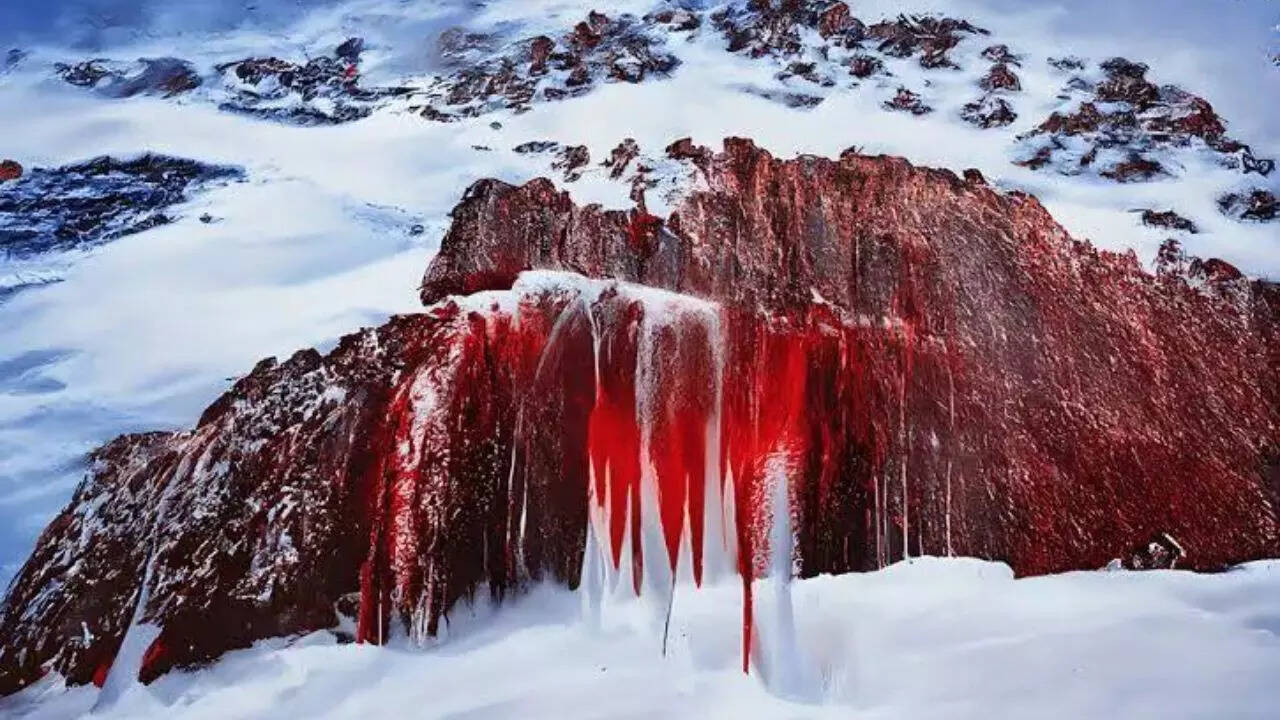
Picture the most silent place you can imagine. A white world without trees, without sound, without movement. The Taylor Glacier stretches across the Antarctic interior like a sheet of frozen stillness, untouched for ages. And then, against all of that white, something impossible appears — a wound. A wide stain of bright, arterial red spilling out of the ice and down across the snow, as if the glacier itself had been cut.
The first explorers who saw it did not have an explanation. They only had a question that refused to leave them alone.
What could possibly make a glacier bleed?

The First Impression: A Wound in the White
There is a reason this place earned the name Blood Falls. From a distance, the red is so vivid, so wet-looking, that the mind reaches for the most literal interpretation. The eye sees blood. The brain insists on it. Set against the blank, blinding white of Antarctica, the color seems almost obscene — too organic, too alive for a continent that is supposed to be the coldest, deadest place on the planet.
For more than a century, the sight baffled the people who stumbled across it. Early visitors guessed at red algae, the way some snowfields blush pink with microscopic life. It was a reasonable guess. It was also wrong.
The truth turned out to be stranger, older, and far more beautiful than algae.
What It Really Is: A Sealed Ancient Sea
Blood Falls is not bleeding. It is rusting.
Beneath the Taylor Glacier lies a hidden reservoir — a body of ancient, iron-rich saltwater that has been trapped beneath the ice for what scientists believe to be millions of years. Sealed off from the sky, from sunlight, from the modern atmosphere, this brine waited in the dark like a memory the Earth never let go of.
Every so often, the pressure and movement of the glacier let a little of that buried water escape. It seeps out at the glacier’s edge. And the moment it touches the open air, a transformation begins.
The iron dissolved in that water meets oxygen for what may be the first time in an unimaginable span of years. It reacts. It oxidizes — the same chemistry that turns an old nail orange, the same process happening on every abandoned piece of metal left out in the rain. The iron rusts. And as it rusts, it stains the ice that deep, unsettling red.
The glacier doesn’t bleed. It corrodes, in slow motion, in the open Antarctic light.

The Detail That Stuns: Life Where There Should Be None
If the story ended with chemistry, it would already be remarkable. But the most haunting part of Blood Falls lives somewhere we can’t see.
Inside that lightless, oxygen-starved brine — sealed away from the sun for ages — there are microbes. Living things. They survive in a place that, by every assumption we once held, should be utterly hostile to life: no sunlight to power them, no oxygen to breathe, locked beneath a glacier in a freezing salt darkness.
A bleeding glacier, fed by a hidden world that has never once seen the Sun.
These organisms appear to make their living from the iron and sulfur in their prison, drawing energy from chemistry instead of light. They are a quiet, stubborn proof that life does not always need the things we thought it needed. It only needs a door, however small, however dark.
Competing and Uncertain Explanations

The broad outline of Blood Falls is now reasonably well understood — the iron, the oxidation, the trapped brine. But the deeper questions are where the honesty has to come in.
How exactly the subglacial water connects, moves, and finds its way to the surface is still being mapped and debated. Some researchers describe a network of brine pockets and channels threaded through and beneath the ice; others emphasize how little we can directly observe of a system buried under a glacier in one of the most remote regions on Earth.
The reddening itself has also been re-examined. While iron oxidation is central, more recent studies have suggested the precise chemistry of the stain may be more complex than a simple coating of rust — involving tiny iron-rich particles in the brine. The picture, in other words, is still being refined.
And the microbes raise their own open questions. How long have they truly been isolated? How do their populations sustain themselves over such timescales? We can sample the outflow, but we cannot easily walk into the sealed sea that feeds it. Much of what we say about that hidden world remains, by necessity, careful and provisional.
Why It Haunts Us
There is something about Blood Falls that lodges in the imagination and won’t let go, and it isn’t only the color.
It’s the idea of a sealed world. A pocket of ancient ocean, locked beneath the ice, carrying its own private chemistry and its own private life, untouched while continents shifted and species rose and vanished overhead. When that red water finally seeps into the light, it is in a sense a message from deep time — a thing that was hidden, made suddenly, violently visible.
Scientists often look to Blood Falls when they wonder about life elsewhere. If organisms can persist in cold, dark, salty isolation here, then the frozen moons of the outer solar system — worlds with ice crusts over hidden oceans — suddenly feel a little less empty. A glacier in Antarctica becomes a rehearsal for imagining life beyond Earth entirely.
Maybe that’s the real reason it stays with us. Blood Falls looks like a wound, but it’s actually a window. It tells us that the planet keeps secrets in places we assumed were sterile and silent — and that “impossible for life” has, more than once, turned out to mean “impossible for us to imagine.”
The glacier still bleeds today, slow and red against the white. And somewhere beneath it, in the dark, something is still alive.
What else is the Earth hiding under its ice, waiting for the air to find it?