They went to work one morning and never came home. Somewhere in the rock, thousands of years later, other miners found them — men who had done the same job, in the same mine, and been crushed there long before. Their hair was still on their heads. The beards were still on their faces. One man’s leg was still inside its leather boot. The thing that killed them turned out to be the only reason they were still there to be found.

Quick Facts
| Who | Ancient salt miners, at least six individuals |
| Where | Chehrabad salt mine, Zanjan Province, northwestern Iran |
| Discovered | From 1993 onward, by modern miners |
| Age | Varied — some around 2,500 years old |
| Cause of death | Several likely killed by the collapse of mine galleries |
| Preservation | Salt drew out all moisture and sealed out decay |
| On display | Zanjan and the National Museum of Iran |
What We Were Told
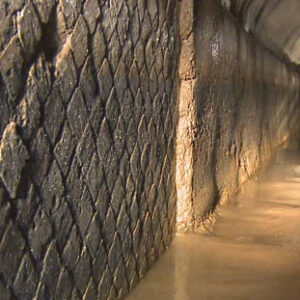
The Chehrabad salt mine, in the mountains of northwestern Iran, is an ordinary working mine. For centuries people have cut salt out of its galleries, and for centuries that was the whole story — a place where men went underground to do hard, unremarkable labor and came back up again.
Image caption: The Chehrabad salt mine in Zanjan Province, northwestern Iran, where the bodies emerged from the rock.
Then, in the winter of 1993, miners cutting a fresh face in the salt hit something that was not salt. It was a head — a human head, with long white hair and a beard, and a gold earring still hanging from one ear. Beside it, iron knives. Personal things. This was not a modern accident. Whoever he was, he had been in that rock for a very, very long time, and the mine had simply kept him.

What Was Found
He was not alone. Over the following years, more bodies emerged from the same deposit, until the count reached at least six men, along with tools, textiles, ropes, pottery, and even a walnut one of them had carried underground.
Modern miners, cutting salt in an Iranian mountain, had found other miners entombed in the rock beneath them — men who had done the identical work, in the identical place, and died there as much as 2,500 years before.
Read that again. The same mine. The same job. The same salt. Separated by twenty-five centuries. The living had gone down to cut salt and come face to face with the dead who had gone down to cut salt, preserved so completely that they still had eyelashes and stubble.
The Detail That Changes Everything
The horror and the wonder of the Salt Men are the same fact, and you cannot separate them: the substance that destroyed these men is the substance that saved them.
Several of them appear to have died violently and suddenly — likely crushed when the galleries they were working in collapsed, buried under tons of rock and salt in an instant. That salt should have been the end of the story. Instead, it became the reason there is a story at all. Salt is ferociously hydrophilic; it pulls water out of everything it touches. It drew every drop of moisture out of the bodies and, in the same motion, denied bacteria the water they need to rot flesh. Decay simply could not start.
Image caption: The head of the first Salt Man, hair, beard, and a gold earring preserved by millennia in the salt.
So the men who were killed by the mine were, in the same breath, embalmed by it. Their killer was their undertaker. Hair, beards, skin, a leather boot with a leg still inside — all of it held, not despite the disaster, but because of it.

The Central Mystery
The Salt Men refuse to line up into a single tidy tale, and that is the strangest thing about them.
They did not all die at once. Radiocarbon dating and study of the remains show that the bodies come from different eras — some from the time of the Achaemenid Persian Empire, others from centuries later under the Sasanians. This was not one cave-in that trapped one crew. It was the same fatal accident, the same collapse of the same treacherous ground, happening again and again across a thousand years, each time adding another man to the rock. The mine had a pattern. It killed, it preserved, and it waited.
What we still cannot fully reconstruct is each man’s last moment. What were they doing when the roof came down? Who was waiting for them at home? The bodies are astonishingly intact, but a preserved face does not tell you the name behind it.
Competing Theories
Not every question about the Salt Men has a clean answer, and researchers hold competing readings of the evidence.
The mainstream interpretation is accidental death — mining is dangerous, salt galleries are unstable, and the injuries on several of the men are consistent with being crushed by a sudden collapse. But the picture is not uniform. The individuals span very different periods and were found in different conditions, and scholars continue to debate exactly how each one died and whether all of them were working miners at the moment of death. The excavation itself has been difficult and, at times, hurried, and some remains were disturbed before they could be studied in place — which means parts of the record may be lost for good. The safest conclusion is the honest one: most were probably killed by the mine, but “probably” is doing real work in that sentence.

Why It Still Haunts Us
Strip away the science and what remains is deeply, ordinarily human. These were not kings or priests prepared for eternity with ritual and gold. They were working men. They laced up a leather boot, pocketed a knife and a walnut, and went down a hole in the ground to earn a living — and the ground closed over them. There was no burial, no ceremony, no farewell. Just salt, and silence, and two and a half thousand years.
And then, one winter, their own successors — men doing the very same work — reached into the rock and pulled them back into the light.
![The Salt Man [Clarke's Day Theme] - Lifestyle & Culture Photos - BSurprised](https://images.openai.com/static-rsc-4/-VDfQ8Bd_RnqDKXf8T7T0uSooDzt5TGoIX4tkvaM3wBItfNzrXJygWaudgYJ77mGFd4gZKg79Vv05v_mOPkffacI64V2VzhFGubzY5yguHozk6fgVnx9bpjKQeIz3K1lmPmQYm9x2a-DyIdzokPu0MscnTZBAP3XWWZr2IaoPSUurZw6wF78IgkhTB4KORPM?purpose=fullsize)
Image caption: A preserved leather boot with the lower leg still inside, one of the artifacts recovered from Chehrabad.
The salt that buried them alive is the only reason we can look them in the face today. How many more are still in that mountain, keeping their last morning to themselves?