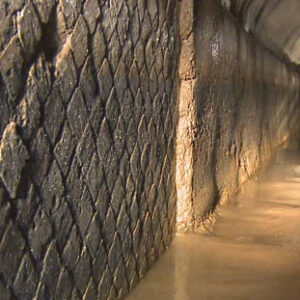
Wood does not survive two thousand years. Leather does not survive two thousand years. And yet here they were, fused together into something that was unmistakably a shield. What the excavators had found had not been placed there for safekeeping. It had been buried alive, mid-collapse, and left untouched until they arrived.

Quick Facts
| Object | Roman scutum (legionary shield) |
| Date | Mid-3rd century CE, buried c. 256 CE |
| Found | Tower 19, west wall of Dura-Europos, Syria — 1932/33 excavation season |
| Material | Wood (three glued layers), leather/rawhide, linen, paint |
| Now held | Yale University Art Gallery, inventory 1933.715 |
| Scientific consensus | The only known surviving example of a full-size, curved rectangular Roman legionary scutum |
What We Were Told
Roman shields are everywhere — carved into Trajan’s Column, stamped on coins, described in a dozen ancient texts. Historians have drawn them, reconstructed them, argued over their exact curve and grip for a century. But every one of those reconstructions rests on secondhand evidence: stone, metal, words. No actual combat scutum, the story went, could possibly have survived. Wood rots. Leather rots. Two thousand years is simply too long.
That was the assumption. But that’s not the whole story.

What Was Found
Dura-Europos sits in one of the driest stretches of the Euphrates valley, and that dryness is the reason anything survived at all. When Roman forces recaptured the city in 254 CE after an earlier Sasanian incursion, they didn’t just repair the walls — they overbuilt them, packing entire houses along the western defenses with earth and brick to blunt the next siege. It worked, for a while.
Two years later, in 256 CE, the Sasanian king Shapur I returned with a force large enough to camp outside Dura in numbers greater than the city itself held. His engineers dug shaft mines under the wall. Roman defenders dug counter-tunnels to meet them underground, in the dark, by torchlight.
Something happened in those tunnels. Twenty Roman soldiers, found later in full equipment, died there — one of them still carrying a coin dated to 256, the detail that let archaeologists pin the whole siege to an exact year. Days afterward, the mining beneath the wall finally brought part of Tower 19 down, along with whatever had been stored inside it.

It is, to this day, the only Roman legionary scutum ever recovered from antiquity.
The shield itself had been smashed into thirteen fragments by the collapse. Reassembled, it measures 105.5 by 41 centimeters, built from thin wood strips layered three deep, then covered in linen and hide and painted with an eagle clutching a laurel wreath, winged figures of Victory, and a lion — the standard visual language of Roman military triumph. The back once carried a covering of red-dyed skin, noted by the original excavators, since lost. It has been restored more than once since 1933, and each restoration reshaped it slightly; the curve you can see in a museum case today is close to, but not identical to, the one a legionary once carried into a mine shaft.
The Detail That Changes Everything
Here is what most retellings skip: the earthen reinforcement of Dura’s western wall was not a frantic, last-minute act. It had stood for roughly two years before the final siege, a deliberate, unglamorous engineering project built after the city was already recaptured once. The shield was not swept up in a moment of panic. It appears to have been ordinary stored equipment, sitting inside a working tower, arsenal-ready, in a city that already knew exactly what was coming.
Which raises the question no one has fully settled: what actually killed the tower? The first excavation report in the 1930s assumed the Roman counter-tunnel simply collapsed under its own instability, trapping the twenty soldiers by accident. A different reading, gaining ground since the 2000s, argues the Sasanians heard the Romans digging toward them and waited — then ignited a mixture of sulfur and bitumen the moment the tunnels broke through, filling the space with toxic gas by design. Soil samples taken from the tunnel in 2009 detected sulfur compounds consistent with that theory.

The Central Mystery
If the gas theory holds, Dura-Europos preserves not just the oldest surviving Roman shield, but potential evidence of one of the earliest deliberate chemical weapon attacks in recorded history — used underground, in the dark, against men who had no way to see it coming.
And yet the mining operation, gas or no gas, ultimately failed. The wall partially gave way. The tower fell. But no breach ever opened. Shapur’s engineers achieved a partial collapse and, without knowing it, sealed a perfect time capsule instead of a way into the city.
Competing Theories
Theory one — accidental collapse. The original 1930s report treated the tunnel deaths as bad luck: unstable ground, a cave-in, twenty men buried in the dark during ordinary siege warfare.
Theory two — deliberate gas attack. Later analysis, including a 2011 study by archaeologist Simon James and chemical residue testing from 2009, argues the Sasanians engineered the collapse and gassed the Roman counter-miners on purpose, then kept digging until the tower above gave way days later.
Theory three — routine storage, not desperation. A smaller but persistent reading holds that the shield’s presence says less about panic and more about how ordinary this arsenal really was — a functioning tower, doing its job, until the ground underneath it stopped cooperating.

No one can say for certain which version is complete. Mainstream scholarship leans toward some form of deliberate gas warfare, but the physical evidence — a partially collapsed tower, a scutum in thirteen pieces, twenty men who never got to tell their side — allows for all three. And that may be the point.
Why It Still Haunts Us
Every other Roman shield you have ever seen is a copy of a copy — a shape inferred from stone carvings, a color scheme guessed from paint traces on unrelated pottery. Dura-Europos is the exception, and it exists only because a mining operation failed in a very specific, very narrow way: destructive enough to bury a tower, not destructive enough to erase what was inside it.
It is a strange kind of luck, built entirely out of a military disaster. A city that fell. A garrison that was wiped out. A siege that, on paper, the Romans lost completely. And from inside that failure, one object survived precisely because everything around it did not.

If a fully staffed, actively defended Roman fortress could vanish this completely and still leave behind an accident this perfect, what else from antiquity is still sitting under the next collapsed wall, waiting for someone to start digging?
Sources & further reading: Wikipedia — “Scutum from Dura-Europos”; Wikipedia — “Siege of Dura-Europos (256)”; Yale University Art Gallery, object 1933.715; Yale News, “A painted shield once wielded by Roman soldiers” (Feb. 21, 2025); Simon James, The Excavations at Dura-Europos… Final Report VII: The Arms and Armour and Other Military Equipment (British Museum Press, 2004).