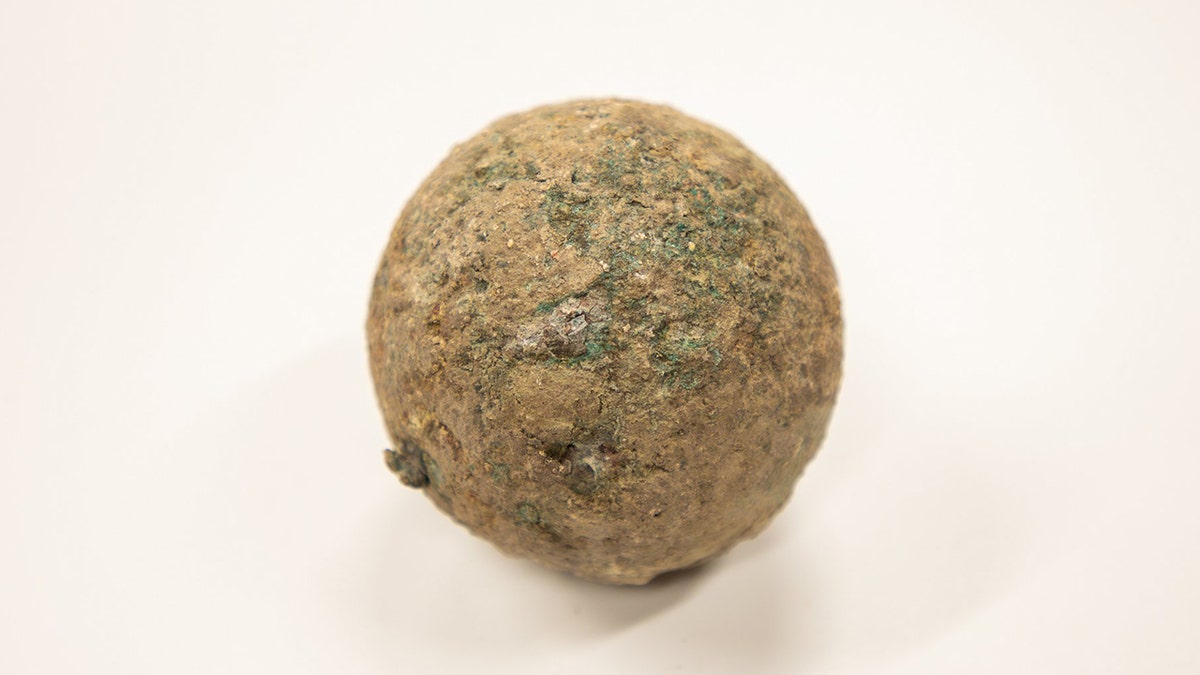
Some battles never really leave the ground they were fought on. Near the northeast corner of the old Alamo Church in San Antonio, archaeologists have just pulled a second intact cannonball out of the earth — and it appears to have been lying there, untouched, since one of the most famous battles in American history.
Finding one battlefield cannonball is the kind of thing an archaeologist might dream about once in a career. Finding two, in the same dig, just months apart? That’s almost unheard of.
A second relic of a legendary siege
The newly found cannonball — made of solid iron — was reportedly recovered on June 2 from undisturbed soil, only a few feet from where a solid bronze cannonball had emerged back in March.
That phrase, “undisturbed soil,” is what makes archaeologists’ hearts race. It means the ground around the objects hadn’t been dug up, shifted or scrambled since the moment they came to rest. In other words: these almost certainly landed during the battle itself — and have been sleeping there ever since, for nearly 190 years.
These are reportedly the first examples of “solid shot” — spherical cannon projectiles — ever recovered at the Alamo.

Two cannonballs, two armies
Here’s the detail that turns a find into a story.
Early analysis suggests the two cannonballs may have come from opposite sides of the fight. The iron one, possibly fired from a six-pound cannon, may have belonged to the Texan defenders. The bronze one found in March may have been fired by the Mexican Army.
If that holds up, then lying just feet apart in the same patch of Texas soil were projectiles from both sides of the 1836 siege — two armies, one desperate battle, frozen in the earth side by side.
Two spheres of iron and bronze, hurled from opposite ends of one brutal siege — and the ground kept them both, together, for nearly two centuries.
Why “undisturbed” matters so much
It’s tempting to think any old object dug from the ground tells a clean story. It usually doesn’t. Most sites have been churned by later building, farming, looting or rivers, mixing eras together until it’s hard to know what belongs to when.
What the team is describing here is the opposite: clean, clearly layered deposits, where the soil above the cannonballs reads like undisturbed pages of a book. That’s why researchers can say with some confidence that these likely date to the battle, not to some later moment — and why each object can be tied, carefully, to the chaos of 1836.

Remembering the Alamo
The Battle of the Alamo, fought in early 1836, became one of the defining moments of the Texas Revolution. A small force was overwhelmed after a famous, costly siege — and “Remember the Alamo” went on to become a rallying cry that echoed through the rest of the conflict.
For generations, the Alamo has been remembered mostly through stories, paintings and legend. Finds like these are different: they’re the physical, undeniable residue of the fighting itself — objects you could hold in your hand that were, very possibly, fired in anger during those exact days.
What two cannonballs can teach us
Beyond the goosebumps, the discovery is genuinely useful. By studying where the cannonballs landed, what they’re made of, and what size cannon fired them, researchers can begin to reconstruct details of the battle that documents alone can’t fully capture — where guns were positioned, how the fighting moved across the ground, which side was firing from where.
And the fact that there are now two, found close together in clean soil, gives archaeologists something rare: not a single lucky relic, but the beginning of a pattern — a chance to read the battlefield itself.
So here’s the thought to sit with: if two cannonballs lay hidden under one famous corner for 190 years, how much of the past is still waiting, just out of sight, beneath the places we walk every day?