Eleven thousand years ago — long before anyone planted the first seed — someone climbed a limestone ridge in what is now southeastern Turkey, and began to carve.
No metal. No wheel. No written word. Just flint, muscle, and an idea apparently powerful enough to move stone. What they left behind, buried for millennia beneath a quiet hill called Karahan Tepe, may be forcing archaeologists to rewrite the opening chapter of human civilization.
And the deeper they dig, the stranger the story gets.
A sister to the world’s oldest temple
You may have heard of Göbekli Tepe — the site often called the world’s “first temple,” older than Stonehenge and the pyramids combined. Karahan Tepe is its lesser-known sibling, sitting reportedly around 35 kilometers (some 20-odd miles) away in the same extraordinary landscape, a cluster of sites Turkish researchers now call **Taş Tepeler**, the “Stone Hills.”
It was first noted in the late 1990s, but serious excavation is recent — and it is already staggering. Surface surveys alone, researchers say, have recorded **at least 266 T-shaped pillars**, even more than have been documented at Göbekli Tepe. And the people who raised them, the evidence strongly suggests, were not farmers at all. They were hunter-gatherers — the very people history textbooks long assumed were incapable of monumental building.
Some researchers believe parts of Karahan Tepe may be **even older** than Göbekli Tepe. If that holds, it isn’t just a sister site. It might be an ancestor.
Carved from the living rock
Here is what makes Karahan Tepe feel almost impossible to stand inside.
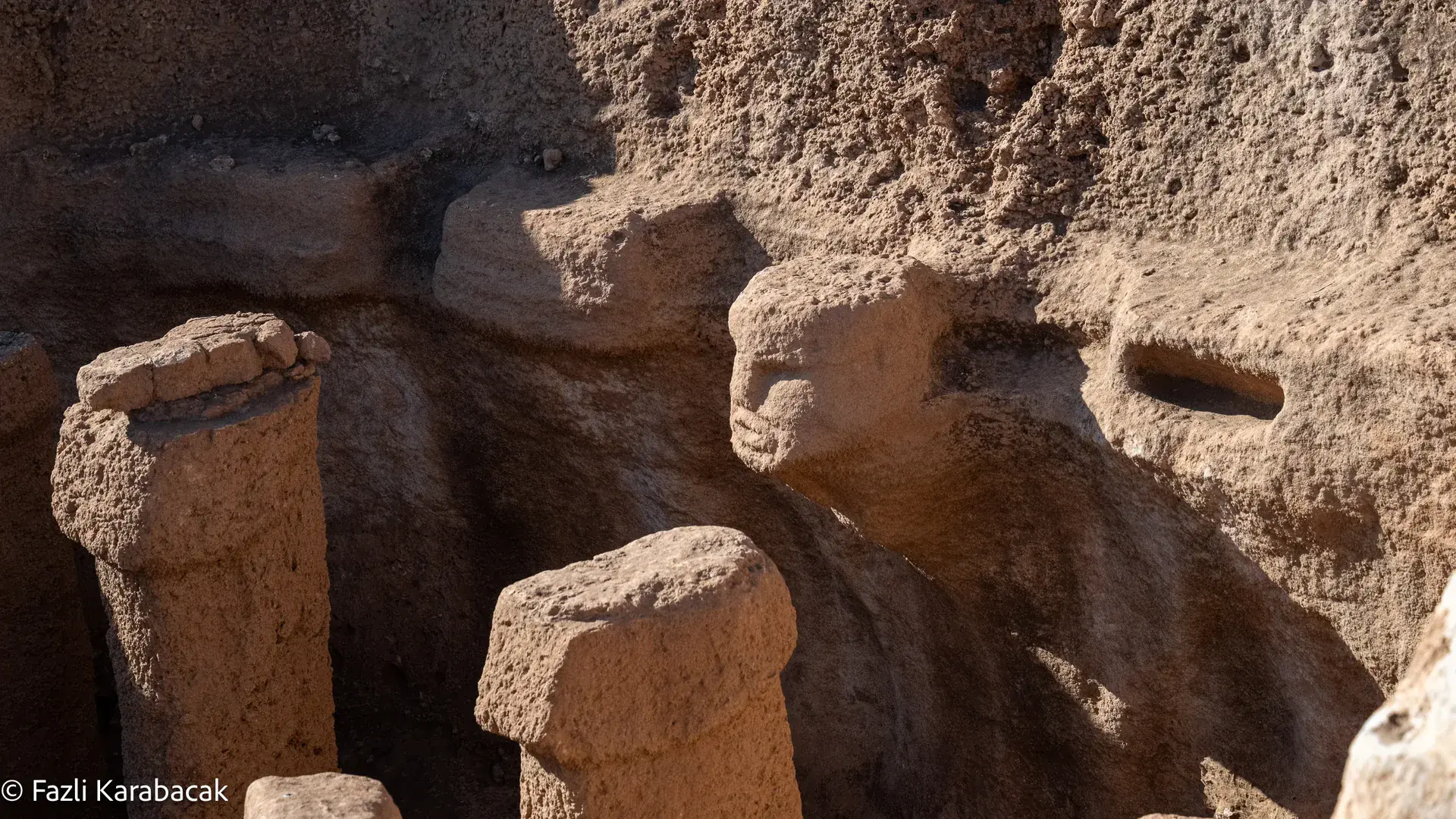
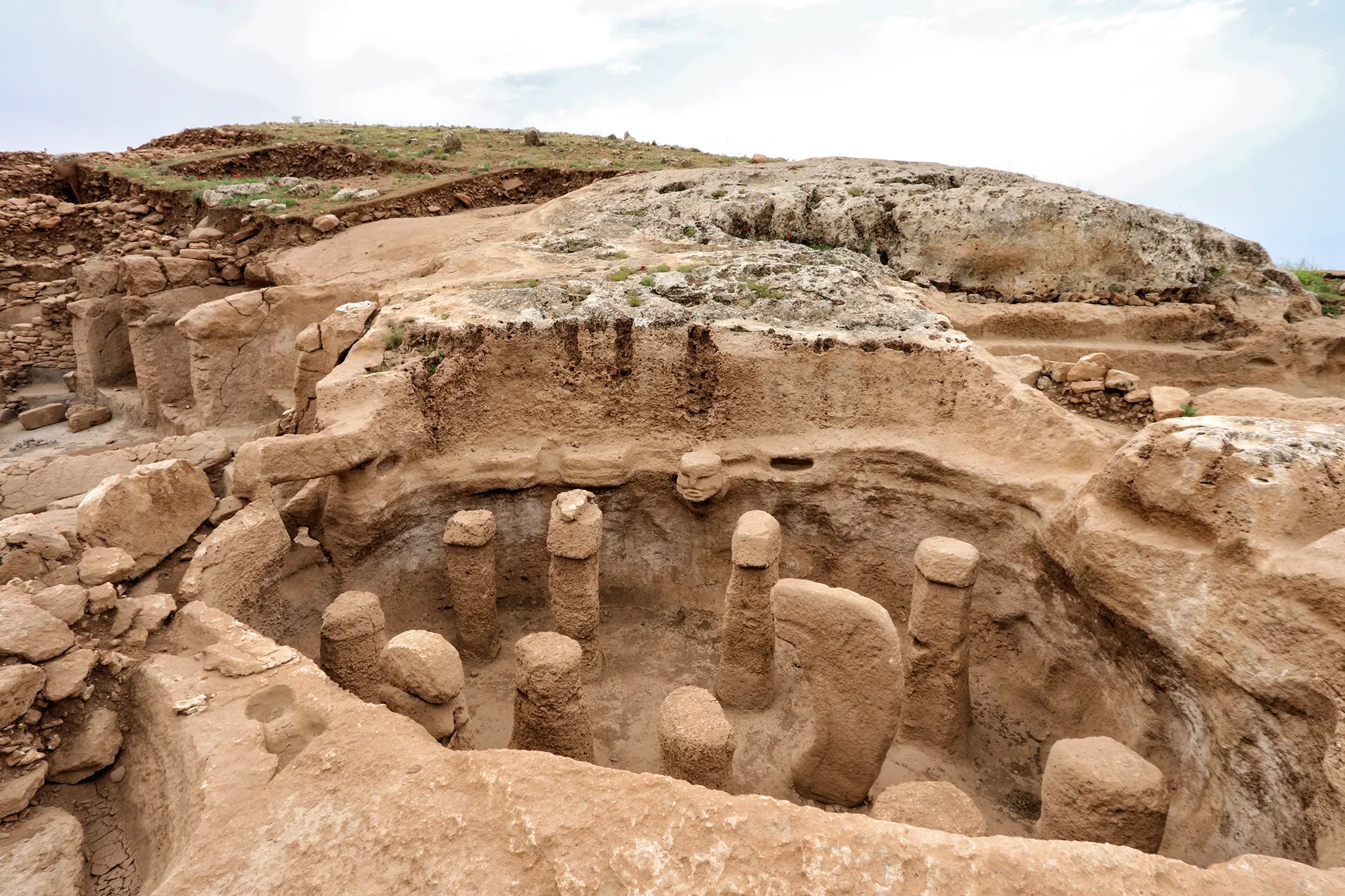
Much of it isn’t built *on* the bedrock — it’s carved *out* of it. Walls, benches, even rows of pillars were cut directly from the natural limestone, as though the hill itself were being sculpted into a sanctuary. At the heart of the site lies a sunken chamber sometimes called the “pillar shrine”: **eleven phallic-shaped stone pillars** rising from the floor, and, watching over them from the rock wall, a **carved human head with a strange, serpentine neck**.
Excavation director Necmi Karul, an archaeologist at Istanbul University, reportedly described the face as the missing piece of a long-suspected pattern — as if the builders had finally given their monument a gaze. Stand in that chamber, and you are being looked at by something carved 11,000 years ago.
In 2023, the ground gave up something even more haunting: a **statue of a man, about 2.3 meters (7.5 feet) tall**, found broken in two. Naked, ribs picked out in stone, he is shown apparently seated, gripping himself with both hands — one of the most lifelike human depictions known from this impossibly early age.
The builders who, on paper, shouldn’t have managed it
Think about what this took.
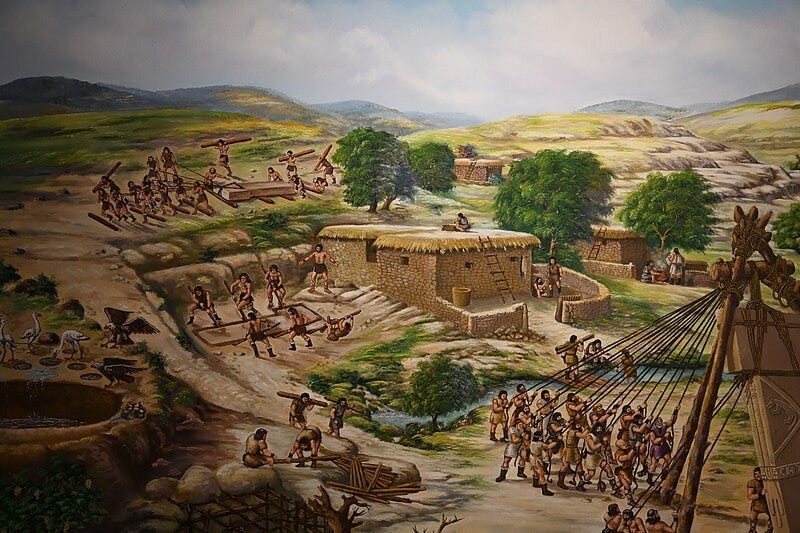
People without farms. Without draft animals in harness. Without the wheel. Without a single written instruction. And yet they planned a complex of chambers, shaped multi-ton pillars, and decorated them with stylized human arms, hands and belts — and with a menagerie of animals: snakes, foxes, birds, gazelles. Some pillars seem to *be* people, abstracted into stone bodies standing eternal guard.
And here’s a detail researchers keep circling back to: across these Stone Hills, it’s often the *dangerous* creatures — snakes, scorpions, predators — that dominate the carvings, not the gentle prey you’d expect hungry hunters to celebrate. Why fill a sanctuary with the very things that could kill you? No one can say for sure.
They came back, the evidence suggests, generation after generation — hauling, carving, gathering. And the obvious modern question, the one that won’t leave you, is simply: *how?* How does a society with no agricultural surplus, no cities, no kings, summon the labor and the will to build something on this scale?
**They built a place to gather before they built a reliable way to feed everyone who gathered — and no one can fully explain why.**
The part that rewrites the textbooks
For most of the last century, the story of civilization had a fixed order. First, humans learned to farm. Farming created surplus food. Surplus created settled villages, free time, social hierarchy — and only *then*, the thinking went, could people afford luxuries like temples, priests and art.
Göbekli Tepe and Karahan Tepe appear to flip that sequence on its head.
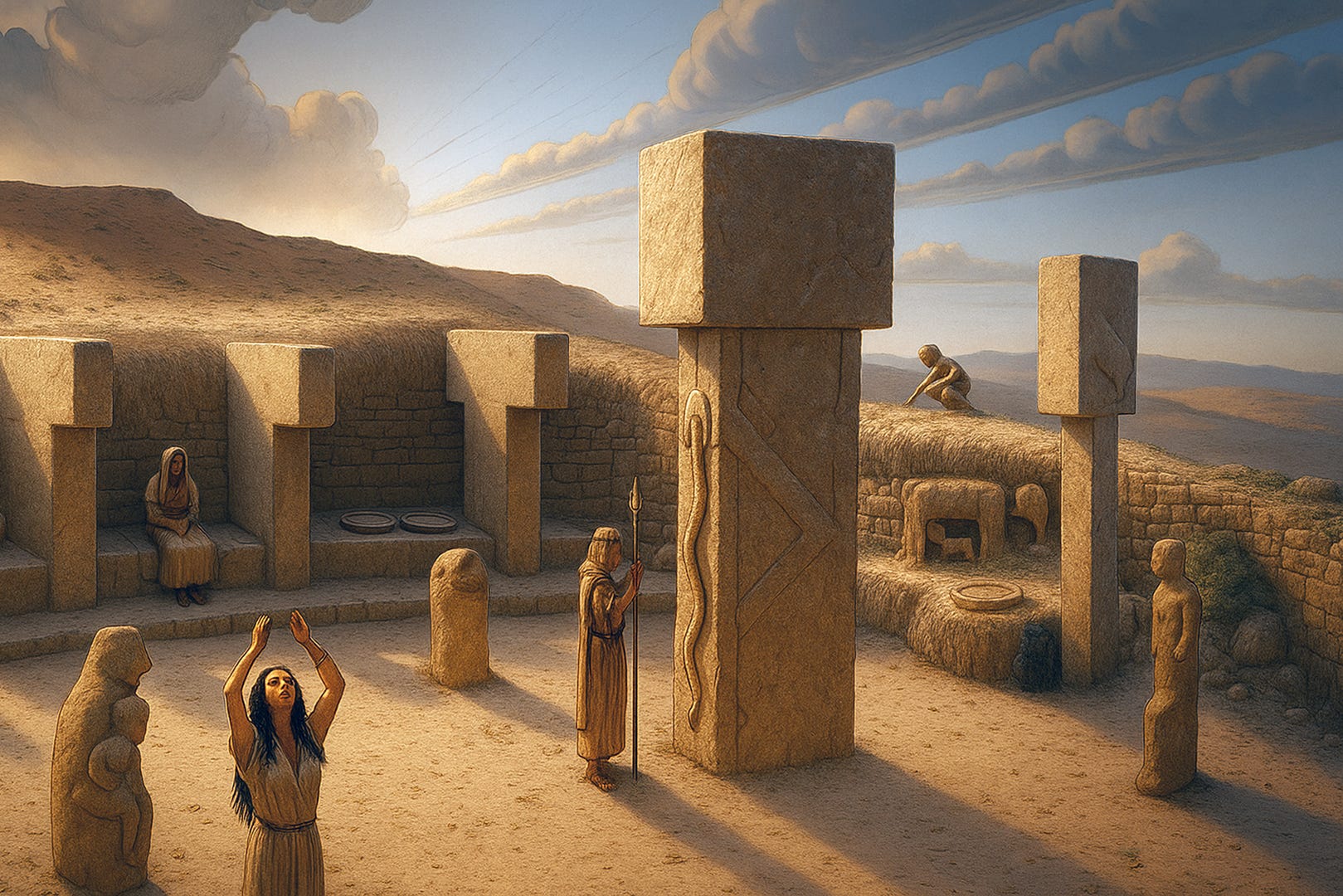
The late archaeologist Klaus Schmidt, who excavated Göbekli Tepe, put the radical idea in five words: **”First came the temple, then the city.”** In this reading, it may have been ritual, belief and the pull of communal gathering that drew scattered hunter-gatherers to one place. They gathered to build. They built to worship. And because they kept gathering, the theory goes, they eventually needed to feed the crowds — storing wild grain, then planting it. Agriculture, in other words, might have been the *result* of settling down, not the cause.
Karul has reportedly echoed this, suggesting the findings show settled life beginning while people were still hunter-gatherers — with farming arriving as an effect, not the trigger.
There’s a poetic twist, too. These hills sit at the edge of the Fertile Crescent — the very region where, not long afterward, humanity is widely thought to have first domesticated wild wheat. It’s almost as if the altar came first, and the farmland grew up around it.
So what could it really be?
This is where honesty matters, because the mystery is far from solved — and that is exactly what makes it so addictive.
Some argue Karahan Tepe was a pure cult or ceremonial center, a pilgrimage point where distant bands met for rites we’ll never fully reconstruct. Others suspect the line between “temple” and “home” is one we’ve imposed; later excavations at Göbekli Tepe have prompted some researchers to reconsider whether people also *lived* at these sites, blurring the neat “sacred-only” picture. A few caution that “the world’s first religion” is a thrilling phrase that runs ahead of the evidence.
The truth is the debate is still very much alive among archaeologists. What almost everyone agrees on is the part that matters most: monumental gathering places existed *before* farming. After that, the meaning is still being argued in the dirt, one carved stone at a time.

Why it still haunts us
Maybe that’s the real power of Karahan Tepe. It sits right at the edge of what we can know — solid enough to touch, old enough to humble us.
We can date the stones. We can map the chambers. We can photograph that serpent-necked face. What we can’t do is ask the people who made it what they believed, what they feared, or what they were reaching for when they cut a human gaze into a hillside before the invention of the plow. They left us a question instead of an answer.
And perhaps that’s the most unsettling discovery of all: that the urge to gather, to build something bigger than ourselves, and to look up and wonder — may be older than civilization itself.
So here’s the question worth sitting with: if the desire to worship came *before* the ability to farm — what does that say about what really makes us human?