It weighs only a handful of silver.
But it carries thousands of years of mythology.
Its body twists like a dragon rising into the clouds.
Its heavy paws belong to a predator that walks the earth.
Every angle tells a different story.
Every glance changes your mind.
Stand before it long enough, and one unsettling realization begins to emerge:
Perhaps it was never meant to be identified at all.
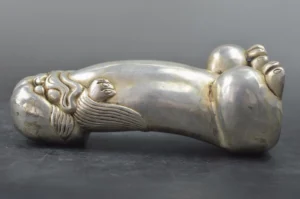
Image caption: Close-up of the 18th-century Chinese silver figurine, revealing its remarkably detailed scales, claws, and expressive face.
Quick Facts
| Category | Information |
|---|---|
| Subject | Silver figurine depicting a dragon or tiger |
| Date | 18th century (Qing dynasty) |
| Material | Handcrafted silver |
| Origin | China |
| Interpretation | A symbolic creature blending characteristics associated with dragons and tigers |
| Scholarly consensus | Most art historians regard the ambiguity as intentional symbolism rather than the depiction of an unknown creature. |
What We Were Told
Few civilizations gave animals greater meaning than China.
The dragon was never simply a beast.
It governed rain, commanded the heavens, and became the ultimate emblem of imperial authority.
The tiger ruled a different kingdom.
It stood for courage, military strength, protection, and the untamed power of the natural world.
One belonged to the sky.
The other ruled the earth.
Together, they formed one of the oldest symbolic pairings in Chinese culture—a balance between opposing forces that appeared in paintings, jade carvings, bronze vessels, silk, porcelain, and precious metals for centuries.
Most artists kept them apart.
Some did something far more intriguing.
Image caption: Traditional Chinese artwork portraying the Dragon and Tiger as complementary cosmic forces.
What Was Found
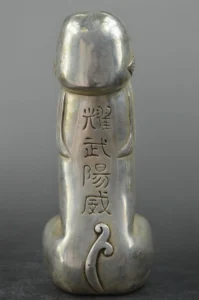
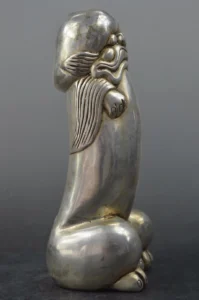
Among surviving Qing dynasty silverwork is an object that refuses to obey familiar rules.
Its spine flows with the effortless rhythm of a dragon.
Its shoulders are thick with feline power.
Its claws grip the ground like a tiger moments before the leap.
Then there is the face.
Not entirely dragon.
Not entirely tiger.
Something balanced delicately between the two.
The closer you examine the sculpture, the less willing it becomes to reveal its identity.
Every line was cut by hand.
Every scale was chased into silver by an artisan whose intention still echoes across the centuries.
Nothing appears accidental.
Image caption: Side profile highlighting the flowing body, muscular limbs, and extraordinary silver craftsmanship.
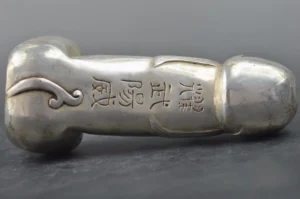
The Detail That Changes Everything
The greatest surprise isn’t what the creature looks like.
It’s why someone may have wanted it to look this way.
During the Qing dynasty (1644–1912), luxury silver objects were prized not only for their craftsmanship but for the layers of symbolism they carried. Decorative art spoke a language of its own. A single image could express prosperity, authority, protection, longevity, harmony, or good fortune—all at once.
To modern eyes, the mixed anatomy seems confusing.
To an eighteenth-century owner, that ambiguity may have been precisely what made the object so meaningful.
Its power did not come from choosing one identity.
It came from embracing several.
Image caption: Qing dynasty silverwork displaying intricate repoussé and chased decorative techniques.
The Central Mystery
So what did the silversmith intend?
A dragon?
A tiger?
Or a creature that existed only in the imagination of Chinese decorative art?
Traditional Chinese dragons are themselves composites, borrowing antlers from deer, claws from eagles, scales from fish, whiskers from catfish, and bodies that move like serpents.
Meanwhile, artistic depictions of tigers often exaggerated muscle, posture, and expression to symbolize strength rather than anatomical precision.
Without an inscription or written record explaining the artist’s purpose, certainty remains out of reach.
And perhaps it always will.
Competing Theories
One interpretation identifies the figurine as a stylized dragon. Its elongated body, flowing posture, and decorative scales closely resemble dragons commonly seen throughout Qing dynasty decorative arts.
Another argues that the sculpture is fundamentally a tiger rendered through the visual language of ornamental metalwork. Its stance, limbs, and powerful paws strongly support this view.
A third interpretation has gained broader acceptance among art historians: the creature was never intended to represent a single animal. Chinese decorative traditions frequently combined auspicious symbols, allowing one object to embody multiple virtues simultaneously.
Current scholarship generally favors this symbolic reading. Rather than searching for a biological identity, researchers view the figurine as an artistic statement in which symbolism outweighed realism.
Image caption: Historic Chinese dragon and tiger imagery displayed side by side for comparison.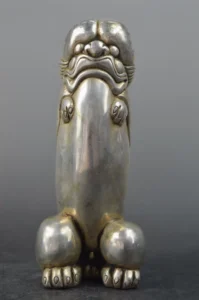
Why It Still Haunts Us
Empires have risen.
Dynasties have fallen.
Languages have changed.
Yet this tiny silver creature continues to ask the same unanswered question.
What are you looking at?
A dragon reaching down from heaven?
A tiger rising from the earth?
Or evidence that some of history’s greatest artists understood something modern viewers often forget—
that mystery can be more enduring than certainty.
And perhaps the finest works of art were never created to give us answers…
Only to make us keep looking.
Sources & further reading: The Palace Museum (Beijing); National Museum of China; British Museum Collection Online; Metropolitan Museum of Art; Jessica Rawson, Chinese Ornament: The Lotus and the Dragon; Patricia Bjaaland Welch, Chinese Art: A Guide to Motifs and Visual Imagery.