Quick Facts
- 1540: An 11-month megadrought struck Europe; the Rhine, Elbe, and Seine reportedly ran so low they could be crossed on foot.
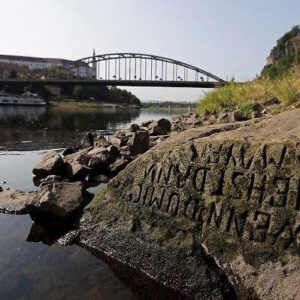
- 2026: A “hunger stone” near Pirna, Germany, has resurfaced as the Elbe’s water level fell below one meter.
- The stone, in the Oberposta district, bears more than 20 carved dates — the oldest from 1707.
- Some researchers and commentators have compared the severity of 2026’s drought to 1540, though the comparison is disputed.
What We Were Told

Headlines about shrinking European rivers and record-breaking drought often frame it as an unprecedented modern crisis — something entirely new, driven only by the present moment.
Image suggestion: a dried, cracked riverbed under a hazy summer sky.
What Was Found
As the Elbe fell below one meter near Pirna in 2026, a large sandstone hunger stone resurfaced from the riverbed. Carved into its face are more than 20 dates spanning centuries, the oldest going back to 1707 — each one marking a year the river ran dangerously low. Similar stones have reappeared along the Elbe in the Czech Republic too, including one near Děčín inscribed in 1904 with the words “If you see me, weep,” referencing markings on the stone dating back as far as 1616.
Image suggestion: a close-up of a hunger stone’s carved dates, weathered by centuries underwater.

The Detail That Changes Everything
These stones weren’t decorative — they were functional warnings. For the boatmen, rafters, and farmers whose livelihoods depended on the river, a visible hunger stone meant lost income and the threat of famine. And even today’s drought may not be Europe’s worst: in 1540, an 11-month megadrought left parts of the Rhine, Elbe, and Seine dry enough to walk across, with researchers estimating discharge on the Rhine and Elbe dropped by roughly 90 percent.
Image suggestion: an illustration or historic engraving depicting 16th-century rural Europe during drought.

The Central Mystery
How the 2026 drought truly measures up against what Europe endured nearly 500 years ago isn’t settled.
Competing Theories
Some point to the scale of 2026’s drought — with rivers across Saxony, including the Mulde, Weiße Elster, Spree, and Neiße, all running low, and Germany’s Environment Minister citing a loss of roughly 60 billion cubic meters of water over 25 years — as a sign it may be approaching 1540-level severity. Others, including climate historians who study the 1540 event, argue it still stands apart: contemporary accounts describe nearly a full year without meaningful rain, temperatures 5–7°C above 20th-century norms, and riverbeds so dry that people crossed them without getting their feet wet — a scale current climate models reportedly still can’t fully simulate.

Why It Still Haunts Us
Every time one of these stones resurfaces, it isn’t just a curiosity pulled up by drought — it’s a warning, carved centuries ago by people who lived through the same fear, left for whoever eventually saw the water disappear again.
Image suggestion: a wide shot of a European river at historically low water, exposed banks stretching into the distance.
Sources & further reading:
- Euronews, “Historic drought: rivers reveal hunger stones, warships and mammoth remains” (Aug. 2026)
- Wetter, O. et al., “The year-long unprecedented European heat and drought of 1540 – a worst case,” Climatic Change (2014)
- Smithsonian Magazine, “This Summer’s Drought Is Europe’s Worst in 500 Years. What Happened Last Time?” (2022)
- Wikipedia, “Hunger stone”